
The Ministry of Trade, Industry and Energy (Minister Kim Jung-kwan) unveiled the achievements and future plans for M.AX (Manufacturing AI Transformation), Korea’s strategy for the AI transformation of its manufacturing sector, in conjunction with its policy briefing on August 4. At semiconductor, automobile and shipbuilding worksites that adopted AI, productivity rose by an average of 30.1 percent while defect rates fell by 15.5 percent, confirming the results in concrete figures on the shop floor.
 [코리안투데이] 제조업 AI 대전환 M AX 현장에서 성과로 답하다 © 장형임 기자 |
The Ministry of Trade, Industry and Energy (Minister Kim Jung-kwan) announced the major achievements and future plans for M.AX (Manufacturing AI Transformation), Korea’s strategy for the AI transformation of its manufacturing sector, in conjunction with its policy briefing on August 4.
Korea’s manufacturing sector faces structural challenges, including a shrinking working-age population, an aging skilled workforce, and slowing labor productivity and manufacturing growth. Combining its strengths of world-class manufacturing firms and high-quality field data with AI, the ministry is pursuing M.AX as a core strategy to innovate not only production processes but also the full range of corporate activities, from product and service development to production planning, supply chain and inventory management.
At the center of the framework is the ‘M.AX Alliance’. Last September, the ministry launched an industry-government-academia-research cooperation body involving some 1,000 organizations, including manufacturers, AI firms, universities and research institutes. This February it added an Industrial Complex AX subcommittee to drive regional AX with industrial complexes as hubs, completing a ‘Best Eleven’ system of 11 subcommittees spanning AI factories, AI semiconductors and AI robots. The number of participating companies and institutions has grown 50 percent to around 1,500 in just eight months since launch, establishing the alliance as the nation’s flagship manufacturing AX platform.
 [코리안투데이] 제조업 AI 대전환 M AX 현장에서 성과로 답하다 © 장형임 기자 |
The results of M.AX have begun to appear at actual manufacturing sites in semiconductors, automobiles and shipbuilding. Through its AI factory pilot projects, the ministry has supported the AX of some 170 worksites, and an inspection of 42 worksites that started early and produced visible results found that productivity rose by an average of 30.1 percent and defect rates fell by an average of 15.5 percent.
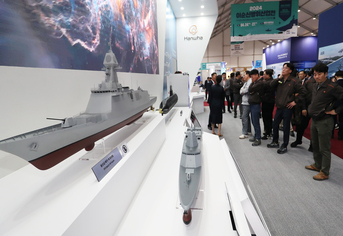
The achievements of individual companies are also clear. In semiconductors, Shinhan Diamond adopted an AI-based automated inspection system for CMP discs, consumables used in the wafer polishing process, cutting quality inspection time by 33 percent, while SurplusGlobal applied AI to the Harvest process for recycling semiconductor equipment, boosting productivity by 66.7 percent. In the automobile sector, Asan Sungwoo Hitech cut quality inspection time by 90 percent with an unmanned autonomous manufacturing system for electric-vehicle batteries, and Hwashin lowered its defect rate by 20 percent by introducing a predictive maintenance system into its battery case production process. In shipbuilding, HD Hyundai Samho raised productivity by 50 percent by applying an AI-based autonomous welding and inspection solution to the welding and production process for rudder trunks, while ENK shortened high-pressure cylinder inspection time by 22 percent with an AI vision inspection system.
 [코리안투데이] 제조업 AI 대전환 M AX 현장에서 성과로 답하다 © 장형임 기자 |
The pilot projects are also fostering the growth of domestic AI solution companies. Ineeji is expanding its process autonomous-operation technology, based on ‘explainable AI’ that presents the grounds for its judgments, into steel, petrochemicals and cement, while OnePredict has grown from a predictive maintenance solution provider into a supplier of an ‘industrial AI operating system’ that redesigns entire factories around AI.
 [코리안투데이] 제조업 AI 대전환 M AX 현장에서 성과로 답하다 © 장형임 기자 |
The scope of M.AX is spreading beyond individual processes to the development of innovative products and the transformation of regional manufacturing ecosystems. In the Product AX area, the ministry has begun developing and demonstrating industry-specific humanoids that perform hazardous or repetitive tasks, such as monitoring and extinguishing fires at shipyard worksites, operating valves in toxic-gas environments, and packaging at logistics sites. Alongside the development of the domestic robot AI model RFM (Robot Foundation Model), it is also ramping up development of on-device AI semiconductors for self-driving cars, robots and home appliances. In the Regional AX area, it launched a ‘MINI Alliance’ of local firms and universities anchored in 10 existing demonstration industrial complexes such as Changwon and Gwangju, and plans to swiftly expand it to three additional demonstration complexes selected this year.
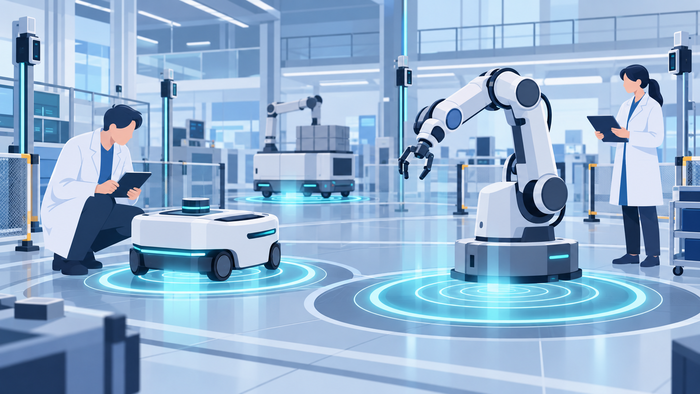
Going forward, the ministry will continue to support the collection of high-quality manufacturing data and the development and demonstration of AI models, with the goal of building 500 AI factories by 2030. It will develop and pursue commercialization and export of core technologies for full-stack AI factories in which AI autonomously operates the entire manufacturing process without human intervention. It will also convert the experience and know-how of master craftsmen and skilled workers into datasets to counter the loss of tacit manufacturing knowledge caused by the decline of skilled workers and generational turnover, and will build a national manufacturing data library. In the Product AX area, it will localize the three robot components most vulnerable to import dependence—actuators, robot hands and sensors—and develop humanoids specialized for 10 major industries. In the Regional AX area, it will expand demonstration industrial complexes to 25 by 2030, operate an M.AX Academy to cultivate field-ready talent, and hold ‘M.AX Talk Concerts’ in cities such as Gwangju, Gumi and Cheongju to share best practices and support measures. In addition, together with the Financial Services Commission, it has launched the ‘National Growth Fund-M.AX Frontier Project’ to begin providing financial support to promising firms in AI factories, robots and semiconductors.
 [코리안투데이] 제조업 AI 대전환 M AX 현장에서 성과로 답하다 © 장형임 기자 |
These results show that AI can serve as a genuine solution for manufacturing sites facing slowing growth amid a shrinking population and an aging skilled workforce. In particular, with the ministry stating that it will spread verified models to small and medium-sized enterprises and regional industrial complexes that lack the capacity to adopt AI, attention turns to whether the fruits of manufacturing innovation—once concentrated in large corporations—will broaden across regional manufacturing ecosystems.
Minister Kim Jung-kwan of the Ministry of Trade, Industry and Energy emphasized, ‘Since results that raise productivity and lower defect rates have been confirmed in the field, we will ensure that verified models spread quickly to small and medium-sized enterprises and regional industrial complexes,’ adding, ‘We will accumulate and utilize manufacturing data and the know-how of skilled workers and implement full-stack AI factories operated by AI and robots, and will actively support Korea in leaping to become the world’s leading M.AX power by 2030.’
지역 홍보대사 신청 기자양성과정 신청 코리안투데이 지부장 신청 코리안투데이 인천강화
THE KOREAN TODAY × WIA CODE
이 기사의 WIA Code

WIA Code 스캐너로 비추면 인터넷 없이 발행 사실과 위·변조 여부를 확인할 수 있습니다.
휴대폰 기본 카메라로 찍으면 스캐너 안내 페이지가 열립니다 — 기사 바로 열기

움직이는 코드는 스트림입니다 — WIA Code 스캐너로 약 87초 비추면 기사 전문(사진 포함)이 폰에 저장되어 인터넷 없이도 읽을 수 있습니다.
WIA Code · 코리안투데이





Leave a Reply