
When I think about the summer of 2027, my heart beats a little faster.
Young people from countries around the world will arrive in the Republic of Korea with backpacks on their shoulders.
They will speak different languages and have different skin colors. They will come from different backgrounds and food cultures. Some will come from Europe, some from Africa, some from South America, and others will begin long journeys from small countries whose names may not even be familiar to us.
Their destination is Seoul, Republic of Korea.
From August 3 to 8, 2027, Seoul will host World Youth Day Seoul 2027. Before the main event, from July 29 to August 2, “Days in the Dioceses” will take place in dioceses throughout Korea, except the Archdiocese of Seoul. Young people from around the world will live together with local churches, experience Korea’s faith communities and culture, and then gather in Seoul. The official master plan presents the entire journey as an 11-day, 10-night program from July 29 to August 8, 2027.
In the master plan announced in October 2025, the Seoul World Youth Day Organizing Committee projected that approximately one million people would attend the closing Mass. Major programs being prepared include the opening Mass, the papal welcome event, youth festivals, catechesis, the Way of the Cross, an overnight vigil, and the closing Mass.
One million people.
An enormous number.
But I do not want to begin the first installment of this series with questions about transportation, accommodation, toilets, or security.
There is something I want to ask first.
With what kind of heart are we waiting for them?
More specifically, I want to ask:
As a Catholic, how am I preparing for World Youth Day Seoul 2027?
What will the government do?
What will the Seoul Metropolitan Government do?
What will the police do?
What will companies support?
These are, of course, important questions.
But before all of them, there should be one question:
“What are our Church and our faithful doing?”
World Youth Day Seoul 2027 is an event of the Catholic Church.
If so, the people who should pray first, prepare first, and open both the doors of their homes and the doors of their hearts first are we Catholics.
This is the original spirit I want us to confirm first as we begin this 30-part series.
Before World Youth Day is a massive international event, it is a “pilgrimage of faith”
To someone encountering World Youth Day for the first time, WYD may look like an enormous international event gathering hundreds of thousands, or even one million, people.
However, the official organizing committee describes WYD as a pilgrimage of faith for the world’s young people, begun by Pope Saint John Paul II. Through prayer, the Eucharist, catechesis, and fellowship, young people encounter Christ and reflect on their faith and vocation. At the same time, it is also a global encounter in which young people from different countries and cultures share the values of friendship, peace, solidarity, and human dignity.
The theme of the 2027 Seoul gathering comes from John 16:33.
“Take courage! I have overcome the world.”
On August 3, 2025, at the conclusion of the Jubilee of Youth in Rome, Pope Leo XIV personally announced that World Youth Day would be held in Seoul from August 3 to 8, 2027. He invited the young people of the world to gather in Seoul together with the successor of the Apostle Peter.
In his 2025 World Youth Day message, he also called on young people to begin the journey toward Seoul 2027, emphasizing friendship with Christ and a life of witness that builds peace in society. In a message to Portuguese youth in July 2026, he urged them to discern their vocations in prayer and silence, not to lose hope, and said that he looked forward to meeting them in Seoul in August 2027.
If we think carefully about these words, the direction of preparation for Seoul WYD becomes clear.
WYD is not an event designed to attract large numbers of tourists.
It is not an exposition created to boast about Korean culture.
Nor is it an international event created to calculate economic benefits.
At its center are Jesus Christ and young people, prayer and faith, peace and hope.
That center must not be shaken.
It is also important to introduce the Republic of Korea to the world.
It is good to introduce K-culture, Korean history, technology, and tourism.
But the order must not be reversed.
Promoting Korea should not be the purpose of WYD. It should be a natural result that follows when we sincerely welcome the world’s young people well.
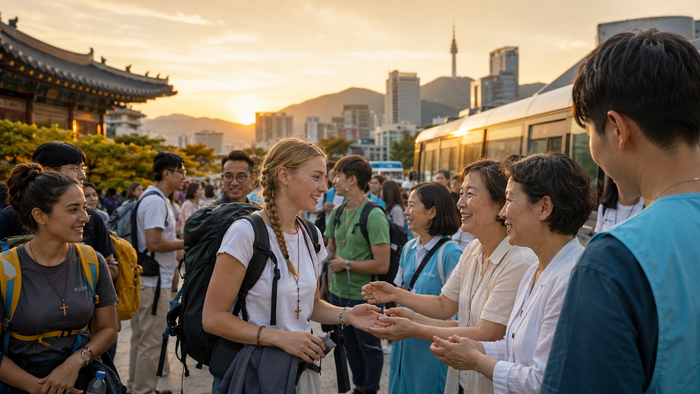 [Korean Today] World Youth Day Seoul 2027 is expected to become a global pilgrimage where young people from many countries share faith, friendship, peace, and hope in the Republic of Korea. The success of Seoul WYD will begin not with spectacular events, but with the spirit in which we welcome the world’s young people. ※ AI-generated image for illustrative purposes © Reporter Ji Seung-ju |
Catholics must prepare first before asking the Republic of Korea for help
I would like to raise a necessary question here, even if it may feel somewhat uncomfortable.
Before we ask the government for anything, what are we, the faithful, doing?
Before asking the Seoul Metropolitan Government for transportation measures, are we ready to guide pilgrims along their way?
Before asking schools and public facilities to provide accommodation, are our families preparing, within their means, to welcome guests?
Before worrying about a shortage of interpreters, are we ready to smile at a young foreign visitor and say Welcome?
Before discussing government budgets, are we prepared to offer our time, talents, and even small donations?
These questions are not meant to scold the faithful.
Rather, they are an invitation to make the precious opportunity of Seoul WYD 2027 a time to look again at our own faith.
If this is an event hosted by the Catholic Church, then the Church must move first.
The faithful must pray first.
The faithful must serve first.
The faithful must yield first.
The faithful must welcome first.
It is most natural for Korean society to see that example and move together with us.
The government, the Seoul Metropolitan Government, police and fire services, medical institutions, businesses, and civil society should not be placed in a structure where they are expected to do the work of the Catholic Church in its place.
Rather, the Church should open the way first through prayer and service, and the Republic of Korea should help widen that way together.
The one-billion-decade Rosary campaign has already begun, but something matters even more than the number
In that sense, a very meaningful movement has already begun.
The Seoul WYD Organizing Committee is conducting a campaign to offer one billion decades of the Rosary for the success of the event and for the young people of the world.
The official guidance encourages people to pray the Rosary, register the number of decades prayed, and then offer the official Seoul WYD prayer. Parishes in Seoul have collection boxes for Rosary beads representing the decades prayed, and these beads are expected to be used later to make Rosaries for Seoul WYD.
And an astonishing number is already appearing.
As of 4:00 a.m. on July 28, 2026, the official website reported 516,816,797 decades.
That is already more than half of the one-billion-decade goal. More than 310 million decades have been counted in the Archdiocese of Seoul alone, while dioceses, religious communities, and organizations throughout the country are participating in the prayer campaign.
It is truly something for which to be grateful.
But there is something we need to be careful about.
Simply reaching the number one billion must not become the sole goal.
It would be regrettable if one decade of the Rosary were recorded as nothing more than a number.
That one decade should change my heart.
As I pray, I should be able to think of one young person somewhere in the world.
I should be able to think of a young person living in a country at war.
I should be able to think of a young person who may not be able to come to Seoul because of poverty.
I should also be able to pray for believers in places where they are persecuted.
We should remember young people struggling with faith, young people afraid of the future, young people in conflict with their families, and young people who are lonely.
If the number of prayers grows and our hearts widen by the same measure, then one billion decades will have truly profound meaning.
One billion decades of the Rosary should not be one billion numbers, but one billion prayers holding the world’s young people in our hearts.
I believe that is the most beautiful first step in preparing for Seoul WYD.
What it means that the official prayer is already resounding in many languages
The official prayer of Seoul WYD is also noteworthy.
The organizing committee’s official website currently provides the prayer not only in Korean and English, but also in Spanish, French, Portuguese, Italian, Indonesian, Chinese, Japanese, Hindi, Thai, Tagalog, and a variety of other languages.
This is not merely a translation service.
It means that the universal Church is offering one prayer in many different languages.
The words are different, but the prayer is one.
The nationalities are different, but the hope is the same.
This is one of the important faces of World Youth Day.
In fact, at a youth prayer gathering for world peace organized by the Seoul WYD Organizing Committee in May 2026, the Rosary, Scripture readings, and prayers of the faithful were offered in several languages, including Korean, English, Spanish, Italian, and Filipino languages.
In 2027, many more languages than these will be heard throughout Seoul.
Will we hear those unfamiliar languages as noise?
Or will we receive them as the diversity of the universal Church?
That difference is precisely what it means to prepare our hearts.
Perhaps the first thing Seoul WYD needs is not an “empty room,” but an “open place”
Let us think about homestays.
Some people may think they can participate only if they have a spare room at home.
Of course, actually providing accommodation requires space, safety measures, family consent, and many kinds of preparation.
But hospitality does not begin only with a spare room.
It can begin with the willingness to leave one place open at my table.
To set aside a few hours of my day.
To offer one seat in my car.
To share my foreign-language skills for a few hours.
To explain the streets of Seoul that I know.
To prepare one meal using the cooking skills I have.
All of these are forms of hospitality.
According to the official master plan and FAQ, Seoul WYD is preparing accommodation centered on 233 parishes, while also planning to use homestays and public facilities such as training centers, gymnasiums, and auditoriums. Group accommodations are planned as air-conditioned indoor spaces, and some participants will use sleeping bags and shared toilets and shower facilities. Separate protection systems are also being prepared for minors.
I hope we do not regard this preparation as the responsibility of the organizing committee and parish coordinators alone.
If we do not have a room, we can find another way.
We can help clean accommodations.
We can organize bedding.
We can carry meals.
We can guide foreign young people between their accommodation and other locations.
We can help with laundry.
We can carry luggage.
Most of all, we can be the first to ask, “Is there anything you need?”
Service does not begin by taking on something grand. It begins by noticing the small things that need to be done.
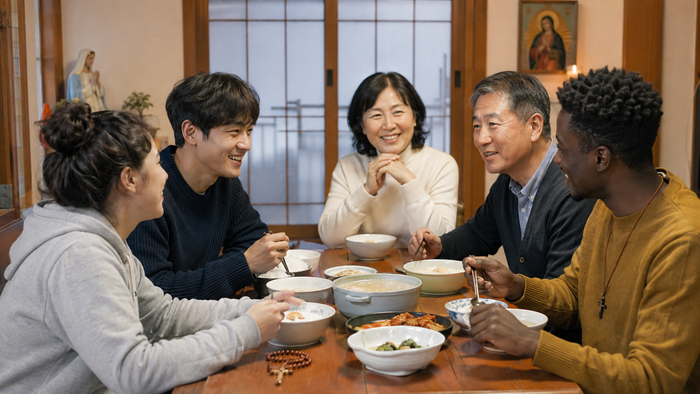 [Korean Today] Hospitality at World Youth Day is not completed by good facilities alone. Like a Korean family sharing a simple meal with overseas pilgrims, the small moments of eating together and listening to one another can become encounters of faith remembered for a long time. ※ AI-generated image for illustrative purposes © Reporter Ji Seung-ju |
Service is not “work for those who have spare time”; it is a way of showing faith
World Youth Day will require a great many volunteers.
But volunteers should not be viewed simply as manpower.
The person who tidies the venue.
The person who gives directions.
The person who interprets.
The person who serves meals.
The person who assists a wheelchair user.
The person who hands water to a young pilgrim exhausted by the heat.
The person who connects someone who is ill with medical staff.
The person who waits late into the night for participants at their accommodation.
These people are the face of the Korean Church that participants will encounter.
The organizing committee currently explains volunteering not as mere labor, but as a role to be carried out with responsibility and a spirit of service. In keeping with WYD’s purpose of helping young people grow as witnesses to the Gospel and as missionaries, it places particular importance on the participation of young volunteers.
Pope Leo XIV has also emphasized to young people on the road to Seoul that Christian witness is not ideological propaganda, but a transformation of life that naturally flows from friendship with the Lord.
We can apply these words to our own service as well.
Rather than loudly explaining that we are Catholics, we can show it through our actions.
We keep order.
We look after the vulnerable first.
We respect people from other cultures.
We do not lose our temper.
We return lost belongings.
We do not overcharge people.
We keep our promises.
If someone is lost, we help them find their way even if it takes a little time.
Actions like these may be the most persuasive language of faith.
I hope World Youth Day becomes an opportunity to look again at our own faith
During the preparation period for WYD, we will offer many prayers.
Banners will be hung.
Parishes will provide information.
Volunteer training will take place.
But how wonderful would it be if, after all this preparation, we ourselves had changed a little?
If we begin greeting parishioners we used to pass without speaking,
if we come to understand young people a little better,
if older people encourage the young,
if young people respect the experience of their elders,
if we begin to see migrants of different nationalities more naturally as part of our community,
if for the first time we notice what difficulties parishioners with disabilities experience in our churches,
and if we share a little so that young people from poorer countries can come to Seoul,
then WYD will already have begun.
The organizing committee’s official preparation guidance also says, “Although there is still time before WYD, the pilgrimage begins now,” and encourages people to deepen their prayer life, read the preparation materials, and take part in the Rosary campaign.
This sentence is very important.
The event will be held in 2027, but the pilgrimage begins now.
Then we too must begin preparing now.
What if the Korean Church preparing to welcome the world first becomes a “listening Church”?
We keep thinking about what we can show.
Let us show Korea’s martyrdom shrines.
Let us show hanbok.
Let us show K-food.
Let us show Korea’s development.
Let us show K-pop too.
All of that is good.
But when we consider the spirit of World Youth Day, perhaps one thing should come first.
Listening to their stories.
Where did you come from?
What is your Church like?
What concerns do young people in your country have?
What do you pray for?
How has war affected your life?
What do family and faith mean to you?
Why did you come all the way to Seoul?
The official World Youth Day prayer also includes the hope that we may become a Church that listens to one another’s voices, discerns God’s will, and walks together with the young people of the world.
Seoul WYD would be far more beautiful if it became not “an event where we show Korea,” but an event where we listen to one another’s stories.
Hospitality is not about speaking a lot.
Good hospitality is about listening well.
When the Church prepares first, hospitality naturally expands into a welcome offered by the whole Republic of Korea
That does not mean WYD can be confined to an event within the Church.
When a major event involving one million people is held, the entire city has to move.
Transportation is needed.
Safety is needed.
Accommodation, meals, and medical care are needed.
Airports, railways, subways, and buses must operate in coordination.
Police, fire services, medical personnel, and public officials all have roles to play.
The Seoul Metropolitan Government has already begun establishing a support system through the “Seoul Metropolitan Government Ordinance on Support for the 41st World Youth Day Seoul 2027,” which took effect on July 13, 2026. The ordinance requires a comprehensive support plan to include safety management and disaster prevention, transportation, accommodation, meals, medical services, tourism, cooperation among related agencies, and support for volunteers. It also provides a legal basis for consultative bodies and sector-specific support teams involving central government ministries, the Seoul Metropolitan Office of Education, district governments, and the organizing committee.
The Seoul Metropolitan Office of Education also began implementing a separate support ordinance on July 9, 2026, establishing an institutional basis for the use of schools and school facilities.
This is something for which we should be grateful.
And there is one thing we should hope for.
It is a beautiful cooperation in which the Catholic Church faithfully fulfills its own role and Korean society helps support that effort.
The Church should not depend on the government for everything.
Nor should the government attempt to take the place of the faith dimension of a religious event.
Each should do what it does best.
The Church should take responsibility for spiritual preparation, welcoming pilgrims, community life, and service.
The government and local authorities should contribute to safety, transportation, public facilities, and administrative support.
Businesses, universities, hospitals, and civil society can share their expertise and resources.
And citizens, as the people of the Republic of Korea, can warmly welcome the young people of the world.
When these roles are connected, WYD can truly become an event of the Catholic Church and, at the same time, a global celebration in which the whole Republic of Korea can share in the joy.
Seoul WYD, One Step Further ① — How about “One Decade of Prayer, One Act of Kindness”?
I would like to make one small proposal here.
In each installment of this series, rather than simply copying previous WYDs, I hope to suggest at least one new idea that could be considered specifically for Seoul.
The first proposal is very small.
For now, let us call it “One Decade of Prayer, One Act of Kindness.”
After praying a decade of the Rosary, we practice one small act of kindness in everyday life.
Call a family member first.
Speak to a parishioner who is alone.
Help a foreign visitor asking for directions.
Give up a seat on the subway.
Help clean the parish.
Visit someone who is ill.
Give a small donation so that a young person in poverty can participate in WYD.
The idea is to let prayer lead to action.
What if one billion decades of the Rosary were connected with one billion small acts of goodness?
Of course, this is not an official program of the organizing committee. It is an idea proposed by this column.
But it is a direction worth considering.
Prayer changes the heart, a changed heart changes actions, and those actions make the world a little warmer.
Is that not a natural expression of faith?
Seoul WYD, One Step Further ② — Let us consider a “Welcome Parish”
The second idea concerns parishes.
I hope the parishes where foreign young people will stay are not given only the role of accommodation facilities.
Each parish could become a small Welcome Parish — a parish of hospitality.
No grand event is necessary.
Parishioners welcome pilgrims.
They teach a few simple Korean greetings.
They explain a map of the neighborhood around the parish.
They point out nearby hospitals, pharmacies, and subway stations.
They introduce Korean family dining culture.
They explain Mass times.
Young people pray briefly together.
On the final day, they may exchange contact information.
One Korean parish and one overseas diocese could even continue a long-term relationship like sister communities.
The relationship would not end when WYD ends, but continue into the next generation.
If World Youth Day is an encounter of the universal Church, the parish can become the smallest and most concrete place where that encounter happens.
Seoul WYD, One Step Further ③ — “Welcome to a Korean Home”
The third idea is hospitality in a distinctly Korean spirit.
In Korea, there is a long tradition of preparing food when a guest comes to visit.
“Have you eaten?”
This is not simply a question about whether someone is hungry.
It is also a greeting that expresses concern for the other person.
In Korea, “jeong (情)” refers to the warmth and bond that grow through long relationships.
“Ye (禮)” refers to an attitude of respecting others and treating them properly.
What if we bring these two values into World Youth Day?
This does not mean serving an elaborate Korean banquet.
Seaweed and rice, a simple soup, and a few side dishes would be enough.
Who we eat with matters more than what we eat.
But true hospitality begins by asking about the guest’s food culture first.
Do they have any allergies?
Are there foods they do not eat?
Are there foods they must avoid for religious or health reasons?
Rather than saying, “This is Korean food, so please try it,”
“What foods are you able to eat?”
is the better question to ask first.
With that kind of attentiveness, Korea’s jeong and ye can become a universal language of hospitality that people from around the world can understand.
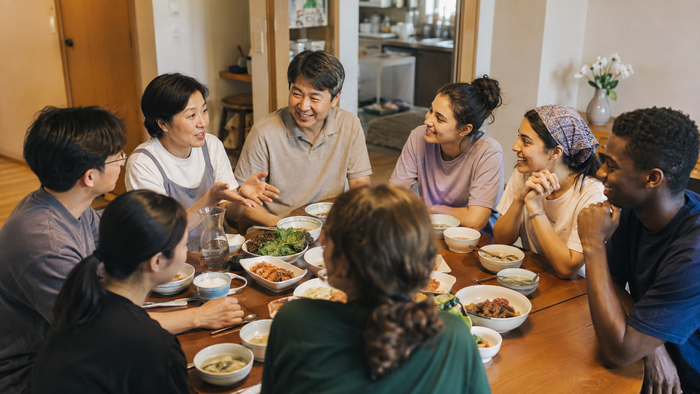 [Korean Today] Korean-style hospitality at World Youth Day Seoul 2027 can begin with small acts of consideration rather than spectacular performances. Respecting the culture and dietary practices of young people from around the world before sharing a meal together is a natural way to communicate Korea’s jeong (情) and ye (禮). ※ AI-generated image for illustrative purposes © Reporter Ji Seung-ju |
If Korea is an advanced nation, technology should also be used for people
Another strength the Republic of Korea can show the world is technology.
But at WYD, there is no need to use technology simply to boast about technology.
Technology should be used to reduce people’s inconvenience.
Imagine, for example, a young foreign visitor getting lost in the subway.
By opening a smartphone, the person can find a destination in their own language.
They can check crowd levels at event venues.
They can find water stations and toilets.
They can check wheelchair-accessible routes.
If they become ill, they can request medical assistance in multiple languages.
If they lose their phone, they can receive help.
In an emergency, they can receive safety information in their own language.
This is the kind of technology Korea can truly be proud of.
Not technology used to proclaim, “We are an AI powerhouse,” but technology that says,
“We prepared this so that you would not feel inconvenienced in an unfamiliar Seoul.”
When advanced technology meets warm hospitality, K-Technology becomes K-Hospitality.
I hope WYD thinks first of young people with disabilities
The best international event is not one designed around the most comfortable participant.
It is one designed so that even those who may face the greatest difficulty can take part together.
The official FAQ says detailed measures are being prepared so that participants who need special support, including those with disabilities, can take part in all activities, and that related information will continue to be released.
A young person who uses a wheelchair.
A young person with a visual impairment.
A young person with a hearing impairment.
A young person with a developmental disability.
A young person with a chronic illness or who uses medical equipment.
Someone who has difficulty walking long distances.
Every one of them is an equally precious guest.
Then we, the faithful, can also ask ourselves:
Is it easy for a wheelchair user to enter our parish?
Can they use the toilets?
Can a person with hearing loss understand the Mass?
Is there guidance for people with visual impairments?
These questions are not only about WYD.
As we prepare for WYD, we can examine how open our parishes ordinarily are to everyone.
If that happens, World Youth Day can become an opportunity to make the Korean Church itself a little warmer and more inclusive.
Seoul’s history of martyrdom should be shown through life, not merely put on display
Seoul is an important place in the history of Korean Catholic martyrdom.
Official Seoul WYD introductory materials present martyrdom sites in Seoul such as Danggogae, Saenamteo, Seosomun, and Jeoldusan, explaining that the Church in Seoul grew on the sacrifices of the martyrs. According to official materials, the Archdiocese of Seoul had approximately 1.52 million Catholics and 233 parishes as of 2024 statistics.
It is important to introduce this history to young people from around the world.
But it would be disappointing if the faith of the martyrs were shown only through tours of historic sites.
We should be able to show through our lives why the martyrs were willing to risk their lives.
Respect the vulnerable.
Value human life.
Live honestly.
Forgive others.
Work for peace.
Help those who are in greater difficulty than we are.
This is what it means to live as descendants of a living faith of martyrdom.
After visiting the shrines, it would be good if young people from around the world remembered,
“Korea has many remarkable martyrdom sites.”
But an even more beautiful memory would be this:
“After meeting Korean Catholics, I think I understand a little better why they say they are descendants of the martyrs.”
Few places are as symbolic as Seoul when speaking about peace
Seoul WYD will be held on a divided Korean Peninsula.
The organizing committee emphasizes the historic significance of Seoul 2027 as the first WYD held in a divided nation, the first held in a non-Christian cultural sphere, and the second international WYD in Asia. The committee presents truth, love, and peace as core spiritual themes.
That is why it is especially meaningful for young people from around the world to speak about peace in Seoul.
Wars and conflicts continue in many parts of the world even now.
Young people are taken to battlefields.
They lose family members.
They leave their homelands.
They come to hate one another because of different politics, religions, and races.
I hope Seoul WYD does not end simply as an event where “young people from around the world gathered and had a good time.”
I hope it becomes a time when young people from around the world pray together on the divided Korean Peninsula and say:
“We need dialogue, not war.”
“We need reconciliation, not hatred.”
“Human dignity comes before nationality.”
Pope Leo XIV has also called on young people throughout the world to build not a world that resolves conflict through weapons, but one in which friendship and dialogue are possible.
This may be one of the deepest meanings of holding WYD in Seoul.
Preparation is already under way with the understanding that care for the environment is part of faith
Ecological action is also part of the preparations for Seoul WYD.
Through the “Breath of Life” campaign, the organizing committee is working with the Seoul Metropolitan Government, the Korea Forest Service, and others on a tree-planting project. The official plan aims to involve about 2,000 young people and plant more than 10,000 trees by 2027.
The organizing committee explains this not simply as an environmental event, but as an act of faith that protects the order of creation and as action toward carbon neutrality.
This too is a good direction.
It would be contradictory to talk about the environment while creating large amounts of new waste for WYD.
Use personal water bottles.
Separate waste properly.
Reduce disposable products.
Use public transportation.
Keep the areas around event venues clean.
We can begin with small actions.
This too is a form of preparation the faithful can undertake.
Seoul WYD, One Step Further ④ — “One Person, One Country, One Friend”
World Youth Day brings young people from countless nationalities.
Then perhaps Korean parishes or youth groups could connect in advance with one particular country or overseas diocese, learning about one another and praying for one another.
For example, if a Korean parish were to welcome young people from a diocese in Africa, it could begin studying that country several months before the event.
Learn greetings from that country.
Learn its culture.
Learn the history of its Church.
Pray for the difficulties that country faces.
Continue communicating online even after the event ends.
For now, we might call it “One Parish, One Friendship.”
Again, this is not an official program, but a proposal.
But if hundreds of relationships like these were created, WYD could grow beyond a ten-day event into lifelong friendship.
Seoul WYD, One Step Further ⑤ — Hospitality lasts until the guest returns home
In Korean culture, when a guest visits our home, we not only welcome them well but also care about their journey home.
We see them off at the door.
If they are traveling far, we say, “Let me know when you arrive safely.”
What if we applied this spirit to WYD as well?
When they arrive at the airport:
“Welcome to Korea.”
And when they leave:
“See You Again in Korea.”
That is how we create one continuous journey of hospitality from arrival to departure.
As young people from around the world board their planes, I hope they can feel:
“The people of Korea were truly waiting for us.”
And when they leave:
“They were genuinely sorry to see us go.”
That experience itself becomes the national brand.
There is no need to forcefully promote Korea.
People with good memories will tell Korea’s story on their own.
What will I prepare as a Catholic?
This is the question I intend to ask in every installment of this series.
Let us begin with the most basic things.
Let us pray.
Even if it is only one decade of the Rosary, let us pray it sincerely and also offer the official WYD prayer.
Let us pray for one young person.
We do not need to know the person’s name. Let us pray for one young person somewhere in the world who will come to Korea in 2027.
Let us pay attention to WYD news in our parish.
Instead of dismissing it as “an event for young people,” let us ask what we ourselves can do.
Let us think about how much time we can offer as volunteers.
If a whole day is difficult, even a few hours is meaningful.
Let us talk with our families about whether a homestay is possible.
If it is difficult, we can find another form of service.
Let us consider making a small donation.
Let us look for ways to stand in solidarity with young people from economically disadvantaged countries so that they can participate.
When we see a foreign visitor, let us smile first.
It is all right if our English is not perfect. Kindness does not require perfect grammar.
Let us look for inconvenient places in our parishes.
Let us see whether there are places that are difficult to use for people with disabilities, foreigners, or first-time visitors.
Let us keep order.
At a large-scale event, keeping order is itself an important form of service.
Let us learn about other cultures.
Learning from them is just as important as showing them what we have.
We can begin with these things.
No one can do everything.
But everyone can do at least one thing.
To the government and the Seoul Metropolitan Government, I want to speak of “cooperation” rather than “demands”
In this series, we will also examine in detail the preparations needed from the government and the Seoul Metropolitan Government.
Transportation.
Extreme heat.
Emergency medical care.
Crowd safety.
Communications.
Toilets.
Accommodation.
Meals.
Waste.
Accessibility for people with disabilities.
Protection of minors.
Airports.
Subways.
Multilingual guidance.
Cybersecurity.
There are countless issues.
But I want to make our basic attitude clear.
Rather than saying,
“Why haven’t you prepared?”
I would rather say:
“The Church is preparing in these ways. If the public capacity of the Republic of Korea joins this effort, the event can become safer and more beautiful.”
The Seoul Metropolitan Government has already established a legal support framework, and the organizing committee entered a full-scale implementation phase after announcing its master plan in 2025. Therefore, I will not conclude that there is no preparation simply because detailed plans have not yet been made public.
When something is being done well, I will say so.
If there is a new idea, I will propose it carefully.
I will also introduce good examples from overseas.
But I will not say that because another country did something, we must do exactly the same.
Seoul needs a Seoul way.
We should learn from past WYDs, but Seoul must remain true to Seoul
World Youth Day has a long history.
According to official Seoul WYD materials, international WYD began in Rome in 1986 and has since been held in cities around the world, with cumulative participation exceeding 23.5 million people. The organizing committee notes that several million people gathered for the 1995 Manila event, and more than 1.5 million people participated in the final event of Lisbon 2023.
We will study the experiences of these host cities.
How did they provide accommodation?
How did they move participants?
How did they respond to the heat?
How did they operate medical systems?
How did they train volunteers?
How did they communicate with local residents?
We should learn from those experiences.
But Seoul does not need to become a copy of Lisbon.
Nor a copy of Kraków.
Nor a copy of Manila.
We must add what the Republic of Korea does well and what is distinctive about the Korean Church.
Advanced information and communications technology.
Convenient public transportation.
Strong medical capacity.
Citizens’ respect for public order.
The Korean Catholic tradition of martyrdom.
And the values of jeong and ye, which Koreans have long considered important.
If we connect these things well, we can create a WYD that is uniquely Seoul.
What we hope for is not “the biggest WYD,” but “the WYD remembered as the warmest”
One million people.
That number alone may draw the attention of the world’s media to Seoul.
But I hope our goal is not a number.
It does not matter whether it is the largest ever.
It does not matter whether the stage is more spectacular than ever before.
What matters more is what participants remember after the event is over.
“Seoul was safe.”
“The people of Korea were kind.”
“I got lost, but someone stayed with me and helped me all the way.”
“Even with a disability, I could participate together with everyone.”
“I remember the meal I shared with my homestay family.”
“The prayers of Korean Catholics were impressive.”
“The stories of the martyrs stayed in my heart.”
“I will never forget the moment we prayed for peace on the divided Korean Peninsula.”
And finally, how wonderful would it be if they said,
“I want to come back to Korea.”
That would be enough.
Before we look at one million young people, let us look at “one person”
The number one million is so large that it can make us forget the face of an individual person.
So let us erase the number for a moment.
One young person comes to Korea.
It may be the first time that young person has ever come to Asia.
It may be the first time they have ever been on an airplane.
They may have saved money for years just to make it to Seoul.
They may come from a country at war.
They may arrive carrying deep questions about faith.
They do not know a single word of Korean.
In the hot Seoul summer, they take the subway and make their way to an unfamiliar parish.
At the door, one Korean Catholic is standing there.
And with a smile, that person says:
“Welcome.”
At that moment, for that young person, the Republic of Korea is not Gyeongbokgung Palace, and it is not K-pop.
It is that person.
That person’s expression.
That one word.
In the end, a nation is remembered through people.
The Church is also remembered through people.
Faith, too, is communicated through human actions.
This is where our original spirit begins
That is why this 30-part series will not be written to judge anyone.
It will first examine the efforts of those responsible.
If they are doing well, we will applaud them.
If there are good examples from overseas, we will study them together.
If there is anything more that can be prepared, we will make suggestions carefully.
And we will always ask ourselves as well:
“What are we doing?”
Before asking the government, I will ask the Church.
Before asking the Church, I will ask myself.
One billion decades of the Rosary are important.
But at the end of those prayers, I hope our hearts will have become a little warmer.
I hope we celebrate Mass with greater devotion,
pray for the world’s young people,
share our time,
share our homes,
share our meals,
share our talents,
and share kindness.
Let the Church move first.
And then let us extend our hands to the Republic of Korea and ask it to join us.
I hope Korean society will gladly take that hand.
If Seoul WYD is prepared in that way, it will not end with simply staging a successful event.
It will leave something with the Korean Church.
It will leave something with the Republic of Korea.
And it will remain for a long time in the hearts of young people around the world.
In August 2027, I hope we hear these words
I imagine the day World Youth Day comes to an end.
Young people from around the world head toward Incheon International Airport.
Some hug Korean friends.
Some say a final goodbye to their homestay families.
Some hold a Rosary they received.
Some look at photographs taken in Seoul.
Before boarding the plane, they say to their Korean friends:
“Thank you.”
“Gracias.”
“Merci.”
“Obrigado.”
“Grazie.”
And after returning to their home countries, they tell their friends about Seoul.
I hope this is what they say:
“WYD was beautiful, but the people I met in Korea were truly warm.”
That one sentence would be enough.
Perhaps that one sentence is why we are praying and preparing now.
The first day of World Youth Day may be July 29, 2027.
The first day of the main Seoul gathering is August 3, 2027.
But the pilgrimage of faith has already begun.
Today, as I pray one decade of the Rosary,
today, as I pray for a young person somewhere in the world,
today, as I begin for the first time to think about what I can do,
perhaps today itself
is the first day of my WYD.
What will I prepare as a Catholic? — A small promise for this first installment
This week, there is no need to do anything grand.
As we pray the Rosary, let us remember World Youth Day Seoul 2027 and the young people of the world.
And after the prayer ends, let us ask ourselves one question.
“Lord, what small thing can I do for this gathering?”
The answer will be different for each person.
It may be prayer.
It may be service.
It may be a donation.
It may be a homestay.
It may be interpretation.
It may be a single smile.
What matters is that we begin.
Seoul WYD, One Step Further — Proposals
This installment proposes five ideas.
① One Decade of Prayer, One Act of Kindness
A movement for the faithful that connects praying the Rosary with small acts of goodness in daily life.
② Welcome Parish
A parish of hospitality that goes beyond providing accommodation and connects faith, culture, and people.
③ Korean Welcome Table
A shared table that respects the guest’s culture and dietary practices first, rather than merely showcasing Korean food.
④ One Parish, One Friendship
A model connecting Korean parishes and youth communities with overseas dioceses and youth communities so that friendship continues beyond WYD.
⑤ Welcome to Korea → See You Again in Korea
A Korean-style journey of hospitality that warmly accompanies guests from arrival to departure.
These five ideas are not official projects of the organizing committee at present. They are proposals made by this column. Any actual implementation would require sufficient review by the Church and relevant authorities.
Next Column
[Is the Republic of Korea Ready for WYD 2027? ②]
What would change if one million young people gathered in Seoul?
In the second installment, rather than treating the number “one million” sensationally, we will translate it into the practical language of a city.
We will follow the complete journey of one young person arriving at the airport, traveling to accommodation, eating, using the subway, finding a toilet, using a mobile phone, entering an event venue, receiving treatment if ill, and returning to accommodation again.
Transportation, accommodation, meals, drinking water, toilets, communications, medical care, extreme heat, waste, and mobility for people with disabilities are not separate issues.
They are all connected within the experience of one person.
And throughout that process, we will ask again:
What should the government prepare?
What should the Church prepare?
And
What can I do as a Catholic?
Ji Seung-ju
Head of the Seoul Branch of Korean Today · Columnist
This column begins with respect and support for the efforts of the Holy See and the organizing committee, the Catholic Church in Korea, the national government, the Seoul Metropolitan Government and local governments, police, fire and medical institutions, educational institutions, parish communities, and volunteers who are working for the success of World Youth Day Seoul 2027. Based on publicly available official materials and the experiences of previous international events, this series aims not to disparage or prematurely judge current preparations, but to continue offering constructive suggestions from the perspective of asking, “Is there perhaps one more thing we can prepare?”
THE KOREAN TODAY × WIA CODE
이 기사의 WIA Code

WIA Code 스캐너로 비추면 인터넷 없이 발행 사실과 위·변조 여부를 확인할 수 있습니다.
휴대폰 기본 카메라로 찍으면 스캐너 안내 페이지가 열립니다 — 기사 바로 열기

움직이는 코드는 스트림입니다 — WIA Code 스캐너로 약 84초 비추면 기사 전문(사진 포함)이 폰에 저장되어 인터넷 없이도 읽을 수 있습니다.
WIA Code · 코리안투데이


Leave a Reply