
The Ministry of Land, Infrastructure and Transport (Minister Kim Yun-deok) is pushing to enact a ‘Mobile Robot Special Act’ to promote the safe use and commercialization of service robots employed in everyday living spaces such as delivery, parking and electric-vehicle charging. On the afternoon of August 13, the ministry will hold a briefing on the bill at the Startup Campus in Pangyo Techno Valley, Seongnam, Gyeonggi Province, to hear the views of robotics companies.
 [코리안투데이] Briefing on the Ministry of Land, Infrastructure and Transport’s Mobile Robot Special Act bill © 장형임 기자 |
The Ministry of Land, Infrastructure and Transport announced that it has drafted the 《Special Act on the Safe Use and Promotion of Commercialization of Mobile Robots》(hereinafter the ‘Mobile Robot Special Act’) and will hold a briefing at the Pangyo Techno Valley Startup Campus on August 13. The briefing was arranged to explain to the industry the purpose and key contents of the bill, which is being pursued through cooperation with the National Assembly, and to hear on-site opinions from companies that develop and operate mobile robots and related software. A total of 44 organizations will attend, including 43 robotics-related companies such as Samsung Electronics, Hyundai Motor, Naver, Rainbow Robotics and Doosan Robotics, as well as the Korea Institute for Robot Industry Advancement.
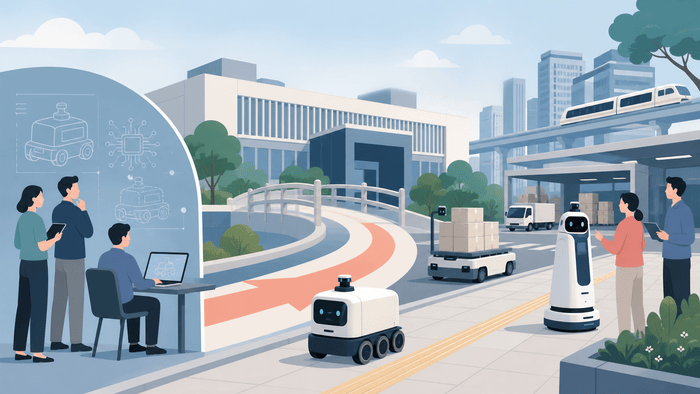
Mobile robots are intelligent robots that perform a variety of tasks — delivery, parking, EV charging, transport, security and maintenance — while moving through indoor and outdoor spaces either autonomously or by remote control. Although the relevant cutting-edge technology has been advancing rapidly, the ministry judges that genuine commercialization requires not only improvements in technology and performance but also an environment in which the spaces and infrastructure where robots operate can accommodate them.
In particular, for mobile robots to operate smoothly in citizens’ living spaces and industrial sites — buildings, apartment complexes, parking lots, outdoor areas and construction sites — the institutional foundations related to spaces and facilities must be overhauled in parallel. As the ministry responsible for systems governing buildings, urban spaces and transport and living infrastructure, the Ministry of Land, Infrastructure and Transport is supporting the swift proposal and enactment of the bill so that mobile robots can be reliably used in citizens’ everyday spaces.
The bill is expected to include institutional grounds and special provisions that rationally improve existing space- and facility-related regulations ill-suited to robot use, and that support the use of robots in buildings, apartment complexes, parking lots, outdoor areas and construction sites. Through this, the ministry plans to lay a foundation for the general-purpose use of robots beyond limited demonstration areas, and to underpin the commercialization of the robotics industry and the expansion of related services.
A safety management system will be established as well. Taking into account the characteristics of the spaces and fields in which mobile robots are used, the ministry will set operating standards and safety management standards by field, thereby resolving the institutional uncertainty that can arise during commercialization. In particular, it plans to clarify responsibilities and response systems in the event of accidents and to put an accident investigation framework in place, so that citizens can use mobile robot services with peace of mind.
This is a measure to prepare for an era in which robots leave laboratories and pilot zones and move alongside people in the apartments, parking lots and streets where residents live. It amounts to an institutional blueprint that will determine whether coexistence with robots can take safe root in citizens’ daily lives. The ministry will review the industry opinions presented at the briefing, convey them during the bill’s proposal and deliberation in the National Assembly, and enhance the effectiveness of the legislation through consultations with relevant ministries.
Minister Kim Yun-deok stressed, ‘No matter how far mobile robot technology advances, it will be difficult to achieve commercialization if the robots cannot move freely in actual living spaces and provide services.’ He added, ‘We have now moved beyond the stage of developing robots; it is time for institutional preparation to transform our everyday spaces into places where robots and people can coexist.’ He continued, ‘I hope you will actively share your on-site experiences and opinions so that the 《Mobile Robot Special Act》can become effective legislation that opens a new path for the mobile robot industry. The government, too, will communicate closely with the industry and swiftly pursue the institutional support needed for mobile robots to take root safely and naturally in citizens’ daily lives.’
지역 홍보대사 신청 기자양성과정 신청 코리안투데이 지부장 신청 코리안투데이 인천강화
THE KOREAN TODAY × WIA CODE
이 기사의 WIA Code

WIA Code 스캐너로 비추면 인터넷 없이 발행 사실과 위·변조 여부를 확인할 수 있습니다.
휴대폰 기본 카메라로 찍으면 스캐너 안내 페이지가 열립니다 — 기사 바로 열기

움직이는 코드는 스트림입니다 — WIA Code 스캐너로 약 23초 비추면 기사 전문(사진 포함)이 폰에 저장되어 인터넷 없이도 읽을 수 있습니다.
WIA Code · 코리안투데이


Leave a Reply