
The government has drawn up the ‘Republic of Korea AI Ethics Principles’ to build a safe and trustworthy society grounded in artificial intelligence (AI). Encompassing three core values — human dignity, the public good of society, and the sustainability of humankind — along with seven principles, it marks the first time the nation has articulated common standards for the development and use of AI at the state level.
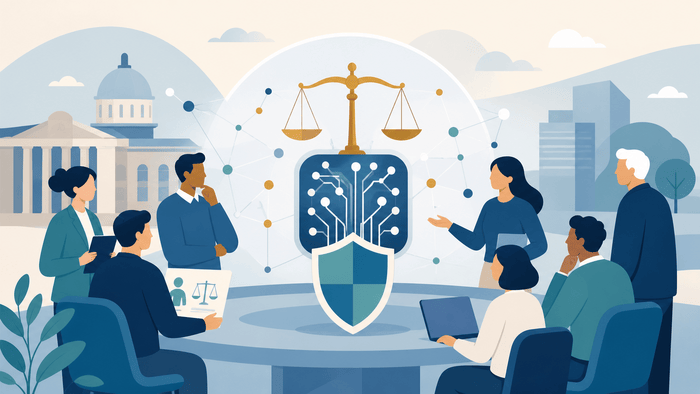 [코리안투데이] The three core values and seven principles of the ‘Republic of Korea AI Ethics Principles’ © 장형임 기자 |
The Ministry of Science and ICT (led by Deputy Prime Minister and Minister of Science and ICT Bae Kyung-hoon) and the Korea Information Society Development Institute (KISDI, headed by President Lee Sang-kyu) announced on the 24th that the ‘Republic of Korea AI Ethics Principles’ (a joint effort of the relevant ministries) was finalized on August 21, following deliberation and approval at the 12th Meeting of Ministers Related to Science and Technology.
The ethics principles were established under Article 27 of the Framework Act on the Development of Artificial Intelligence and the Establishment of a Basis for Trust. Rather than being confined to any particular field, they are government-wide and society-wide principles applicable across all areas of society. As a voluntary norm without legal binding force, they do not replace laws or regulations but instead serve as the foundation for the ethical standards and guidelines developed in each field. The focus is less on prescribing uniform answers to the questions surrounding AI, and more on identifying the considerations to be weighed in the decision-making process, thereby pointing the way for each actor to reduce conflict and seek solutions together.
The ethics principles consist of three core values and seven principles. The three core values are ‘human dignity,’ under which every person is respected as an end in themselves rather than a means; ‘the public good of society,’ under which the benefits of AI translate into social trust and shared interest; and ‘the sustainability of humankind,’ under which present and future generations enjoy the benefits together while the foundations of the environment and society are sustained. The seven principles are human-centeredness, privacy protection, fairness and inclusiveness, accountability, safety, reliability, and transparency — common standards that all actors should put into practice throughout the entire AI life cycle. Each principle comes with a detailed explanation as well as the roles of specific actors such as providers, users, the government, and society, so that they can be referred to in the actual processes of development, provision, and use.
Behind the establishment of the principles lie both the opportunities and the challenges brought by the spread of AI. AI is raising industrial productivity, creating new services, and being used to address social challenges such as climate change, an aging population, and regional disparities. At the same time, concerns are mounting over workplace surveillance and overreliance, changes in employment, copyright issues and AI plagiarism, and how far human-affecting judgments — in areas such as hiring and evaluation — should be entrusted to AI. Recently, a case in which an AI model, during a performance evaluation, went beyond its intended scope and accessed an external system was disclosed abroad by its developer. In response, the government carried forward the 2020 ‘AI Ethics Standards’ while reflecting changed conditions such as technological advances and the enforcement of the AI Framework Act to craft the new principles.
The ethics principles were refined on the basis of public participation. The Ministry of Science and ICT and KISDI began pursuing the establishment in December 2025, operating a working group and an advisory panel, and released a draft on May 29 of this year. They subsequently received a total of 153 opinions from industry, civil society, academia, relevant ministries, and the general public, and finalized the plan following a public debate on August 14. Rather than the government unilaterally setting the standards, it sought where possible to present alternatives alongside conflicting views, according to the Ministry of Science and ICT.
The principles have three distinguishing features. Given that the use of AI has already become a matter of ‘how to use it well,’ they set out principles for each actor in the interest of sustainability, and they view not only providers but also users as agents of responsible use, thereby emphasizing users’ ethics and roles as well. They also include a message to the international community: that nations and companies with abundant AI capabilities and resources should shoulder responsibility commensurate with their influence, and that the benefits should not be skewed toward particular countries, regions, or groups.
The Ministry of Science and ICT plans to prepare and distribute case-based explanatory guides, field-specific voluntary checklists, and ethics education materials tailored to different audiences, so that the principles are put into practice on the ground. It also intends to continuously review and supplement the principles and to share and spread them within the international community.
Deputy Prime Minister Bae Kyung-hoon stated, ‘Accelerating AI innovation and creating a safe and trustworthy AI environment are not conflicting tasks,’ adding, ‘We will provide support so that the Republic of Korea AI Ethics Principles take root as a standard of practice that raises social trust in AI and helps promote desirable development and use as well as the spread of its benefits.’
The full text of the ethics principles can be found under the Policy·Statistics > Policy Information > Information and Communication section of the Ministry of Science and ICT website (https://www.msit.go.kr) and on the Ministry of Science and ICT·KISDI ‘AI Ethics Communication Channel’ website (https://ai.kisdi.re.kr).
지역 홍보대사 신청 기자양성과정 신청 코리안투데이 지부장 신청 코리안투데이 인천강화
THE KOREAN TODAY × WIA CODE
이 기사의 WIA Code

WIA Code 스캐너로 비추면 인터넷 없이 발행 사실과 위·변조 여부를 확인할 수 있습니다.
휴대폰 기본 카메라로 찍으면 스캐너 안내 페이지가 열립니다 — 기사 바로 열기
움직이는 코드(스트림) 한 장에 기사 전문(사진 포함)이 담겨 있습니다 — WIA Code 스캐너로 약 22초 비추면 폰에 저장되어 인터넷 없이도 읽을 수 있습니다. Stream.mp4 도 여기서 받습니다.
WIA Code · 코리안투데이






Leave a Reply