
The Ministry of Science and ICT and the National Information Society Agency (NIA) re-inspected 87 sites nationwide that had been rated substandard in last year’s telecommunications service quality evaluation, and confirmed that quality had improved at 79 of them (91%). All indoor facilities were improved, but eight subway sections still fell below standard, while improvements to key high-speed rail sections will be completed before the Chuseok holiday.
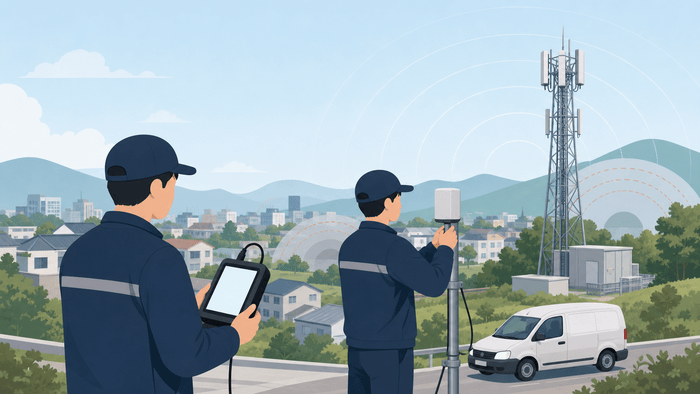 [코리안투데이] A field measurement of fifth-generation mobile communications quality on the Seoul metropolitan subway © 장형임 기자 |
The Ministry of Science and ICT (led by Deputy Prime Minister and Minister of Science and ICT Bae Kyung-hoon) and the National Information Society Agency (President Kim Hyung-chul) announced that they had re-inspected a total of 87 sites which, in the 2025 telecommunications service quality evaluation, had shown either slow transmission speeds (poor quality) or weak radio signal strength (poor connection) to determine whether they had been improved. The inspection found that 79 sites had been improved, while eight remained substandard.
Poor quality refers to cases where the proportion of measurements falling below the download reference speed (12 Mbps for 5G, 6 Mbps for LTE) is 10% or higher, while poor connection refers to cases where the proportion of 5G signal strength falling below a set threshold (RSRP -105 dBm) is 10% or higher. The measure is intended to single out locations where users experience inconvenience in everyday life and to press carriers to make improvements.
This inspection focused intensively on substandard areas in indoor facilities and subways where users are densely concentrated. Substandard high-speed rail sections, where facility investment applying Shared Network 2.0 technology is under way, will be inspected separately at the end of this year when the investment is completed.
Among indoor facilities, all 30 sites — including 24 with poor 5G connection and six with poor LTE quality — were improved. The average download transmission speed rose 196%, from 33.61 Mbps before improvement to 99.34 Mbps afterward. By carrier, SKT, KT and LGU+ all improved 100% of their respective facilities.
Gaps emerged in subway sections. For 5G, 12 of the 13 substandard sections (92%) were improved, leaving one section outstanding. All nine standalone-network sections were improved, whereas one of four 5G shared-use areas remained unimproved. The unimproved section is the Seonghwan–Jiksan stretch on the Seoul metropolitan Line 1, where poor quality occurred in KT’s service within a shared-use area provided by SKT. For LTE, 37 of 44 sections (84%) were improved, leaving seven outstanding. These sections include Busan Line 1 (Myeongnyun–Oncheonjang), Busan Line 3 (Gangseo-gu Office–Sports Park), the Busan-Gimhae Line (Gwaebeop Renecite–Sasang), Seoul metropolitan Line 1 (Seryu–Byeongjeom, Seonghwan–Jiksan), the Suin-Bundang Line (Oido–Darwol) and the Busan-Gimhae Line (Bulam–Daesa). In the sections that were improved, the average download speed rose about 87% for 5G, from 354.34 Mbps to 661.54 Mbps, and about 125% for LTE, from 52.84 Mbps to 118.98 Mbps.
High-speed rail improvements are being pursued on a separate timeline, targeting travel demand during the holidays. The Ministry of Science and ICT and the three mobile carriers — SK Telecom, KT and LG Uplus — plan to complete the integration of all three carriers’ equipment before Chuseok on the busiest key sections of the Gyeongbu and Honam lines — namely Pyeongtaek Jije–Daejeon, Daejeon–Miryang, Dongdaegu–Ulsan, Osong–Iksan and Iksan–Jeonju — thereby improving the communications environment for holiday travelers. Shared Network 2.0 facilities on the remaining Gyeongbu and Honam line sections will also be completed within the second half of the year, and quality improvements across all high-speed rail lines and sections will be pursued by 2027.
Shared Network 2.0 is a method of expanding transmission capacity and distributing user load by additionally installing and integrating the equipment (RU) of the using operator onto the equipment (antenna, RU, DU) of the lead operator in existing 5G shared-network areas.
The Ministry of Science and ICT stated that, since carriers’ facility investment is essential to creating a high-quality communications environment that citizens can tangibly experience, it will encourage such investment through continuous quality evaluations and re-inspections of substandard areas. In particular, it said it would scrutinize the eight still-unimproved subway sections and the high-speed rail sections such as the Gyeongbu and Honam lines even more rigorously in the second-half quality evaluation, and follow through to the end in confirming whether substantive improvement has been achieved.
지역 홍보대사 신청 기자양성과정 신청 코리안투데이 지부장 신청 코리안투데이 인천강화
THE KOREAN TODAY × WIA CODE
이 기사의 WIA Code

WIA Code 스캐너로 비추면 인터넷 없이 발행 사실과 위·변조 여부를 확인할 수 있습니다.
휴대폰 기본 카메라로 찍으면 스캐너 안내 페이지가 열립니다 — 기사 바로 열기
움직이는 코드(스트림) 한 장에 기사 전문(사진 포함)이 담겨 있습니다 — WIA Code 스캐너로 약 19초 비추면 폰에 저장되어 인터넷 없이도 읽을 수 있습니다. Stream.mp4 도 여기서 받습니다.
WIA Code · 코리안투데이






Leave a Reply