
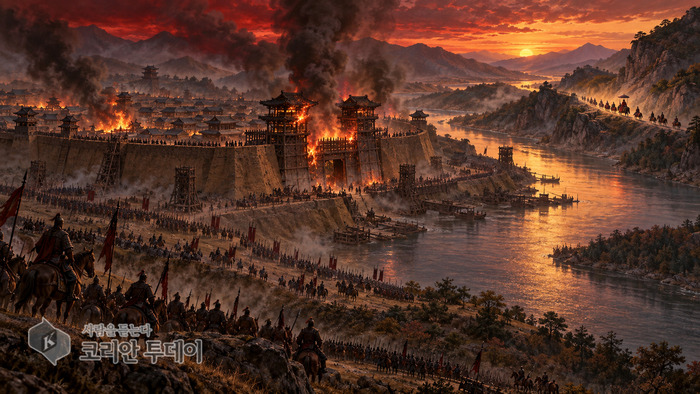
Seven days. That is how long it took for a royal capital that had stood for nearly a century to burn to the ground.
In the ninth lunar month of 475 CE, King Jangsu of Goguryeo led an army of 30,000 to surround Hanseong, the capital of the kingdom of Baekje, on the Korean peninsula. Gates burned, the fortress fell, and the king himself was captured and executed. It was, by any measure, the single worst day in Baekje’s history to that point.
Does a kingdom truly end when its capital burns and its king is killed? Or can a state be rebuilt from the ashes of catastrophic defeat? The fall of Hanseong – and the desperate flight that followed – is Baekje’s answer to that question, and it still resonates with anyone who has watched a nation, a company, or an institution face sudden, total collapse.
🌍 Western Historical Parallel
The timing is almost eerie: just one year after Hanseong fell in 475, the Western Roman Empire met its own symbolic end. In September 476, the Germanic warlord Odoacer deposed the last Western Roman emperor, Romulus Augustulus, at Ravenna. Two ancient states, on opposite sides of the Eurasian continent, lost their capitals and their ruling houses within twelve months of each other – one through outright dethronement, the other through a king’s execution and forced exile of his court.
◆ The Ancient Landscape
The roots of the disaster stretch back nearly eighty years. In 396 CE, King Gwanggaeto the Great of Goguryeo had already crushed Baekje, capturing 58 fortresses and 700 villages and forcing King Asin to surrender at his own capital, handing over his brother and ten ministers as hostages. Gwanggaeto’s successor, King Jangsu, moved his own capital from Gungnae-seong to Pyongyang in 427 CE – a deliberate strategic pivot that placed the “southward advance policy” at the center of Goguryeo’s national strategy, much as a rising power might relocate its seat of government closer to a contested frontier.
Sensing the threat, King Gaero of Baekje sent a secret diplomatic letter to Northern Wei in 472 CE, pleading for a joint military campaign against Goguryeo. Northern Wei refused, citing its traditional friendship with Goguryeo – and the failed overture only deepened Baekje’s diplomatic isolation while further inflaming Goguryeo’s hostility. To make matters worse, a Goguryeo spy disguised as a Buddhist monk, Dorim, had won the king’s trust and persuaded him to pour the state treasury into lavish palace walls, towers, and tomb renovations, exhausting the kingdom’s resources and its people’s patience.
“Georyeon [King Jangsu], king of Goguryeo, personally led his troops and surrounded the royal capital of Hanseong… When the fortress fell, the king fled. Goguryeo generals Geollu and others, upon seeing him, dismounted and bowed – then spat on the king’s face three times, denounced his crimes, and had him bound and taken to be executed beneath Achaseong fortress.”
◆ Same Era, Different Worlds
🏛️ China
The Northern and Southern Dynasties period: Northern Wei ruled the north, Liu Song the south. Baekje’s plea for help went to the very power that valued peace with Goguryeo more than an alliance with Baekje.
🗿 Byzantine Empire
In Constantinople, Emperor Zeno had just reclaimed his throne in 476 after a brief usurpation – the Eastern Roman Empire, unlike its western twin, would endure for another millennium.
⚔️ Western Europe
The Western Roman Empire’s last emperor was deposed in 476, and Germanic kingdoms – Odoacer’s Italy, the Visigoths in Iberia – were carving up former Roman territory.
🌏 Japan
A Wa (Japanese) king, likely the ruler later identified as Emperor Yuryaku, was sending envoys to Liu Song China, closely watching the shifting balance of power on the Korean peninsula.
[Image: The 475 CE fall of Hanseong and King Munju’s flight to Ungjin]
⚔️ Scene from That Day
“On the seventh day of the siege, with the North Fortress already ablaze, King Gaero slipped out under cover of darkness with a few dozen horsemen. But the riders who caught him were not strangers – they were Jaejeunggeollu and Goiman-nyeon, former Baekje generals now wearing Goguryeo armor.”
“The two men dismounted and bowed to their former king – then spat in his face three times before condemning him for his failures and dragging him to Achaseong for execution. It was a betrayal as intimate as it was brutal, not unlike a Roman general turning his own legion against the emperor he once served.”
◆ Uncovering Historical Truth
King Gaero’s downfall was never purely a military defeat. A treasury emptied by the spy-monk Dorim’s construction schemes, a diplomatic gambit toward Northern Wei that backfired into deeper isolation, and simmering conflict with powerful noble clans had already hollowed out the kingdom from within – not unlike how internal fiscal exhaustion and elite infighting weakened the Western Roman Empire even before the barbarian invasions finished the job.
Archaeologically, the earthen fortresses of Pungnap-toseong and Mongchon-toseong in modern Seoul’s Songpa district are widely identified as the North and South Fortresses recorded in the Samguk Sagi. Their massive rammed-earth walls, moats, and large building foundations confirm this was the defensive core of the 5th-century Baekje capital – comparable in scale to a provincial Roman fortress town. Yet even these formidable walls could not withstand a coordinated four-sided assault by a disciplined 30,000-strong army for more than a week.
Politically, the loss was catastrophic: Baekje lost the fertile Han River basin and its access to trade routes with China in a single stroke – the economic and strategic equivalent of Rome losing Italy itself. With the king dead and the capital in ashes, the kingdom’s very survival was genuinely in doubt.
Period
475 CE (King Gaero, year 21)
Key Figures
King Gaero, King Jangsu, King Munju
Key Event
Fall of Hanseong, move to Ungjin
Impact
Loss of the Han River basin, dynastic reset
🔍 International Academic Perspectives
Korean/Asian Scholars
Emphasize the Dorim affair, wasteful construction projects, and internal noble conflicts as decisive causes that invited and enabled Goguryeo’s invasion.
Comparative Historians
Note, similarly to debates over Rome’s decline, that Jangsu’s southward expansion was a long-planned strategic inevitability – meaning Baekje’s defeat may have been a matter of when, not if, regardless of King Gaero’s internal missteps.
📖 Key Terms Explained
- Baekje (백제)
- One of Korea’s Three Kingdoms (traditionally 18 BCE – 660 CE), centered first on the Han River basin, later on Ungjin and Sabi.
- Goguryeo (고구려)
- The northernmost of the Three Kingdoms, then at the height of its power under King Jangsu, controlling much of Manchuria and the northern peninsula.
- Hanseong (한성)
- Baekje’s original capital, located in what is now southeastern Seoul, comprising twin fortresses on the Han River.
◆ Lessons for Today’s World
What makes the fall of Hanseong worth remembering today is not the defeat itself, but what came immediately after. Within a month of his father’s execution, King Munju relocated Baekje’s capital to Ungjin, in present-day Gongju – a mountain-and-river-ringed fortress far more defensible than the exposed Han River plain.
It was a pragmatic, almost ruthless calculation: trade prestige for survivability. That single decision kept Baekje alive for nearly two more centuries, offering a template for any organization – or nation – forced to rebuild after its center has been destroyed.
| Aspect | Baekje Era | Modern Parallel |
|---|---|---|
| Diplomacy/Security | A rejected appeal to Northern Wei left Baekje isolated and exposed | Nations reassess alliance reliability and prioritize self-sufficient defense |
| Crisis Response | Immediate relocation to a defensible capital after the fall of the old one | Rapid contingency planning and leadership continuity after institutional collapse |
| Relocating State Functions | Move to Ungjin for defense and rebuilding (475 CE) | Sejong Special Self-Governing City’s administrative relocation (2012-present) |
[Image: Baekje’s path from Hanseong to Ungjin, set against Rome’s fall the following year]
📚 Diving Deeper
- Pungnap-toseong and Mongchon-toseong, Seoul’s Songpa district – visit the Baekje Hanseong Museum to see excavated fortress remains firsthand
- The tale of the spy-monk Dorim winning the king’s trust through a game of baduk (Go) later became a cautionary folk story, much like tales of court flatterers in European chronicles
- The Gongju National Museum holds artifacts documenting the Baekje royal court’s rebuilding at Ungjin after 475 CE
The Voice of Living History
The death of a king and the burning of a capital did not mean the end of a nation. The decision to take one more step forward, even from the ashes, is what carried Baekje into its next two centuries.
“What fell was a fortress – not the will of a kingdom.”
Previous Episode
Episode 4: The Seven-Branched Sword – A 1,600-Year-Old Diplomatic Document
Next Episode
Episode 6: The Move to Ungjin – Rebuilding in Gongju
The Korean Today “History Lives On” Series
The Baekje Chronicle (30 Episodes)
Bridging Ancient East Asia and the Modern World
© 2025 The Korean Today. All rights reserved.
This content is based on historical facts and presents balanced academic perspectives
for international readers.
THE KOREAN TODAY × WIA CODE
이 기사의 WIA Code

WIA Code 스캐너로 비추면 인터넷 없이 발행 사실과 위·변조 여부를 확인할 수 있습니다.
휴대폰 기본 카메라로 찍으면 스캐너 안내 페이지가 열립니다 — 기사 바로 열기
움직이는 코드(스트림) 한 장에 기사 전문(사진 포함)이 담겨 있습니다 — WIA Code 스캐너로 약 30초 비추면 폰에 저장되어 인터넷 없이도 읽을 수 있습니다. Stream.mp4 도 여기서 받습니다.
WIA Code · 코리안투데이


Leave a Reply