
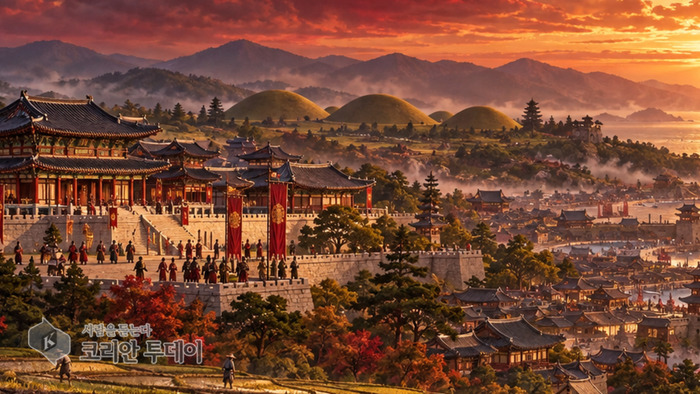
A name is the oldest brand there is. The word “Silla” (新羅) was chosen in a court debate in the year 503, when Europe’s new Germanic kingdoms were still deciding what kind of states they would be.
According to the Samguk Sagi, in the fourth year of King Jijeung’s reign (503 CE), ministers proposed that the kingdom’s name be fixed as “Silla” and that its ruler adopt the Chinese-style title of “wang” (king) in place of the native title “maripgan.” The names we now treat as natural were, in that moment, a deliberate act of statecraft.
How did a man who took the throne at 64 manage, in under fifteen years, to ban human sacrifice, promote plowing with oxen, reorganize provincial government and bring an island kingdom under control? And what does the Frankish king Clovis, building his own state at the same moment, tell us about this wave of early state-making?
🌍 Western Historical Parallel
Jijeung reigned 500-514. In those same years Clovis (r. 481-511) united the Franks, made Paris his base around 508, and a Frankish law code (the Salic Law) was compiled in his time. Both rulers turned a loose warrior polity into a state by combining a new identity, written rules and administrative reach. Silla, however, did it with a Chinese-style royal title, while the Franks leaned on Roman Christian legitimacy.
◆ The Ancient Landscape
Throughout the fifth century Silla, in the southeast of the Korean peninsula, lived under strong Goguryeo influence. By 500, when Jijeung took the throne, the state was still written with several variants of its name (Saro, Sara, Silla), and its kings bore the title “maripgan,” generally understood to be a native Silla word.
The Samguk Sagi records a steady sequence: in 502 a ban on burying people alive with the dead and the first use of ox plowing; in 503 the new name and royal title; in 505 the organization of provinces, commanderies and counties, with Silcheok province (near today’s Samcheok) placed under Isabu as its first military governor; in 509 the opening of an eastern market in the capital; in 512 the submission of Usan-guk (today’s Ulleung Island); and in 514 the king’s death, when the posthumous name “Jijeung” was first used.
“[He] issued an order forbidding burial of the living with the dead, and for the first time used oxen for plowing.” And later: “Now the assembled ministers, of one mind, respectfully offer the title ‘King of Silla’.” (paraphrased translation)
◆ Same Era, Different Worlds
🏛️ China
The Northern and Southern Dynasties era (long before the Sui and Tang). The Liang dynasty was founded in 502 in the south, while the Northern Wei carved Buddhist cave temples at Yungang and Longmen.
🗿 Byzantine Empire
Emperor Anastasius I (r. 491-518) ruled Constantinople; Justinian was still a generation away from his reign (527).
⚔️ Western Europe
Successor kingdoms of the fallen Western Empire: the Franks under Clovis, the Ostrogoths under Theodoric in Italy, the Visigoths in Iberia.
🕌 Islamic World
Not yet in existence: Muhammad was born around 570, so the caliphates were more than a century away. Arabia was then a landscape of tribes and caravan cities.
[Image: Key reforms of King Jijeung’s reign, 500-514 CE]
⚔️ Scene from That Day
“Summer, 512. The East Sea is rough. Isabu’s warships reach the cliffs of Usan-guk, whose people trust their steep coast and violent currents. He orders his men to fill the ships with carved wooden lions.”
“‘Submit, or I will release these beasts and trample you all.’ The Samguk Sagi says the islanders, terrified, surrendered at once: a victory won without drawing a sword, closer to the stratagem of the Trojan Horse than to a Roman legion’s assault. Details of the story come from later records and carry the flavor of legend.”
◆ Uncovering Historical Truth
The Samguk Sagi explains the name “Silla” as meaning that virtue and works grow new each day (新) and that the realm spreads its net over all four directions (羅). It was a vision statement, not merely a label. Likewise, replacing “maripgan” with “wang” signaled a shift from the chief of a confederation of elites to a monarch in the East Asian imperial tradition, much as Germanic rulers borrowed Roman titles and trappings to claim legitimacy.
Inscribed stones give a rare firsthand view. The Naengsu-ri Stele, discovered in 1989 in Pohang and now a Korean national treasure, is dated to about 503 and records a ruling in a property dispute, evidence of a working rule-based government. Its text still reads as “Sara” (斯羅), while the Bongpyeong Stele of 524 uses “Silla” (新羅), a reminder that the new name settled in gradually. Think of such stelae as Silla’s counterpart to Anglo-Saxon charters, rather than the grave goods of Sutton Hoo.
The ban on human sacrifice and the promotion of ox plowing were two pillars of reform. Ending the burial of retainers preserved labor and tied royal authority to a more humane image, while oxen raised farm output. Add the 505 provincial reorganization and the 509 market, and you can see the skeleton of a centralized state, something closer to a bureaucratic empire than to a feudal patchwork of Western Europe’s local lords.
Period
Early 6th century CE (500-514)
Key Figures
King Jijeung; General Isabu
Key Events
Name and title fixed (503); Usan-guk submits (512)
Legacy
Foundation for King Beopheung’s legal code and Buddhism
🔍 International Academic Perspectives
Korean/Asian Scholars
Most accept the Samguk Sagi dating: ox plowing in 502, name and title in 503, and see these as the start of centralization. Some argue “for the first time” means state-sponsored adoption, since oxen may have been used earlier.
Western Historians
Scholars of early states tend to read such “founding” episodes with caution, since the Samguk Sagi was compiled in 1145, centuries later. They stress the contemporary inscriptions as the more reliable evidence, and compare Silla to other states built on borrowed prestige models.
📖 Key Terms Explained
- Silla (新羅)
- Ancient Korean kingdom, traditionally founded in 57 BCE and lasting until 935 CE, one of the Three Kingdoms. The name combines “new” (新) and “net” (羅).
- Maripgan (麻立干)
- The native Silla royal title used before 503, roughly “chief of chiefs.”
- Usan-guk (于山國)
- Island polity in the East Sea, generally identified with today’s Ulleung Island.
- Ox plowing (牛耕)
- Using cattle to pull plows, which let farmers till deeper and cover more land than hand tools.
◆ Lessons for Today’s World
Jijeung’s reforms began with naming and continued with institutions, a pattern familiar from modern nation branding, or from a union like the EU that must define who it is before it can build common rules.
But a new name alone changed little. Silla paired it with farming technology, administrative geography, a market and an end to a cruel custom. Symbols and substance have to move together if reform is to last.
| Aspect | Silla Era | Modern Parallel |
|---|---|---|
| Governance | Fixed name and royal title; provinces and counties organized | National branding; administrative reform |
| Economy | Ox plowing; the eastern market | Smart agriculture; digital marketplaces |
| Values | Ban on human sacrifice; mourning code | Human-rights-centered institutions |
[Image: From an ancient kingdom’s identity to modern Korea’s national brand]
📚 Diving Deeper
- Gyeongju Historic Areas (UNESCO World Heritage) preserve the capital where these reforms were carried out; the Naengsu-ri Stele itself was found in Pohang.
- Inscribed stelae such as Naengsu-ri play a role comparable to Anglo-Saxon legal texts, while Sutton Hoo’s rich burial offers a Western contrast to Silla’s abolition of retainer sacrifice.
- Further reading: the Encyclopedia of Korean Culture entry on King Jijeung, and the Samguk Sagi in translation; for context, the Cambridge History of China volumes on the Northern and Southern Dynasties.
The Voice of Living History
Jijeung named a state, rewrote its customs and reorganized its fields, markets and coasts. Identity is declared in words, but it becomes real only when institutions prove it.
“Renewed each day, reaching in every direction – that is how the name of Silla began.”
Previous Episode
Episode 4: In Goguryeo’s Shadow – Kings Silseong and Nulji
Next Episode
Episode 6: King Beopheung and Ichadon – Buddhism Sanctioned in Blood
The Korean Today “History Lives On” Series
The Silla Chronicle (35 Episodes)
Bridging Ancient East Asia and the Modern World
© 2025 The Korean Today. All rights reserved.
This content is based on historical facts and presents balanced academic perspectives
for international readers.
THE KOREAN TODAY × WIA CODE
이 기사의 WIA Code

WIA Code 스캐너로 비추면 인터넷 없이 발행 사실과 위·변조 여부를 확인할 수 있습니다.
휴대폰 기본 카메라로 찍으면 스캐너 안내 페이지가 열립니다 — 기사 바로 열기
움직이는 코드(스트림) 한 장에 기사 전문(사진 포함)이 담겨 있습니다 — WIA Code 스캐너로 약 33초 비추면 폰에 저장되어 인터넷 없이도 읽을 수 있습니다. Stream.mp4 도 여기서 받습니다.
WIA Code · 코리안투데이


Leave a Reply