
The government has finalized three regional hubs to lead the industrialization of quantum technology. The Ministry of Science and ICT announced that it will designate Seoul (quantum computing), Jeonnam-Gwangju (quantum communication), and the Southeastern region of Busan-Ulsan-Gyeongnam (quantum sensing) as quantum clusters.
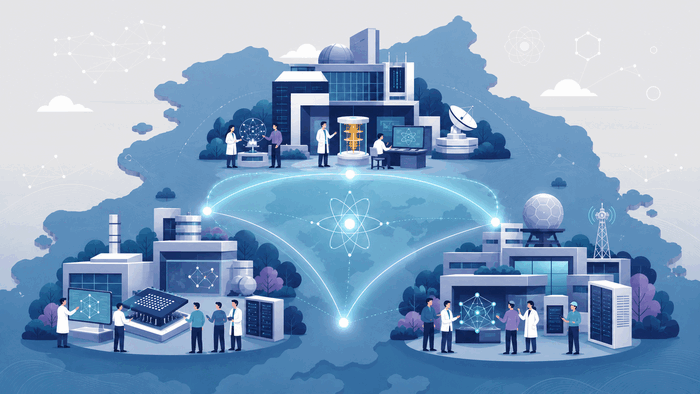 [코리안투데이] The specialized fields of the three quantum clusters designated by the Ministry of Science and ICT © 장형임 기자 |
The Ministry of Science and ICT (Deputy Prime Minister and Minister of Science and ICT Bae Kyung-hoon) announced on September 1, 2026, that, following deliberation and resolution by the Quantum Strategy Committee (chaired by the Prime Minister), it would designate Seoul, Jeonnam-Gwangju, and the Southeastern region of Busan-Ulsan-Gyeongnam as quantum clusters specialized in quantum computing, quantum communication, and quantum sensing, respectively. Contingent on Cabinet approval, the designation is a measure to support the industrialization of the quantum field—one part of the future growth engine 「7 SEED」 strategy—at the regional level.
Quantum technology is regarded as a national strategic technology that will shape future industry and national security. Recently, global competition has been shifting from securing core technologies to a race to preempt industrial ecosystems. In January, the government established the 「First Comprehensive Plan for Quantum Science, Technology and Industry Development」 and the 「First Basic Plan for Quantum Clusters」, pursuing both the acquisition of core technologies and the creation of industrial ecosystems in parallel. This cluster designation is intended to connect research achievements to companies and markets and to generate quantum use cases linked to regional specialized industries.
The Ministry conducted an open competition from April with the goal of designating three clusters, and seven regional consortiums applied. Candidates were then selected through review by the Quantum Cluster Expert Committee, consultation with relevant ministries, and on-site inspections, with the final three confirmed through deliberation and resolution by the Quantum Strategy Committee. In the selection process, in accordance with the 「Guidelines for Establishing Quantum Cluster Development Plans」, the government comprehensively reviewed quantum technology capabilities and human resource foundations, the potential for use in connection with regional industries, conditions for diffusion based on demand companies and industrial sectors, and the implementation capacity of local governments. In particular, the potential to create tangible industrial outcomes—such as the connection between the technology field chosen by a region and its specialized industries, corporate demand, and commercialization potential—was given significant weight.
The Seoul quantum computing cluster will build a utilization ecosystem linked to diverse industrial demand, including bio, finance, and AI, based on the strengths of the metropolitan area where research, corporate, and investment capabilities are concentrated. It will provide connected support from algorithm development to device packaging and productization, while pursuing industry-challenge-solving QX projects together with technology start-ups, investment, and workforce training. The technology hubs are the tentatively named Hongneung R&D Support Center and KIST.
The Jeonnam-Gwangju quantum communication cluster will use the domestic optical communication and optical device industry base to expand the quantum communication materials-parts-equipment ecosystem and establish a demonstration foundation linked to regional industries such as energy, AI, and aerospace. Based on product manufacturing and evaluation infrastructure and a demonstration network, it will demonstrate and diffuse technology while supporting companies’ quantum transition and the training of specialized personnel. The technology hubs are GIST, the Korea Photonics Technology Institute, and Gwangju Technopark.
The Southeastern quantum sensing cluster has strengths in bringing together an abundant manufacturing base and research, manufacturing, and materials-parts-equipment capabilities to lead to application on industrial sites. To convert laboratory-stage quantum sensors into systems and products, it will provide support from manufacturing to packaging, testing, certification, and on-site demonstration, and will pursue the creation of use cases linked to specialized industries such as maritime, manufacturing, and defense, as well as the quantum transition of manufacturing companies. The technology hubs are Pusan National University, UNIST, and Kyungnam College of Information & Technology’s Centum Campus.
The Ministry plans to create use cases centered on demand-company-linked quantum transition (QX) R&D so that regional development plans lead to concrete outcomes, and to strengthen the linkage of R&D results to technology transfer and commercialization. It plans to establish a system for inter-cluster cooperation and performance management so that each region’s achievements spread across the nation’s quantum industry as a whole. In addition, the central and local governments will cooperate to flesh out detailed projects and prepare an implementation plan within the year, launching full-scale project promotion from next year.
Minister Bae Kyung-hoon, vice-chair of the Quantum Strategy Committee, said, ‘Quantum technology is a core strategic technology that changes the landscape of future industry while being directly linked to national security,’ adding, ‘We will nurture these quantum clusters as a flagship model of ‘real growth,’ in which the achievements of science and technology connect to regional strengths and industries to create new markets.’ He continued, ‘The government will support each region in establishing distinctive strategies based on its industrial and research capabilities so that companies, universities, and research institutions can create outcomes together, ensuring that innovation begun in the regions leads to a new growth engine for the Republic of Korea.’ Inquiries can be directed to the Ministry’s Quantum Innovation Technology Development Division (044-202-6871).





답글 남기기