
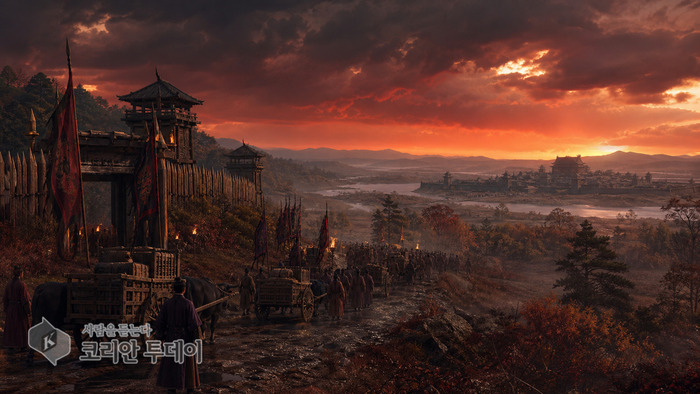
In 494 CE, Buyeo was not conquered. It walked in on its own.
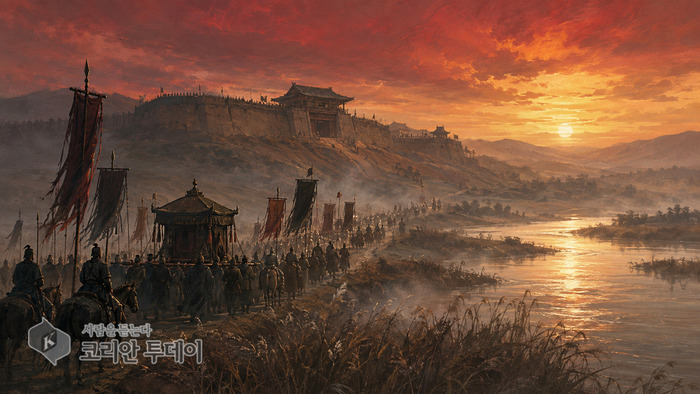
Buyeo was the longest-surviving state in Korean and Manchurian history after Gojoseon, holding its name for nearly seven centuries. Yet its final scene contains no roaring battle, no burning palace. The chronicle’s sentence is short and dry: “The King of Buyeo, together with his wife and children, brought the whole state and surrendered.” It reads less like a war record and more like a handover memo.
This was the kingdom whose founding myth both Goguryeo and Baekje claimed as their own royal origin. Why, in its final hour, did it not raise a sword? A nation that vanished through absorption rather than conquest raises a question just as relevant today: is failing to hold on really different from choosing to surrender?
🌍 Western Historical Parallel
Just 18 years before Buyeo’s surrender, in 476 CE, the Germanic warlord Odoacer deposed Romulus Augustulus, the last Western Roman Emperor, without a decisive battle — he simply pensioned the boy-emperor off. Historians mark 476 as the line between antiquity and the Middle Ages in Europe. Buyeo’s 494 surrender belongs to the same pattern: a state ending not in fire, but in a quiet handover of authority.
◆ The Ancient Landscape
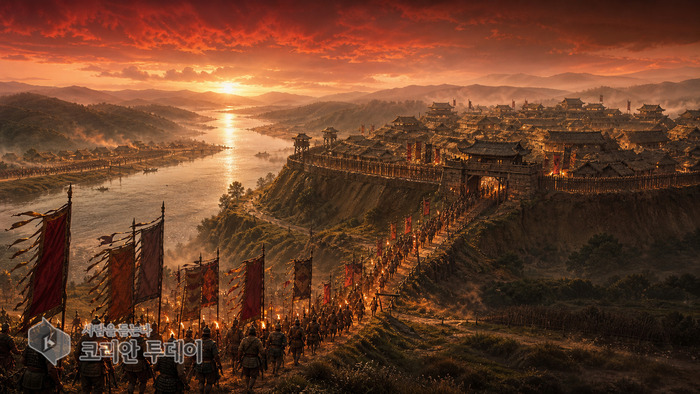
From the 4th century onward, Buyeo was struck hardest and first every time Manchuria’s power map shifted. In 346 CE, Murong Huang, ruler of the Xianbei-founded Former Yan, sent his sons to storm Buyeo. King Hyeon was captured before he could organize resistance, and some 50,000 of his people were marched off to Former Yan territory. Murong Huang co-opted Hyeon as a son-in-law and titled him a “General Who Pacifies the East” — a gesture that made clear Buyeo was no longer an independent state, but a frontier ward of a greater power.
Less than half a century later, a new power rose from the south: King Gwanggaeto of Goguryeo. In 410 CE, he personally led troops to conquer Eastern Buyeo; five aproro (ruling clan leaders) of Eastern Buyeo submitted to Goguryeo. Some surviving remnants of the old Buyeo royal line fled north instead and founded a separate small state called Dumangnu, which endured for roughly three more centuries. “Buyeo” was ceasing to mean a single kingdom and becoming the name of a people scattered across several fragments.
“The King of Buyeo, together with his wife and children, brought the whole state and came to surrender.”
◆ Same Era, Different Worlds
🏛️ China
In the very same year Buyeo surrendered, 494 CE, Emperor Xiaowen of Northern Wei moved his capital from Pingcheng to Luoyang and forced his Xianbei nobility to adopt Han Chinese dress and language — a sweeping assimilation policy unfolding across the continent at once.
🗿 Byzantine Empire
Emperor Anastasius I had ascended the Eastern Roman throne in 491 CE and was busy stabilizing an empire that, in the West, had already watched its Roman half quietly dissolve in 476.
⚔️ Western Europe
Frankish and other Germanic successor kingdoms were consolidating power across former Roman Gaul, in a landscape of shifting, absorbed, and reorganized post-Roman polities much like Manchuria’s own churn of tribal powers.
🌏 Manchurian North
Mulgil, successors of the Yeungnu people and forerunners of the later Malgal, expanded along the Songhua River, squeezing what remained of Buyeo from the north.
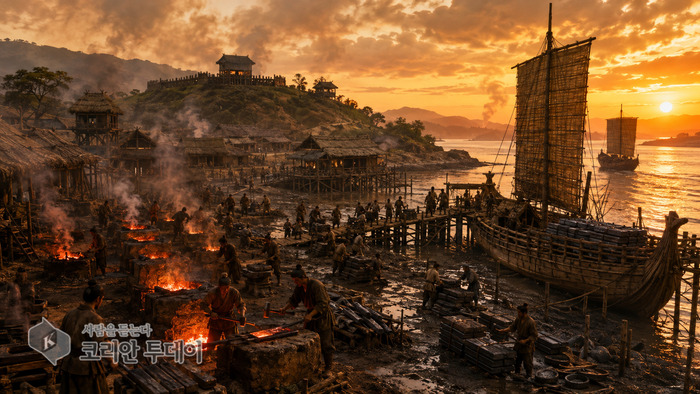
[Image: Buyeo’s territory contracting over 148 years, from the 346 Former Yan invasion to absorption by Goguryeo in 494]
⚔️ Scene from That Day
“On an autumn day in 494, the courtyard of Buyeo’s last palace held more ox-carts than soldiers. Only a handful of spearmen still guarded the gate; everyone else was packing.”
“Mulgil raiders from the northern forests had already burned several border villages. The king loaded his wife and children onto a cart and turned south, toward Goguryeo. What awaited him there was not a conqueror’s spearpoint, but a safe residence granted by King Munjamyeong. The chronicle does not even record his personal name — it calls him simply ‘the remnant king,’ the one who was left.”
◆ Uncovering Historical Truth
What makes Buyeo’s end unusual is that it was a bloodless absorption — rare among ancient state collapses. Compare it to Baekje’s fall in 660, when Tang-Silla forces stormed the capital, or Goguryeo’s own collapse in 668 after a grinding siege. Against those, the scene of 494 is strikingly quiet. Samguk Sagi records no major battle — only the single, terse line that “the whole state” surrendered.
Archaeological evidence from Buyeo’s old heartland around present-day Jilin similarly shows no large-scale destruction layer or fire damage from this period. Instead, cultural strata thin gradually before being replaced by Goguryeo-style artifacts — a pattern consistent with slow absorption of population and elites rather than an abrupt, violent break, much like how Romano-British sites show gradual Anglo-Saxon material replacing Roman goods rather than a single catastrophic layer.
Politically, Buyeo had already been unable to survive independently since the 346 Former Yan invasion. It was the fate of a buffer state caught between two rising powers: Mulgil pushing down from the northern forests along the Songhua River, and an already dominant Goguryeo to the south. For the royal house, the real choice was extinction or absorption — and choosing Goguryeo was less a surrender than a final negotiation for survival.
Period
Late 5th century (494 CE)
Key Figures
King Munjamyeong of Goguryeo, the last king of Buyeo
Key Event
Buyeo royal house surrenders and is absorbed into Goguryeo
Impact
End of roughly 700 years of Buyeo history
🔍 International Academic Perspectives
Korean/Asian Scholars
Because Samguk Sagi records no battle, most Korean historians read 494 as a peaceful absorption — the Buyeo elite choosing incorporation into Goguryeo’s protection rather than being militarily crushed.
Alternative Views
Some researchers argue Mulgil’s military pressure made the surrender effectively coerced. Others note that not all Buyeo refugees were absorbed — some fled north and founded Dumangnu, which survived roughly three more centuries until Balhae’s King Mu annexed it in 726 — cautioning against describing Buyeo’s “end” as total.
📖 Key Terms Explained
- Buyeo (夫餘)
- Ancient state in Manchuria and northern Korea (c. 4th-3rd century BCE – 494 CE), regarded as the ancestral kingdom of both Goguryeo and Baekje royal houses.
- Mulgil (勿吉)
- A Tungusic forest people of the Songhua River basin, successors to the earlier Yeungnu and forerunners of the later Malgal (and ultimately the Jurchen).
- Dumangnu (豆莫婁)
- A successor state founded around 410 CE by Buyeo remnants who fled north; it survived until conquered by Balhae’s King Mu in 726 CE.
◆ Lessons for Today’s World
We are used to seeing a decades-old family business quietly take down its own sign one day and put up a conglomerate’s logo instead. It is not defeat by a competitor — it is a founder recognizing that the entire market has shifted beneath them, and signing the acquisition papers themselves. What disappears in that moment is the signage, not the people, the know-how, or the loyal customers’ memory of the place.
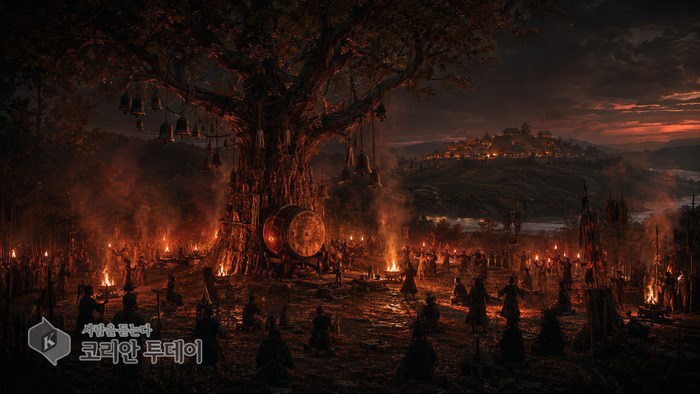
Buyeo’s 494 was much the same. The name vanished from the map, but its founding myth and royal lineage were claimed by both Goguryeo and Baekje as their own origin, and a portion of its people carried the name Dumangnu for three more centuries. Buyeo’s ending shows that a smaller polity does not only vanish by conquest — it can also choose, deliberately, to walk into a larger system.
| Aspect | Buyeo & Samhan Era | Modern Parallel |
|---|---|---|
| Geopolitics | A buffer state’s fate, squeezed between Mulgil in the north and Goguryeo in the south | Smaller states deepening alliance dependence amid great-power security dilemmas |
| Military/Diplomacy | Loss of independent military strength, survival chosen through diplomatic absorption | Choosing merger and strategic integration over standalone survival |
| Culture/Spirit | National name disappears, but founding myth passes on as successor royal legitimacy | A brand disappears, but its technology, people, and culture persist under new ownership |
[Image: Buyeo’s absorption illustrated as a modern corporate merger and acquisition]
📚 Diving Deeper
- Excavations of Buyeo-related fortress sites and tomb clusters around present-day Jilin, China continue, focusing on the abrupt cultural-layer shifts around 346 CE.
- Dumangnu, founded by fleeing Buyeo remnants, endured roughly three centuries before being annexed by Balhae’s King Mu in 726 CE.
- Northeast Asian History Foundation research on “Mulgil’s Expansion into Buyeo and Dumangnu in the 5th-6th Centuries” remains a key study of this northern Manchurian power shift.
The Voice of Living History
A nation’s end need not be written in fire and clamor. What Buyeo left behind after seven centuries was not a record of defeat, but a record of a choice made to survive.
“The sign came down, but the story walked into the next dynasty’s founding myth.”
Previous Episode
Episode 5: The Fallen Capital, the Reclaimed Kingdom – The Restoration of Kings Uiryeo and Uira
Next Episode
Episode 7: From Jinguk to Samhan – The Scattered States of the Southern Peninsula
The Korean Today “History Lives On” Series
The Buyeo & Samhan Chronicle (13 Episodes)
Bridging Ancient East Asia and the Modern World
© 2025 The Korean Today. All rights reserved.
This content is based on historical facts and presents balanced academic perspectives
for international readers.
THE KOREAN TODAY × WIA CODE
이 기사의 WIA Code

WIA Code 스캐너로 비추면 인터넷 없이 발행 사실과 위·변조 여부를 확인할 수 있습니다.
휴대폰 기본 카메라로 찍으면 스캐너 안내 페이지가 열립니다 — 기사 바로 열기
움직이는 코드(스트림) 한 장에 기사 전문(사진 포함)이 담겨 있습니다 — WIA Code 스캐너로 약 23초 비추면 폰에 저장되어 인터넷 없이도 읽을 수 있습니다. Stream.mp4 도 여기서 받습니다.
WIA Code · 코리안투데이


Leave a Reply