

For seven centuries, Goguryeo never once bowed to a Chinese emperor as the “Son of Heaven.” It claimed that title for its own kings.
Rising from the mountainous middle reaches of the Yalu River, Goguryeo eventually stretched across Manchuria and northern Korea, sharing borders with nomadic steppe powers to the north and unified Chinese empires to the west. Small states wedged between great powers usually pick one of two paths: submit quietly, or make themselves strong enough to refuse. Goguryeo chose the latter.
How many kingdoms of its size twice defeated the mightiest empires of their age, Sui and Tang China? The answer was not raw manpower. It was a mindset — one that historians now call Goguryeo’s martial spirit and independent worldview.
🌍 Western Historical Parallel
When King Gwanggaeto declared his own era name in 391 CE rather than use a Chinese one, Rome had already split in two, and the Western Empire was just decades from collapse (476 CE). Much as the Byzantine Empire later insisted it — not the Germanic kingdoms of the West — was the true heir of Rome, Goguryeo insisted it was the true center of its own heaven-sanctioned world order, not a subordinate of any Chinese dynasty.
◆ The Ancient Landscape
When Gwanggaeto ascended the throne in 391 CE, he immediately proclaimed his own era name, “Yeongnak” (永樂, “Eternal Joy”) — refusing to date his reign by any Chinese emperor’s calendar. Known in his lifetime as “the Great King Yeongnak,” he spent 22 years crushing the Later Yan, seizing the Liaodong region, subjugating the Khitan and Sushen peoples, and drawing Baekje, Silla, and Dongbuyeo into his sphere of influence.
His son, King Jangsu, went further still. The Stele of King Gwanggaeto, erected in his honor, frames Goguryeo as a kingdom founded by descendants of Heaven, with neighboring states cast as tributary subjects within Goguryeo’s own world order — not a copy of China’s Sinocentric worldview, but a Goguryeo-centered one. Two centuries later, that same self-regard was what General Eulji Mundeok and the nameless defenders of Ansi Fortress were willing to die for.
“Your divine plans have fathomed the heavens, your subtle calculations have spanned the earth. Your battles have won you great merit already — is it not time you knew when to stop?”
◆ Same Era, Different Worlds
🏛️ China
The 5th century was an age of division (Northern and Southern Dynasties); the 7th saw Sui and Tang re-emerge as unified superpowers Goguryeo faced head-on.
🗿 Byzantine Empire
After Rome’s fall in the West (476 CE), Constantinople alone carried the imperial claim, much as Goguryeo alone claimed heavenly sanction in the East.
⚔️ Western Europe
Frankish and Germanic kingdoms were forming out of Rome’s wreckage, each staking its own claim to legitimacy — a pattern of fragmented sovereignty Goguryeo resisted by staying unified.
🌏 Japan
The Yamato court was consolidating a unified state and absorbing Goguryeo’s culture and Buddhism.
[Image: Goguryeo’s mountain fortress defense network and its symbol, the mounted warrior]
⚔️ Scene from That Day
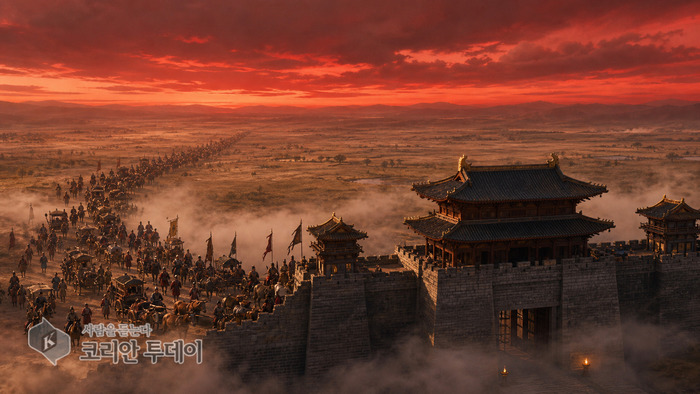
“Summer, 645 CE. Atop the walls of Ansi Fortress, the banners of a 200,000-strong army led personally by Emperor Taizong of Tang covered the plain below. The garrison hadn’t slept properly in two months.”
“The fortress commander drew his bow atop the wall. Soldiers, elders, even children hauled stone and packed earth to reinforce the walls. Eighty-eight days later, the army once thought unstoppable turned back. History barely recorded the commander’s name — but it recorded, in full, that the wall held.”
◆ Uncovering Historical Truth
Goguryeo’s martial spirit was not improvised in wartime — it was cultivated through ritual. Every October, the entire kingdom celebrated Dongmaeng (東盟), a nationwide festival centered on sacrifice to the spirit of a great cave east of the capital. Feasting, singing, and dancing were paired with archery and martial contests — worship and warrior training fused into a single sacred occasion, roughly comparable to how Roman military festivals blended religious observance with displays of martial prowess.
Youths trained at Gyeongdang (扃堂), local academies built across the capital and provincial cities, where they studied Confucian classics alongside archery and military drills — a fusion of scholarship and swordsmanship not unlike the ideal knight-scholar later imagined in medieval European chivalry, though Goguryeo’s version was embedded in a kingdom-wide defense network of mountain fortresses.
This ethos translated directly into foreign policy defiance. Gwanggaeto’s independent era name and heaven-sanctioned worldview were a refusal to accept a Sinocentric order, and two centuries later that same defiance became battlefield fact. At the Battle of Salsu (612 CE), only 2,700 of a reported 300,000 Sui soldiers made it home. At Ansi Fortress (645 CE), Emperor Taizong’s personally led invasion force withdrew after an 88-day siege. Both opponents were the largest unified empires of their age.
Period
Late 4th – mid 7th century CE
Key Figures
King Gwanggaeto, General Eulji Mundeok
Key Events
Battle of Salsu (612), Siege of Ansi (645)
Legacy
Independent worldview, self-reliant defense
🔍 International Academic Perspectives
Korean/Asian Scholars
Korean historians point to Goguryeo’s independent era name and heaven-sanctioned worldview as proof it operated as a sovereign power on equal footing with China, not a subordinate state.
Contested Framing
China’s “Northeast Project” (Dongbei Gongcheng) has attempted to recast Goguryeo as a regional government under Chinese dynasties — a framing most international historians reject, citing its 700-year continuity and independent institutions.
📖 Key Terms Explained
- Goguryeo (고구려)
- Ancient Korean kingdom (c. 37 BCE – 668 CE), the northernmost of Korea’s Three Kingdoms, spanning Manchuria and the northern Korean peninsula.
- Yeongnak (永樂)
- “Eternal Joy” — King Gwanggaeto’s independent era name, declared in 391 CE instead of using a Chinese emperor’s calendar.
- Sui and Tang Dynasties
- Chinese unified empires (581-618 CE and 618-907 CE) that each launched major invasions of Goguryeo and were repelled.
◆ Lessons for Today’s World
A state without overwhelming resources or population that still survives beside superpowers needs discipline, organization, and above all self-respect — the conviction that it can chart its own course. That is exactly what Goguryeo demonstrated. It was not raw power but the direction of a nation’s will that decided its fate.
South Korea’s rise in semiconductors, defense manufacturing, sports, and cultural exports is not a rootless accident. It resembles, again and again, the historical experience of a peninsula nation carving its own path between great powers.
| Aspect | Goguryeo Era | Modern Parallel |
|---|---|---|
| Politics/Security | Independent era name and worldview asserting sovereignty | Domestic defense industry and diversified diplomacy for self-reliant security |
| Military | Mountain fortress network, dual scholar-warrior education at Gyeongdang | Advanced defense exports (e.g., K9 self-propelled howitzers) |
| Culture | Martial and pioneering spirit expressed through the Dongmaeng festival | K-Defense, and a broader challenger mindset across sports and industry |
[Image: How Goguryeo’s martial and independent spirit flows into modern Korea]
📚 Diving Deeper
- The Stele of King Gwanggaeto, standing over 6 meters tall in present-day Ji’an, China, bears 1,775 inscribed characters — one of East Asia’s largest surviving monumental inscriptions.
- Eulji Mundeok’s “Poem to Sui General Yu Zhongwen” is considered the oldest surviving Korean poem in the five-character classical Chinese verse form.
- The commander of Ansi Fortress is not named in official histories; the name “Yang Manchun” comes from later, less certain sources.
The Voice of Living History
Goguryeo defined its own time, its own worldview, and its own fate even in the shadow of superpowers. That self-respect and martial spirit still runs through us today.
“Is it not time you knew when to stop? — Eulji Mundeok’s words were not surrender. They were a warning.”
Previous Episode
Episode 37: Goguryeo’s International Relations – East Asia’s Balancer
Next Episode
Episode 39: Lessons of Goguryeo History – Glory and Downfall
The Korean Today “History Lives On” Series
The Goguryeo Chronicle (40 Episodes)
Bridging Ancient East Asia and the Modern World
© 2025 The Korean Today. All rights reserved.
This content is based on historical facts and presents balanced academic perspectives
for international readers.
THE KOREAN TODAY × WIA CODE
이 기사의 WIA Code

WIA Code 스캐너로 비추면 인터넷 없이 발행 사실과 위·변조 여부를 확인할 수 있습니다.
휴대폰 기본 카메라로 찍으면 스캐너 안내 페이지가 열립니다 — 기사 바로 열기

움직이는 코드는 스트림입니다 — WIA Code 스캐너로 약 23초 비추면 기사 전문(사진 포함)이 폰에 저장되어 인터넷 없이도 읽을 수 있습니다.
WIA Code · 코리안투데이





Leave a Reply