

Two superpowers, one steppe empire, two peninsular rivals, and an island power across the sea. A kingdom that survived 700 years faced all five at once.
From 37 BCE to 668 CE, Goguryeo lived through China’s unifications and fragmentations, shifting hegemons on the Mongolian steppe, rivalry among Korea’s Three Kingdoms, and a push-and-pull relationship with the Japanese archipelago. It never fully submitted to one power, nor did it fight everyone at once. When useful, it paid tribute and accepted investiture titles. When necessary, it struck first, deep into enemy territory.
How does a kingdom wedged between great powers survive for seven centuries? It is not so different from the question 21st-century South Korea asks daily, caught between the United States, China, Japan, and Russia.
🌍 Western Historical Parallel
While Goguryeo repelled Tang China’s armies at the fortress of Ansi in 645, the Byzantine Empire under Heraclius was locked in its own existential struggle against Sassanid Persia — both frontier states absorbing the shock of a would-be universal empire.
◆ The Ancient Landscape
While China was fractured into the Sixteen Kingdoms and then the Northern and Southern Dynasties (4th–6th century), Goguryeo maintained tributary ties with multiple Chinese courts simultaneously, never fully beholden to any single one. When the Northern Wei unified northern China and grew assertive, Goguryeo allied with the Rouran Khaganate on the steppe to check it — a partnership so well known that in 472 Baekje’s letter to the Northern Wei explicitly referenced the Goguryeo-Rouran alignment.
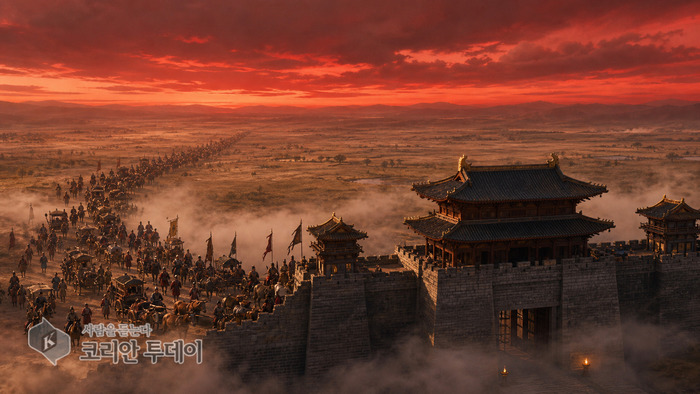
In 598, King Yeongyang launched a preemptive strike into Liaoxi with Malgal auxiliaries; Sui Emperor Wen’s retaliatory force of 300,000 was decimated. In 612, Sui Emperor Yang mobilized roughly 1.13 million troops, only for general Eulji Mundeok to annihilate them at the Salsu River (the Battle of Salsu). In 645, Tang Taizong’s army besieged the fortress of Ansi for three months and was forced to withdraw. Yet repeated wars drained the kingdom, and in 668, the combined forces of Tang and Silla took Pyongyang, ending Goguryeo.
“Your uncanny strategy has fathomed the heavens; your subtle calculations have exhausted the earth. Your victories in battle have already earned you great merit — knowing when enough is enough, I hope you will now cease.”
◆ Same Era, Different Worlds
🏛️ China
The Sui (581–618) and then Tang (618–907) reunified China and expanded outward — Goguryeo stood as the first sustained resistance to that expansion.
🗿 Byzantine Empire
Under Justinian (527–565) and Heraclius (610–641), Byzantium fought grinding wars against Sassanid Persia to its east.
⚔️ Western Europe
The Merovingian Frankish kingdoms were consolidating power in a post-Roman patchwork of successor states.
🕌 Islamic World
By the mid-7th century, the early Caliphate was expanding rapidly out of Arabia, just as Goguryeo made its last stand against Tang.
[Image: Goguryeo at the center of a five-way regional relations map]
⚔️ Scene from That Day
“July 612. Morning mist lifts off the Salsu River. As the retreating vanguard of the Sui army reaches midstream, a dam quietly built upriver breaks open.”
“Eulji Mundeok had already lured the enemy to the gates of Pyongyang through repeated feigned surrenders and staged retreats. Of the 300,000-strong Sui vanguard, starved of supplies, the chronicles record that barely 2,700 made it home — a defeat as decisive as Cannae, on Korean soil.”
◆ Uncovering Historical Truth
The essence of Goguryeo’s diplomacy was not neutrality but asymmetric pragmatism. During China’s Northern-Southern Dynasties split, Goguryeo paid tribute to both the southern Song, Qi, Liu Song courts and the northern Wei, accepting investiture from each without severing ties with the other — not unlike a modern middle power maintaining channels with rival blocs simultaneously. When the Northern Wei grew too strong, Goguryeo turned to the Rouran Khaganate on the steppe as a counterweight, playing one power against another rather than confronting either alone.
Once China reunified under Sui and Tang, leaving no rival power to court, Goguryeo’s strategy shifted to direct confrontation: the 598 preemptive strike into Liaoxi, the 612 victory at Salsu, and the 645 defense of Ansi Fortress all replaced negotiation with military resistance. But this resistance was itself a war of attrition. Compounded by internal strife after the death of strongman Yeon Gaesomun, the kingdom’s exhausted resources finally gave way in 668, when the combined Tang-Silla army breached Pyongyang.
On the peninsula, Gwanggaeto the Great and his son Jangsu pressed a southward expansion policy against Baekje, Silla, and Gaya. Jangsu’s move of the capital to Pyongyang in 427 and the fall of Baekje’s capital Hanseong in 475 — with King Gaero’s death — showed that even the Silla-Baekje alliance of 433 could not hold the line. Yet in 400, Gwanggaeto had also repelled a joint Wa-Gaya-Baekje invasion of Silla, cementing Goguryeo’s influence over the southern peninsula. The Gwanggaeto Stele records that campaign — and later became the epicenter of the controversial “Mimana Nihonfu” debate. Culturally, the monk Hyeja in 595 and Damjing around 610 traveled to Japan, transmitting Buddhism, painting, and papermaking that helped shape the Asuka culture — military tension and cultural exchange running in parallel, much like neighboring states today.
Period
4th century – 668 CE
Key Figures
Gwanggaeto, Jangsu, Yeongyang, Eulji Mundeok
Key Events
Battle of Salsu (612), Siege of Ansi (645)
Legacy
Fulcrum of East Asian balance of power
🔍 International Academic Perspectives – The 391 CE “Sinmyo Year” Inscription
Earlier Japanese Scholarship
Read as stating that Wa crossed the sea in 391 and subjugated Baekje and Silla — once cited as evidence for the “Mimana Nihonfu” theory of Japanese rule over southern Korea.
Korean and Recent International Scholarship
Since Jeong In-bo’s 1930s reparsing of the text, and more recent forensic study of the stone confirming no tampering, focus has shifted to reading the passage as Goguryeo’s own rhetorical self-glorification rather than literal fact.
📖 Key Terms Explained
- Goguryeo (고구려)
- Ancient Korean kingdom (37 BCE – 668 CE), the northernmost of Korea’s Three Kingdoms, controlling much of Manchuria and the northern peninsula
- Investiture (책봉, cefeng)
- A Chinese-centered diplomatic ritual in which a Chinese emperor formally recognized a neighboring ruler’s title — accepted pragmatically, not as real subordination
- Wa (倭)
- Classical Chinese/Korean term for the polities of the Japanese archipelago, generally associated with the Yamato court
◆ Lessons for Today’s World
Goguryeo’s oldest lesson is that alliances are variables, not constants. Its partnership with the Rouran, pressure on the Silla-Baekje pact, and simultaneous cultural exchange and military conflict with Wa all coexisted — much as 21st-century South Korea navigates a layered environment that no single relationship can fully explain.
Amid US-China strategic competition, the push-and-pull of Korea-Japan relations, and variables involving Russia and North Korea, what Korea today calls “middle-power diplomacy” and “pragmatism” echoes the survival grammar Goguryeo practiced for seven centuries: acknowledge power without submitting to it, fight decisively when you must, but never close the door to negotiation.
| Aspect | Goguryeo Era | Modern Parallel |
|---|---|---|
| Geopolitics | Multilateral tribute during China’s disunity; direct resistance once China reunified | Dual-track security and economic policy amid US-China rivalry |
| Military/Diplomacy | Alliance with the Rouran to counterbalance the Northern Wei | Anchoring the US-Korea alliance while diversifying diplomatic channels |
| Culture | Transmitting Buddhism and craft to Wa even amid military tension | K-Culture soft power paired with pragmatic security policy |
[Image: How Goguryeo’s balance-of-power grammar carries into modern Korean middle-power diplomacy]
📚 Diving Deeper
- The Gwanggaeto Stele in Ji’an, Jilin Province, China — a 1,775-character inscription, one of East Asia’s most important primary sources on 4th-5th century international relations
- Eulji Mundeok’s “Poem Sent to Sui General Yuzhongwen” — considered the oldest surviving Korean poem
- The Kondo (Golden Hall) murals of Horyu-ji Temple, Japan — traditionally attributed to the Goguryeo monk Damjing, an icon of Asuka-period culture
The Voice of Living History
Goguryeo endured 700 years beside empires far larger than itself. Its secret was neither reckless isolation nor blind submission, but pragmatism calibrated to each moment.
“Knowing when enough is enough, I hope you will now cease” — Eulji Mundeok’s words to a defeated general were the voice of a kingdom that understood power without ever kneeling to it.
Previous Episode
Episode 36: Studying Goguryeo – Perspectives from North and South
Next Episode
Episode 38: The Goguryeo Spirit – Martial Ethos and Worldview
The Korean Today “History Lives On” Series
The Goguryeo Chronicle (40 Episodes)
Bridging Ancient East Asia and the Modern World
© 2025 The Korean Today. All rights reserved.
This content is based on historical facts and presents balanced academic perspectives
for international readers.
THE KOREAN TODAY × WIA CODE
이 기사의 WIA Code

WIA Code 스캐너로 비추면 인터넷 없이 발행 사실과 위·변조 여부를 확인할 수 있습니다.
휴대폰 기본 카메라로 찍으면 스캐너 안내 페이지가 열립니다 — 기사 바로 열기

움직이는 코드는 스트림입니다 — WIA Code 스캐너로 약 24초 비추면 기사 전문(사진 포함)이 폰에 저장되어 인터넷 없이도 읽을 수 있습니다.
WIA Code · 코리안투데이





Leave a Reply