
One nation’s history, told two different ways — that is the story of Goguryeo studies in a divided Korea today.
Nearly eighty years of division have split a single field of study into two. North Korean scholars can physically walk the sites around present-day Pyongyang and Nampo, while South Korean researchers can only access most Goguryeo remains through photographs, texts, and limited international academic exchange. Read the same ancient chronicle, and where you place the emphasis changes the face of the kingdom itself.
Can these two traditions of scholarship ever meet again — with unification, or even without it? In August 2026, as inter-Korean relations remain frozen once more, the question feels more urgent than ever, and offers a useful lens for any reader who has watched a divided nation argue over a shared past.
🌍 Western Historical Parallel
The split is not unlike what happened to German historiography during the Cold War: East German scholars wrote a Marxist-inflected national history centered on their own accessible archives, while West German historians worked from a different documentary base and framework. Reunification in 1990 forced a slow, still-unfinished reconciliation of the two narratives — a preview of what Korean historians may face if the peninsula ever reunites.
◆ The Ancient Landscape
Goguryeo moved its capital three times. In 37 BCE, King Jumong founded the kingdom at Jolbon (Onyeosan Fortress, near today’s Huanren, Liaoning, China). In 3 CE, King Yuri moved the court to Guknaeseong (near today’s Ji’an, Jilin, China). Finally, in 427 CE, King Jangsu relocated the capital to Pyongyang, opening a new chapter of southward expansion. Pyongyang remained the heart of the kingdom for over 240 years, until Goguryeo fell in 668 CE.
Here is the problem for today’s researchers: Jolbon and Guknaeseong now sit inside China, while Pyongyang lies in North Korea. Not a single one of Goguryeo’s three capitals is directly accessible to South Korean scholars. Goguryeo studies, from the outset, cannot avoid being a matter of borders and ideology.
“In the fifteenth year, the capital was moved to Pyongyang.”
◆ Same Era, Different Worlds
🏛️ China
China was fragmented into the Northern and Southern Dynasties around the time of the Pyongyang move, later unified under the Sui and Tang, which brought it into direct conflict with Goguryeo.
🗿 Byzantine Empire
Emperor Justinian sought to restore the old borders of Rome, while the Sassanid Persians fought Byzantium in a long war of attrition.
⚔️ Western Europe
Merovingian Francia was consolidating power in Western Europe, laying groundwork for what would later become the Carolingian world.
🕌 Islamic World
By the time Goguryeo fell in 668, the early Islamic Caliphate had already begun its rapid expansion out of the Arabian Peninsula.
(Image: Jolbon, Guknaeseong, and Pyongyang — Goguryeo’s shifting capitals mapped onto today’s borders)
⚔️ Scene from That Day
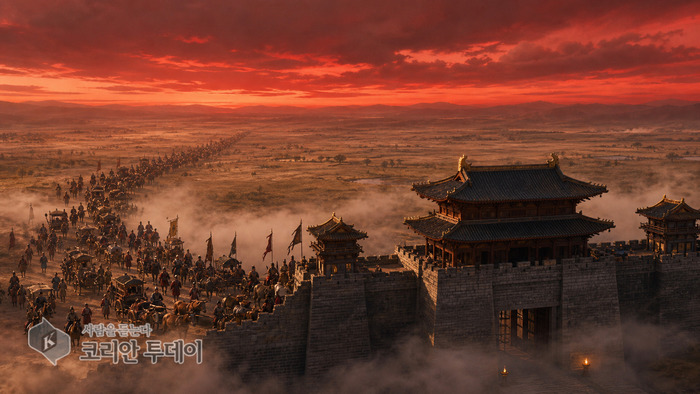
“In 427, the procession leaving Guknaeseong took days to pass. Officials, soldiers, artisans, and commoners loaded ox-carts with their belongings and moved steadily south, toward a new capital whose walls still smelled of raw earth.”
“Nearly 1,580 years later, in the winter of 2006, a joint North-South survey team stepped together into the burial chamber of the Great Tomb of Gangseo. As their flashlights swept across the Azure Dragon, White Tiger, Vermilion Bird, and Black Tortoise painted on the walls, a South Korean researcher — who had only ever seen the murals in photographs — stood speechless for a long moment.”
◆ Uncovering Historical Truth
Division severed access to the sites first. North Korea can directly excavate and study sites around Pyongyang and Nampo — the Great Tomb of Gangseo, Daeseongsan Fortress, the ruins of Anhak Palace. But Guknaeseong, Hwando Mountain Fortress, and the stele of King Gwanggaeto, all near present-day Ji’an, sit in China’s Jilin Province, largely out of reach for both South and North Korean scholars alike. Each side has, in effect, written Goguryeo’s history from the ground it could actually stand on.
Since the 1990s, North Korean academia has promoted the “Daedonggang Culture Theory,” centered on the Pyongyang region. It designates the Daedong River basin as one of the world’s five great cradles of civilization and pushes Goguryeo’s founding date back from 37 BCE to as early as 277 BCE. South Korean scholars generally read this as an attempt to cast Goguryeo as a “thousand-year power” descended from the earlier kingdom of Gojoseon — a narrative closely tied to North Korea’s Juche-based historiography.
South Korean scholarship, meanwhile, sharpened its emphasis on evidence-based methodology in response to China’s Northeast Project, launched in 2002. In March 2004, the government established the Goguryeo Research Foundation; it was absorbed into the Northeast Asian History Foundation in September 2006, which remains the central institution countering historical distortions in the region today. For sites inside China, like Guknaeseong and Hwando Fortress, South Korean researchers still depend on limited academic exchange with Chinese counterparts, satellite imagery, and published Chinese field reports.
Period
Goguryeo’s three-capital era, 37 BCE – 668 CE
Key Institutions
North: Institute of Archaeology, Academy of Social Sciences / South: Northeast Asian History Foundation
Key Event
2004 joint UNESCO inscription of Goguryeo tombs, North and China
Impact
A divided scholarship, and the task of reintegration after unification
🔍 International Academic Perspectives
Mainstream View
Mainstream Korean and international scholarship follows the Samguk Sagi’s 37 BCE founding date, cross-checking textual sources against archaeological evidence as a matter of method.
Alternative View
North Korea’s Daedonggang Culture Theory pushes the founding date back to 277 BCE; South Korean and Western historians largely regard this as a politically motivated interpretation rather than a consensus academic finding.
📖 Key Terms Explained
- Guknaeseong (國內城)
- Goguryeo’s second capital (3-427 CE), located near present-day Ji’an, Jilin Province, China
- Daedonggang Culture Theory
- A North Korean historiographical framework, developed from the 1990s, that positions the Daedong River basin as a major cradle of civilization and pushes Goguryeo’s origins earlier than commonly accepted
◆ Lessons for Today’s World
In 2006 and 2007, North and South Korean teams actually did survey the condition of North Korea’s Goguryeo mural tombs together, including the Great Tomb of Gangseo. That cooperation, achieved even amid deep political tension, suggests the bridge between the two scholarly traditions is not permanently broken — only temporarily down.
If unification ever comes, Goguryeo studies may be among the first fields to reunite. Field data from Pyongyang combined with the evidence-based methods of international scholarship could finally open the door to joint research on Guknaeseong and Hwando Fortress, sites that today belong to neither Korea. Academic freedom, in the end, is only complete once it crosses political borders.
| Aspect | Goguryeo Era | Modern Parallel |
|---|---|---|
| Geopolitics | A Pyongyang-centered defense system balanced among the Three Kingdoms and Sui-Tang China | A divided Korea, each side claiming historical legitimacy through a different reading of Goguryeo |
| Military/Diplomacy | Relocating from Guknaeseong to Pyongyang to reorganize defenses along the Liaodong-peninsula line | Guknaeseong and Hwando Fortress, now on Chinese soil, turning scholarly access into a diplomatic issue |
| Culture/Spirit | A martial ethos paired with an open, pluralistic worldview | The possibility of cooperation, glimpsed in the joint 2004 UNESCO inscription |
(Image: A bridge of academic exchange linking North and South Korean Goguryeo research)
📚 Diving Deeper
- The Four Guardian Deities mural in the Great Tomb of Gangseo — UNESCO-listed in 2004, surveyed jointly by North and South Korean teams in 2006-2007
- Guknaeseong and Hwando Mountain Fortress, near present-day Ji’an, Jilin — home to the stele of King Gwanggaeto and the General’s Tomb
- The Northeast Asian History Foundation’s “3D Virtual Exhibition of Goguryeo Tomb Murals,” a workaround South Korean researchers use in place of direct site access
The Voice of Living History
Goguryeo was one kingdom, but the scholars who study it today are two. Yet that winter morning in 2006, when North and South Korean researchers stood together before the murals of the Great Tomb of Gangseo, proved that scholarship can build a bridge before politics ever does.
“From Jolbon to Guknaeseong, from Guknaeseong to Pyongyang — Goguryeo always moved forward across borders. That same spirit is being asked for again, at the border now drawn through scholarship itself.”
Previous Episode
Episode 35: Visiting Goguryeo’s Ruins – Encountering History on Site
Next Episode
Episode 37: Goguryeo’s International Relations – Balancer of East Asia
The Korean Today “History Lives On” Series
The Goguryeo Chronicle (40 Episodes)
Bridging Ancient East Asia and the Modern World
© 2025 The Korean Today. All rights reserved.
This content is based on historical facts and presents balanced academic perspectives
for international readers.
THE KOREAN TODAY × WIA CODE
이 기사의 WIA Code

WIA Code 스캐너로 비추면 인터넷 없이 발행 사실과 위·변조 여부를 확인할 수 있습니다.
휴대폰 기본 카메라로 찍으면 스캐너 안내 페이지가 열립니다 — 기사 바로 열기

움직이는 코드는 스트림입니다 — WIA Code 스캐너로 약 23초 비추면 기사 전문(사진 포함)이 폰에 저장되어 인터넷 없이도 읽을 수 있습니다.
WIA Code · 코리안투데이






Leave a Reply