
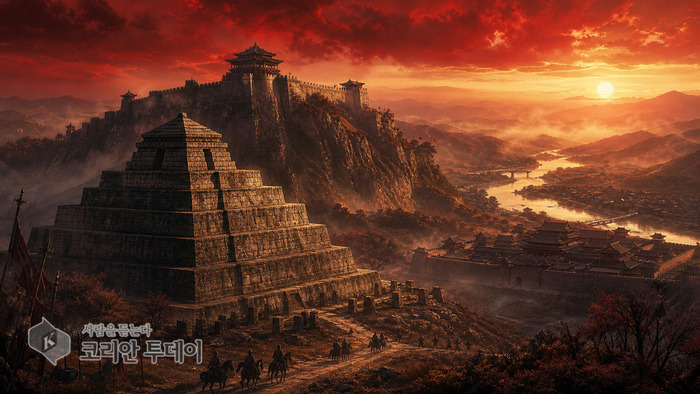
Across the Yalu River in Ji’an, Jilin Province, a colossal stepped stone pyramid rises out of a cornfield. It is known as the General’s Tomb. Yet in the 21st century, scholars still cannot agree on who is actually buried inside.
Last episode traced how China’s Northeast Project tried to rebrand Goguryeo as a mere “regional regime” of Chinese history. But where do the actual physical stakes of that history war stand today? Gungnaeseong and Hwando Mountain City sit in China; Daeseongsan Fortress and Anhak Palace sit in North Korea. A single kingdom’s capitals are now split across two national borders.
For a Korean citizen to walk the ground of their ancestors’ palace, a passport, a visa, and sometimes political permission are required. History knows no borders, but a field trip does. This episode follows 700 years of Goguryeo’s footprint across real geography – from Gungnaeseong to Anhak Palace in Pyongyang.
🌍 Western Historical Parallel
While King Gwanggaeto was conquering Manchuria and northern Korea (391-413 CE), Western Rome was collapsing under the same historical clock: in 410 CE, Visigothic king Alaric sacked Rome itself. Two empires, one at its zenith and one in terminal decline, rose and fell within the same generation on opposite ends of Eurasia.
◆ The Ancient Landscape
Goguryeo was founded in 37 BCE at Jolbon (near today’s Huanren, Liaoning), anchored by the mountain fortress of Onyeosanseong. In 3 CE, King Yuri moved the capital to Gungnaeseong, in the Tonggou basin of modern Ji’an. Gungnaeseong was a flat-plain walled capital, paired with Hwando Mountain City on the ridge behind it – a refuge fortress for wartime. This “plain city plus mountain fortress” pairing became a hallmark of Goguryeo’s urban defense system.
The Gungnaeseong era lasted an astonishing 424 years, until King Jangsu relocated the capital to Pyongyang in 427 CE. In between, King Gwanggaeto completed a vast empire spanning Manchuria and northern Korea in the early 5th century, and his son Jangsu erected a massive stele near Gungnaeseong in 414 CE to memorialize his father’s conquests. After the move to Pyongyang, Daeseongsan Fortress became the new defensive stronghold, with Anhak Palace built at its foot as the royal seat until Goguryeo’s fall in 668 CE.
“In the winter, the tenth month, of the twenty-second year, the king moved the capital to Gungnae and built Wuinaam Fortress.”
◆ Same Era, Different Worlds
🏛️ China
The Gungnaeseong era (3-427 CE) overlapped with the fall of Han and the chaotic Wei-Jin and Northern-Southern Dynasties period, letting Goguryeo expand into Liaodong.
🗿 Rome & Byzantium
As Gwanggaeto conquered the north, the Western Roman Empire spiraled toward collapse (Rome sacked 410 CE), while the Eastern Roman Empire under Theodosius II endured in Constantinople.
⚔️ Western Europe
Germanic tribes – Visigoths, Vandals, Franks – were carving new kingdoms out of Roman territory, much as Goguryeo carved its own out of Han commanderies.
🕌 Japan
Yamato-period Japan was raising its own giant burial mounds (kofun) near Osaka – the same “age of monumental tombs” gripping East Asia.
[Image: Schematic map of Gungnaeseong, Hwando Mountain City, and the royal tomb cluster around Ji’an]
⚔️ Scene from That Day
“In the autumn of 414, thousands gathered on the plains of Gungnaeseong. Carts creaked past loaded with granite blocks; stonemasons chiseled clerical script character by character – 1,775 in all, listing every city and nation King Gwanggaeto had conquered.”
“King Jangsu watched the stele rise, certain it would endure a thousand years. It has – sixteen centuries later, the stone still stands on the same spot, though now across a border, inside a foreign country’s tourist site.”
◆ Uncovering Historical Truth
In the Yushanxia tomb cluster of Ji’an’s Tonggou basin, the General’s Tomb and Taewangneung (King’s Tomb) stand side by side. The General’s Tomb is a seven-tiered stepped stone cairn built from dressed granite, roughly 32 meters per side and 13 meters tall – so precisely engineered it is often called the “Pyramid of the East,” a peer to Egypt’s pyramids or England’s megalithic monuments in engineering ambition. Taewangneung is far larger, 62.5 to 68 meters per side, but its structure has largely collapsed, leaving its original form hard to read – not unlike the weathered ruins of a Roman mausoleum.
Gungnaeseong itself lies mostly buried beneath modern Ji’an’s streets and houses, with only fragments of its walls visible – a situation familiar to anyone who has seen Roman walls poking through a modern European city. Hwando Mountain City is better preserved, its stone ramparts and palace foundations still traceable along the ridge. On July 1, 2004, UNESCO inscribed 43 Chinese Goguryeo sites – including Gungnaeseong, Hwando, and the royal and noble tombs – as “Capital Cities and Tombs of the Ancient Koguryo Kingdom.”
Remarkably, at the very same meeting, North Korea’s Goguryeo tomb complex was inscribed separately – 63 tombs (16 with murals) spread across five zones in Pyongyang, Nampo, and Anak, including Gangseo Great Tomb, the Tomb of King Dongmyeong, and Ssangyeong Tomb. A divided nation’s shared heritage was recognized under two separate names on the same day – a scenario with few parallels, perhaps closest to how Jerusalem’s holy sites are managed under overlapping, contested authorities. Researchers count 717 confirmed Goguryeo heritage sites in total: 406 in China, 214 in North Korea, 89 in South Korea, and 8 in Japan.
Gungnaeseong Era
3-427 CE (424 years)
Key Figures
King Gwanggaeto, King Jangsu
UNESCO Listing
July 2004, dual inscription China/DPRK
Total Sites
717 across 4 countries
🔍 International Academic Perspectives – Which Tomb Holds the King?
Taewangneung Theory
Chinese scholars and some Korean researchers favor Taewangneung, citing its overwhelming scale and a brick inscription reading “May the Great King’s tomb stand firm as a mountain, solid as a peak.”
General’s Tomb Theory
Other Korean and Japanese scholars point to roof-tile inscriptions and artifacts casting doubt on Taewangneung, arguing the General’s Tomb is the more likely resting place. No consensus has emerged since Taewangneung’s discovery in 1906.
📖 Key Terms Explained
- Gungnaeseong (國內城)
- Goguryeo’s capital from 3 to 427 CE, located in present-day Ji’an, Jilin Province, China
- Hwando Mountain City (丸都山城)
- A paired mountain fortress serving as wartime refuge capital alongside Gungnaeseong
- Anhak Palace (安鶴宮)
- A moated, diamond-shaped royal palace at the foot of Daeseongsan Fortress in Pyongyang, used from the 6th century until Goguryeo’s fall in 668 CE
◆ Lessons for Today’s World
Pyongyang’s Daeseongsan Fortress and Anhak Palace are in even harder straits than Ji’an. Daeseongsan was built as a defensive stronghold when King Jangsu relocated the capital in 427 CE, with Anhak Palace – a roughly 2.5-kilometer-perimeter walled compound – believed to have housed the royal court, though its exact construction date remains disputed, ranging from the early 6th century to as late as the Goryeo period.
In 2006, the Seoul Metropolitan Government and the Goguryeo Research Foundation conducted a joint North-South excavation of Anhak Palace with 15 experts from Kim Il Sung University – the first inter-Korean collaboration on a Goguryeo site since division, though inter-Korean tensions have prevented any repeat since. Meanwhile, Ji’an has been developed into a Chinese national holiday tourist destination, yet field reports note a striking absence of signage informing visitors that the site is UNESCO-listed at all – a gap comparable to under-marked heritage corridors seen at some contested sites elsewhere in the world.
| Aspect | Goguryeo Era | Modern Parallel |
|---|---|---|
| Access | Kings and subjects freely traveled between Gungnaeseong and Pyongyang | Korean division limits Koreans to visiting only the Chinese sites; Pyongyang’s ruins are effectively off-limits |
| Stewardship | The Goguryeo royal court directly built and maintained the sites | China and North Korea separately manage sites in their own territory, each inscribed by UNESCO in 2004 |
| Memory & Record | Steles, murals, and chronicles preserved royal achievements | Limited scholarly cooperation (the 2006 joint dig); digital reconstruction and VR now supplement restricted physical access |
[Image: From the founding of Gungnaeseong to today’s heritage preservation efforts]
📚 Diving Deeper
- The Yushanxia tomb cluster contains thousands of stone cairns and mound tombs beyond the General’s Tomb and Taewangneung, testifying to Gungnaeseong’s density as a royal capital.
- The Gwanggaeto Stele’s full 1,775-character clerical-script inscription survives intact, making it one of East Asia’s largest surviving epigraphic monuments – its disputed “sinmyo year” passage remains hotly debated.
- The 2006 Anhak Palace joint excavation remains the only case of North and South Korean archaeologists digging together at a Goguryeo royal site.
The Voice of Living History
Every stone of Gungnaeseong, every foundation stone of Anhak Palace, is evidence of a kingdom that was whole before borders divided it. Preserving these ruins is not embalming the past – it is preparing for the day both halves might look upon the same stones with one set of eyes again.
“Borders are lines on a map. Beneath the stone cairns, the kings still dream of one nation.”
Previous Episode
Episode 34: China’s Northeast Project – A War over History
Next Episode
Episode 36: Goguryeo Studies – North and South Perspectives
The Korean Today “History Lives On” Series
The Goguryeo Chronicle (40 Episodes)
Bridging Ancient East Asia and the Modern World
© 2025 The Korean Today. All rights reserved.
This content is based on historical facts and presents balanced academic perspectives
for international readers.
THE KOREAN TODAY × WIA CODE
이 기사의 WIA Code

WIA Code 스캐너로 비추면 인터넷 없이 발행 사실과 위·변조 여부를 확인할 수 있습니다.
휴대폰 기본 카메라로 찍으면 스캐너 안내 페이지가 열립니다 — 기사 바로 열기

움직이는 코드는 스트림입니다 — WIA Code 스캐너로 약 25초 비추면 기사 전문(사진 포함)이 폰에 저장되어 인터넷 없이도 읽을 수 있습니다.
WIA Code · 코리안투데이






Leave a Reply