
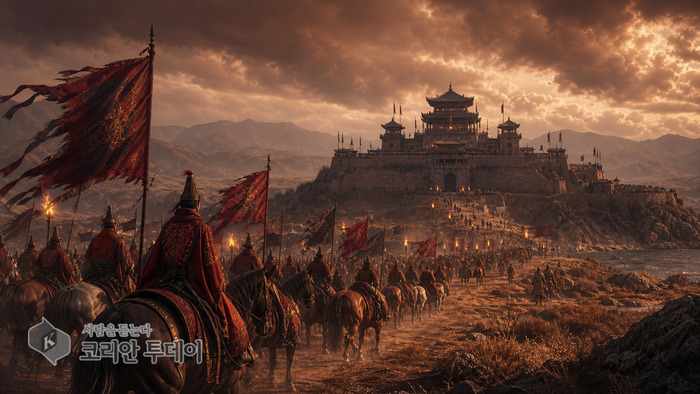
At the very moment Rome was confiscating the property of anyone caught wearing trousers, Goguryeo made trousers the formal dress of kings and nobles.
On the dark walls of tombs near Ji’an, in what is now China’s Jilin province, figures step out of the 5th century: horsemen in wide-cut trousers galloping across the plain, officials in conical caps crowned with two bird feathers, women dancing in jackets trimmed with two-toned bands at the collar and cuffs. These are the earliest ancestors of the hanbok Koreans still wear on holidays today.
Why did the people of Goguryeo wear trousers in the first place? And why, 1,500 years later, does that basic grammar of jacket-and-trousers still shape how Koreans dress?
🌍 Western Historical Parallel
While Goguryeo horsemen were riding into battle in wide trousers, imperial Rome was doing the exact opposite: in 397 CE, Emperors Honorius and Arcadius banned trousers (braccae) within the city of Rome, treating them as the unmistakable mark of “uncivilized” Germanic and Gallic tribesmen — a mirror-image case of the same garment carrying opposite social meaning at opposite ends of Eurasia.
◆ The Ancient Landscape
Goguryeo clothing traces back to the steppe horse-riding cultures often labeled “Scythian-style” dress: a fitted jacket (yu), trousers with a distinct leg (go), and a long overcoat (po) worn on top — a three-piece system built for practical riding, not sitting formally in a robe. You simply cannot gallop a horse in a skirt, and that constraint shaped an entire clothing tradition.
The Tomb of the Dancers (Muyongchong), the richest surviving source on everyday Goguryeo dress, is dated on stylistic and structural grounds to roughly the first half to mid-5th century. The nearby Tomb of the Wrestlers (Gakjeochong) is somewhat later, dated to the late 5th to early 6th century. Both lie near Ji’an, close to the tomb of King Gwanggaeto, making this cluster the single best visual record of how Goguryeo’s ruling class actually dressed.
“Men wear a narrow-sleeved jacket (dongsusam) and trousers with wide, flaring hems (daegugo).”
◆ Same Era, Different Worlds
🏛️ China
Under the Northern and Southern Dynasties, the northern states — including the Xianbei-led Northern Wei — also wore trousers as part of their steppe heritage, even as Han-style robes remained standard for formal court dress.
🗿 Byzantine Empire
As the Western Roman Empire collapsed (476 CE) and the Byzantine east consolidated, Roman elites still clung to the toga as a marker of civilization, only gradually and grudgingly adopting trousers under military pressure from horse-riding neighbors.
⚔️ Western Europe
Gallic and Germanic tribes had worn braccae for centuries by this point — the very garment Rome tried to legislate out of existence, punishable by exile and confiscation of property.
🌏 Japan
Haniwa clay figures from Japan’s contemporaneous Kofun period show comparatively simple, string-tied garments — a useful contrast to Goguryeo’s elaborate rank-coded trousers and feathered headgear.
[Image: Goguryeo horsemen and officials reconstructed from Muyongchong and Gakjeochong tomb murals (5th century)]
⚔️ Scene from That Day
“Spring wind moves past the stables at Ji’an. A young warrior of the sogaga rank ties his daegugo trousers snug at the ankle, straps on his sword, and swings up onto his horse. Two bird feathers, fixed to his jeolpung cap, ripple in the wind.”
“At the city gate, a noblewoman walks with her attendants in a jacket trimmed at collar and cuff with a two-toned band. Everyone passing by understands, without a word exchanged, exactly what that single decorative stripe says about her rank.”
◆ Uncovering Historical Truth
The backbone of Goguryeo dress was a three-piece system: jacket, trousers, overcoat. The jacket originally closed left-over-right in the Scythian-style manner, with narrow sleeves, before growing wider sleeves and a right-over-left closure under Chinese cultural influence — much as Roman military dress gradually absorbed “barbarian” trousers it once scorned. Trousers themselves carried rank: the higher the status, the wider the flared hem (daegugo), while commoners wore narrower-cut trousers. The width of one’s trouser leg was, quite literally, a badge of class.
Headwear carried an even finer-grained hierarchy. The base layer was the jeolpung, a cone-shaped cap believed to have originated as wind protection for riders. Adding bird feathers turned it into a jokwan (feathered crown) marking status; a version in purple silk with gold and silver ornamentation, worn by aristocrats, was called sogol. Contemporary Chinese chronicles note that those holding official rank inserted feathers specifically “to set themselves apart” from others.
One especially telling detail in women’s dress is the two-toned trim (seon) at the collar, front overlap, and cuffs of the jacket — a decoration that, in the surviving murals, appears exclusively on noblewomen’s clothing. Most scholars read this not as mere ornament but as a deliberate, visible marker of social order, much like the elaborate rank badges of later Confucian court dress. The group dance scene at Muyongchong and the wrestling scene at Gakjeochong remain the two richest windows onto both this hierarchy and everyday Goguryeo life.
Period
Early 5th – early 6th century CE
Key Source
Muyongchong & Gakjeochong murals
Core Garments
Jacket, daegugo trousers, jokwan
Legacy
Foundational structure of hanbok
🔍 International Academic Perspectives
Korean/Asian Scholars
The dominant view holds that Goguryeo’s clothing derives from northern steppe, “Scythian-style” nomadic dress — the jacket-trousers-overcoat system and conical caps being the clearest surviving evidence of that lineage.
Revisionist Scholars
More recent research questions a simple one-way diffusion narrative, suggesting indigenous weaving and tailoring traditions in the Korean peninsula and Manchuria likely predated and blended with steppe influence rather than being wholly replaced by it.
📖 Key Terms Explained
- Jeolpung (折風)
- A conical leather cap, Goguryeo’s base-layer headwear, likely originating as a rider’s windbreak.
- Jokwan / “Feathered Crown” (鳥羽冠)
- A jeolpung fitted with bird feathers, worn by those holding official rank as a visible status marker.
- Daegugo (大口袴)
- Trousers with a wide, flaring hem; the wider the flare, the higher the wearer’s status.
◆ Lessons for Today’s World
At the exact same historical moment Rome was branding trousers “barbaric” and outlawing them by imperial decree, Goguryeo made trousers the formal dress of kings and nobles. What counts as “civilized” clothing, this contrast makes clear, was never a fixed truth — it was always a choice each society made for itself.
Today the hanbok has moved well beyond holiday formalwear, reappearing on runways in Paris and New York — asymmetric jacket fronts, flowing wide-legged silhouettes echoing the daegugo of 1,500 years ago. Behind the global rise of K-fashion sits a simple continuity: the clothes Goguryeo horsemen perfected for practicality on horseback are still, in a real sense, moving through the world today.
| Aspect | Goguryeo Era | Modern Parallel |
|---|---|---|
| Base Structure | Jacket, trousers, overcoat as a three-piece system | Hanbok’s jacket-and-lower-garment skeleton, largely unchanged |
| Rank Signaling | Headwear (jeolpung/jokwan/sogol) and trim color marked class | Embroidery and formality level mark occasion, not caste |
| Cultural Standing | Practical riding dress and a symbol of social order | A marker of identity and an inspiration for global K-fashion |
[Image: Timeline from Goguryeo mural clothing through Joseon hanbok to modern K-fashion]
📚 Diving Deeper
- The Muyongchong and Gakjeochong tombs near Ji’an are difficult for most travelers to visit directly, but digital reconstructions and museum replicas offer an accessible alternative.
- Goguryeo envoys in feathered crowns also appear in Tang-dynasty Chinese tomb murals (such as the “tribute-bearers” scene in Prince Zhanghuai’s tomb), showing that Goguryeo dress was recognized abroad as a national emblem — a diplomatic-era equivalent of a national costume being instantly recognizable on a foreign stage.
- The Book of Zhou, Book of Northern Histories, and the Old and New Books of Tang each contain an “Eastern Barbarians” section on Goryeo (Goguryeo) — outside observers’ accounts, not written by Goguryeo people themselves, but invaluable supplementary sources on dress detail.
The Voice of Living History
Clothing cannot speak, yet it testifies more honestly than almost anything else to how people actually lived. The trousers Goguryeo perfected on horseback still live on, quite literally, in the collar of every hanbok jacket worn today.
“The most practical garment is the one that survives the longest.”
Previous Episode
Episode 27: Cities of Goguryeo — From Gungnae to Pyongyang
Next Episode
Episode 29: Goguryeo Food Culture — Maekjeok and Sujegyuk
The Korean Today “History Lives On” Series
The Goguryeo Chronicle (40 Episodes)
Bridging Ancient East Asia and the Modern World
© 2025 The Korean Today. All rights reserved.
This content is based on historical facts and presents balanced academic perspectives
for international readers.
THE KOREAN TODAY × WIA CODE
이 기사의 WIA Code

WIA Code 스캐너로 비추면 인터넷 없이 발행 사실과 위·변조 여부를 확인할 수 있습니다.
휴대폰 기본 카메라로 찍으면 스캐너 안내 페이지가 열립니다 — 기사 바로 열기

움직이는 코드는 스트림입니다 — WIA Code 스캐너로 약 25초 비추면 기사 전문(사진 포함)이 폰에 저장되어 인터넷 없이도 읽을 수 있습니다.
WIA Code · 코리안투데이






Leave a Reply