
Long before they became battlefield enemies, Goguryeo and Tang China exchanged gods, music, and ink.
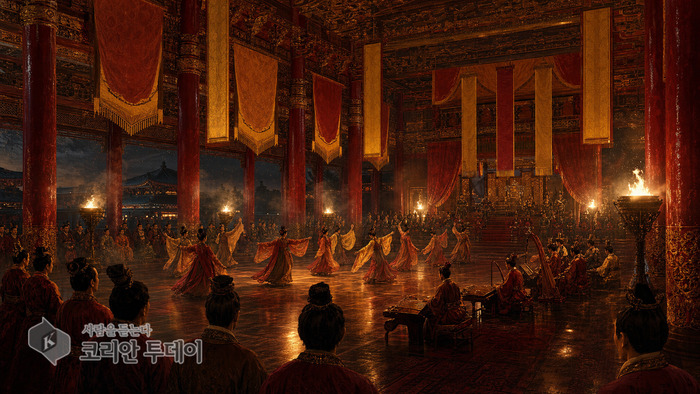
In 624 CE, Tang Emperor Gaozu sent a Daoist priest to Goguryeo’s court bearing an image of the Celestial Venerable and a lecture on the Dao De Jing. In the same century, Goguryeo musicians performed on the stage of Chang’an’s imperial palace, plucking zithers and harps in a style the Tang court found irresistible.
We remember the wars. We forget that before the armies clashed, envoys, priests, and dancers had already worn a path between the two courts.
🌍 Western Historical Parallel
While Goguryeo was absorbing Daoist teachings from Tang envoys in the 620s-640s, the Byzantine Empire under Emperor Heraclius was closing out its exhausting war with Sassanid Persia, and on the Arabian Peninsula a new faith — Islam — was rapidly expanding under the Rashidun Caliphate. It was an age, from Chang’an to Constantinople to Medina, when religion and diplomacy moved together across imperial courts.
◆ The Ancient Landscape
Tang China, founded in 618 CE after the fall of Sui, rose swiftly into East Asia’s dominant power. Goguryeo had already embraced Buddhism through the Former Qin in 372 CE, but the 7th century brought a new guest to its court: Daoism. In 624 CE (the seventh year of King Yeongnyu), Tang Gaozu proactively sent a Daoist priest and an image of the Celestial Venerable to lecture on the Dao De Jing before the king and his court. The following year, Yeongnyu dispatched envoys to Tang to study both Buddhism and Daoism.
In March 643 CE (the second year of King Bojang), the powerful minister Yeon Gaesomun pushed the relationship further, arguing that “Confucianism, Buddhism, and Daoism are like the three legs of a cauldron — none can be missing.” Tang Taizong responded by sending eight Daoist priests led by Sukdal, along with the Dao De Jing. Bojang, delighted, converted Buddhist temples into residences for the new arrivals — a moment when religious rivalry became the language of state diplomacy.
“Tang Gaozu sent a Daoist priest bearing an image of the Celestial Venerable and Daoist teachings to lecture on Laozi’s doctrine; the king and the people of the country listened.”
◆ Same Era, Different Worlds
🏛️ China
Tang Taizong (r. 626-649) established the “Ten Styles of Music,” giving Goguryeo’s ensemble a permanent place alongside troupes from Kucha, India, and Kang, in the imperial court.
🗿 Byzantine Empire
Emperor Heraclius was finishing his epic war against Sassanid Persia, only to face the sudden rise of Arab-Islamic forces from the south.
⚔️ Islamic World
The Rashidun Caliphate (632-661) expanded explosively, toppling the Sassanid Empire and pressing into Byzantine territory.
🌏 Japan
In 610 CE, the Goguryeo monk-painter Damjing traveled via Baekje to Japan, teaching papermaking and ink-making techniques at the Asuka court.
[Image: Routes of Daoism, music, and craft exchanged across 7th-century East Asia]
⚔️ Scene from That Day
“Inside the Taiji Palace at Chang’an, a night banquet. As the Kuchan lute falls silent, the Goguryeo ensemble takes the stage. Fourteen dancers in crimson sleeves spread their arms like birds in flight, while zithers and harps pluck an unfamiliar, riveting melody.”
“At that same hour in Pyongyang’s palace, a newly arrived Tang Daoist priest recites the Dao De Jing before an image of the Celestial Venerable, the king and his ministers gathered to learn the names of a foreign god. It was brush and melody, not blade, that crossed the border that night.”
◆ Uncovering Historical Truth
Goguryeo music was no provincial curiosity. It already held a place in Sui China’s “Nine Styles of Music,” and when Tang Taizong expanded the roster into the “Ten Styles,” Goguryeo’s ensemble kept its seat. Eight instruments — including the zither, harps, lute, and various flutes — rang out in the heart of Chang’an’s palace, proof that Goguryeo competed on the East Asian stage not only with spears but with art, much as Byzantine emperors displayed conquered peoples’ music at their own courts.
That internationalism is carved into stone as well. The dancers of Muyongchong (Tomb of the Dancers) move with what scholars describe as a distinctly nomadic, Central Asian sensibility, while the wrestling scene of Gakjeochong depicts a Goguryeo wrestler grappling with a hook-nosed, foreign-featured opponent — possibly a man from the Western Regions, though scholars remain divided on how literally to read the image. What is widely agreed is that tombs near Pyongyang lean toward Chinese pictorial style, while those in the Ji’an region — Muyongchong, Gakjeochong, the Jangcheon tombs — preserve a distinctly Goguryeo character even as their world reached toward Central Asia.
Religious exchange was inseparable from politics. Yeon Gaesomun’s push for Daoism is widely read not as piety but as a calculated move to counterbalance a Buddhist-leaning aristocracy — a dynamic not unlike how Byzantine emperors used church councils to manage rival factions within their own court.
Period
7th century (c. 618-643 CE)
Key Figures
King Yeongnyu, King Bojang, Yeon Gaesomun
Key Event
Daoism’s arrival; Goguryeo music enters the Tang court
Impact
A shared East Asian religious and artistic network
🔍 International Academic Perspectives
Korean/Asian Scholars
Most historians read Yeon Gaesomun’s Daoist push as political calculation aimed at curbing a Buddhist-leaning aristocracy, not genuine religious conviction.
Alternative View
Some scholars point to the foreign-featured figure in the Gakjeochong wrestling mural as physical evidence that Goguryeo’s reach genuinely extended into Silk Road networks, beyond mere court politics.
📖 Key Terms Explained
- Goguryeo (고구려)
- Ancient Korean kingdom (37 BCE – 668 CE), one of the Three Kingdoms of Korea
- Ten Styles of Music (十部伎)
- Tang China’s official roster of court music troupes drawn from ten regions and peoples, including Goguryeo
- Dao De Jing
- Foundational Daoist text attributed to Laozi, central to the teachings the Tang court exported to Goguryeo
◆ Lessons for Today’s World
Goguryeo music earning a permanent seat at the Tang court was, in the end, a form of power — the recognition that influence flows not only from armies but from culture. Fourteen centuries before the term “soft power” existed, Goguryeo was already practicing it.
Today’s landscape — K-pop topping the Billboard charts, K-dramas dominating Netflix — is not so unfamiliar. Winning hearts across borders through song and dance rather than weapons: the Goguryeo ensemble on Chang’an’s stage was, in that sense, a distant prototype of K-Culture.
| Aspect | Goguryeo Era | Modern Parallel |
|---|---|---|
| Geopolitics | Pragmatic diplomacy absorbed both Daoism and Buddhism before war broke out | Economic and cultural ties buffer geopolitical tension |
| Military/Diplomacy | Envoys, priests, and musicians kept moving even amid tension | Cultural exchange functions as Track II diplomacy |
| Culture | Goguryeo music permanently seated in the Tang court’s Ten Styles | K-pop and K-dramas enter the global cultural mainstream |
[Image: Goguryeo’s stage debut abroad, linked to today’s K-Culture soft power]
📚 Diving Deeper
- The Four Guardian Deities mural at Gangseo Daemyo, Pyongyang — widely viewed as the artistic peak of late-Goguryeo tomb murals, saturated with Daoist cosmology, viewable via Korea’s National Research Institute of Cultural Heritage 3D archive
- The scholarly debate over the foreign-featured wrestler in Gakjeochong, part of the UNESCO World Heritage-listed “Complex of Koguryo Tombs” (inscribed 2004)
- The theory that Damjing’s papermaking and ink techniques contributed to the origins of Japan’s traditional washi paper
The Voice of Living History
It was never the spear that crossed the border first — it was the song. When Goguryeo’s music rang through the halls of Chang’an, the kingdom had already learned how to compete with the world through culture.
“Before blades ever met, brush and melody had already crossed the border.”
Previous Episode
Episode 21: The Migration of Goguryeo Refugees – A Diaspora
Next Episode
Episode 23: Goguryeo Tomb Murals – A Thousand Years Carved in Stone
The Korean Today “History Lives On” Series
The Goguryeo Chronicle (40 Episodes)
Bridging Ancient East Asia and the Modern World
© 2025 The Korean Today. All rights reserved.
This content is based on historical facts and presents balanced academic perspectives
for international readers.
THE KOREAN TODAY × WIA CODE
이 기사의 WIA Code

WIA Code 스캐너로 비추면 인터넷 없이 발행 사실과 위·변조 여부를 확인할 수 있습니다.
휴대폰 기본 카메라로 찍으면 스캐너 안내 페이지가 열립니다 — 기사 바로 열기

움직이는 코드는 스트림입니다 — WIA Code 스캐너로 약 25초 비추면 기사 전문(사진 포함)이 폰에 저장되어 인터넷 없이도 읽을 수 있습니다.
WIA Code · 코리안투데이






Leave a Reply