
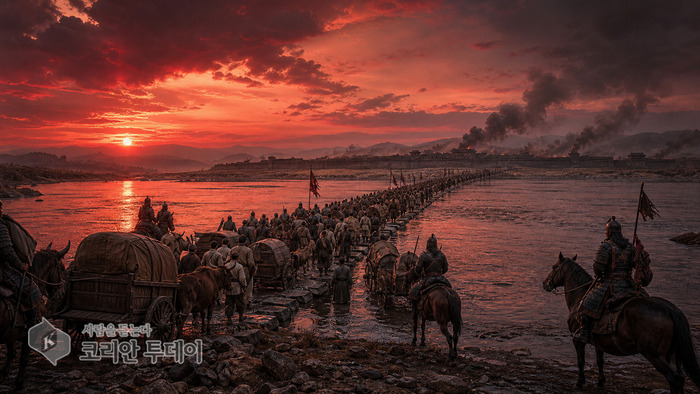
In the autumn of 668 CE, as Pyongyang Fortress fell, more than 200,000 people were marched away from everything they had known.
Today we watch refugee columns fleeing Syria, Ukraine, and Myanmar and feel the weight of displacement. Thirteen centuries earlier, a comparably massive forced migration unfolded across the Korean peninsula and Manchuria. When a kingdom that had stood for over 700 years collapsed, its people scattered — some dragged into the Tang Chinese interior, some surrendering to Silla, some crossing the sea to Japan, and some who would, decades later, found an entirely new state.
Collapse was not the end. The people of Goguryeo left traces everywhere they landed, and one branch of them rebuilt a kingdom within a single generation. Why does this ancient diaspora still matter to a world of refugee crises?
🌍 Western Historical Parallel
When Tang China forcibly resettled Goguryeo’s elite in 669 CE, the Byzantine Empire under Constantine IV was resettling conquered Slavic populations within its own borders — a nearly contemporaneous echo of the same imperial logic: scatter a conquered people so they cannot regroup to rebel.
◆ The Ancient Landscape
In September 668 CE, the combined forces of Tang China and Silla breached Pyongyang Fortress, ending 705 years of Goguryeo history. But conquest was only the beginning. The following year, Tang Emperor Gaozong ordered a mass forced relocation of Goguryeo’s elite and prominent families deep into Chinese territory — to the Jianghuai region south of the Yangtze and Huai rivers, and to the harsh frontier lands of Shannan and Longyou. The logic was strategic: a conquered population left in place could always reignite resistance.
Estimates of this forced migration vary between sources, but the consensus figure — including the royal family and ministers — exceeds 200,000 people relocated to Tang. Around the same time, roughly 666 CE, Yeon Jeongto, younger brother of the powerful minister Yeon Gaesomun, defected to Silla with twelve fortresses and their populations. Prince Ansung likewise surrendered to Silla and was enthroned as king of the vassal state of Bodeok, based in modern Iksan. Others crossed the sea to Japan entirely. A single fallen kingdom scattered into at least four distinct diasporic streams.
“General Li Ji led King Bojang, princes Boknam and Deoknam, and more than 200,000 ministers and subjects back to Tang.”
◆ Same Era, Different Worlds
🏛️ Tang China
Under Emperor Gaozong and Empress Wu Zetian’s rising influence. Resettling conquered elites into the interior was standard Tang practice, later applied to Uyghur and Turkic populations too.
🗿 Byzantine Empire
Constantine IV had just survived the Arab siege of Constantinople (c. 674-678 CE). Forced resettlement of Slavic populations mirrored Tang policy toward Goguryeo almost exactly.
⚔️ Western Europe
The Frankish kingdoms under the late Merovingians were fragmenting into regional power centers — a contrast to the tight imperial control Tang exerted over its new subjects.
🕌 Japan
Under Emperors Tenji and Tenmu, Japan actively welcomed Goguryeo and Baekje refugees, absorbing their administrative and fortress-building expertise into its emerging ritsuryo state.
[Image: Conceptual map of the four major migration routes after Goguryeo’s fall]
⚔️ Scene from That Day
“In the spring of 669, thousands of ox-carts lined the ferry crossing on the Yalu River. An old man refused to let go of his grandson’s hand; soldiers pushed the column forward. Across the river lay a homeland they would never see again; on this side, an exile with no promised end — not unlike the columns crossing the Bosphorus after Constantinople’s own sieges.”
“At the same hour, in Iksan’s Geummajeo, refugees who had enthroned Prince Ansung were laying the foundations of a new palace. The kingdom was gone, but its royal line and five-tribe administrative system had been carried with them intact. For these people, rebuilding was simply another word for survival.”
◆ Uncovering Historical Truth
The lives of scattered Goguryeo refugees are confirmed today through stone inscriptions they left behind. The 1923 discovery of the epitaph of Cheon Namsan in Luoyang is a landmark case. Born in 639 as the third son of the powerful minister Yeon Gaesomun, he surrendered in 668 and was taken to Tang — yet his life there appears in no official chronicle, neither the Old Book of Tang nor the Samguk Sagi. Only this stone epitaph records it. Similar epitaphs for other Goguryeo nobles, such as Go Eul-deok and Go Hyeon, have since surfaced around Luoyang, showing that much of the deported elite was absorbed into the Tang bureaucracy rather than erased.
Those who fled to Silla followed a different trajectory. King Munmu enthroned Prince Ansung as king of Bodeok and granted him Geummajeo, in what is now Iksan. Bodeok preserved Goguryeo’s five-tribe structure and even fought alongside Silla in the Silla-Tang War — yet as Silla’s centralization advanced, the vassal state was eventually dissolved, its people relocated to Namwon. Useful to its conqueror yet ultimately unable to preserve its autonomy, Bodeok’s fate is a template many small diaspora polities have repeated throughout history.
The most dramatic reversal, however, unfolded on the Manchurian plains. Some of the very people deported to Tang broke away three decades later, in 698 CE, under the leadership of Dae Joyeong. Fleeing the Tang garrison at Yingzhou, they founded a new state at Dongmo Mountain, naming it Jin (振) — with Dae Joyeong proclaiming himself King Go. This was not mere rebellion; it was the political reconsolidation of a scattered Goguryeo identity. When Tang formally recognized the new state in 705, the diaspora had, in effect, become sovereign again.
Period
668-716 CE
Key Figures
Dae Joyeong, Prince Ansung, Go Yakgwang
Key Event
Four-way diaspora: Tang, Silla, Balhae, Japan
Legacy
Identity reconsolidated through Balhae’s founding
🔍 International Academic Perspectives
Korean/Asian Scholars
Most scholars agree that the majority of deportees to Tang gradually assimilated into Han Chinese society, and that Balhae’s founders represented only a fraction of the total diaspora. The exact scale of the forced migration (200,000 individuals versus roughly 38,000 households) remains debated across sources.
Alternative Theory
A minority view proposes that Goguryeo refugees resettled in southern China became a founding element of today’s Miao ethnic minority. This claim rests on limited linguistic and genetic evidence, is not broadly accepted by mainstream historians, and is treated as an unproven hypothesis requiring further verification.
📖 Key Terms Explained
- Goguryeo (고구려)
- Ancient Korean kingdom (37 BCE – 668 CE), the largest and northernmost of Korea’s Three Kingdoms
- Balhae (발해)
- Successor state founded in 698 CE by Goguryeo refugee leader Dae Joyeong, combining Goguryeo and Mohe (Malgal) populations, lasting until 926 CE
- Bodeok (보덕국)
- A short-lived vassal kingdom of Goguryeo refugees established under Silla protection in Iksan, dissolved as Silla centralized power
◆ Lessons for Today’s World
State collapse and war still produce mass displacement in the 21st century. The Syrian civil war has displaced over 10 million people; the war in Ukraine has scattered millions across Europe. The Goguryeo diaspora reads uncannily like today’s headlines — people forcibly relocated at a conqueror’s convenience, yet clinging to communal identity and re-rooting themselves in unfamiliar land.
At the same time, Balhae’s founding proves that diaspora history need not end in erasure. Within thirty years of scattering, Goguryeo’s refugees rebuilt a state through their own agency. Today’s global Korean diaspora — some 7.5 million strong — carrying a Korean identity across borders may be the longest-running descendant of that same impulse first proven at Dongmo Mountain.
| Aspect | Goguryeo Era | Modern Parallel |
|---|---|---|
| Cause of Displacement | State collapse, forced resettlement by conquerors | Civil war, conflict, political persecution |
| Resettlement Pattern | Absorption into bureaucracy, vassal states, enclave settlements | Refugee camps, resettlement programs, diaspora communities |
| Identity | Preserved via royal lineage and tribal structure; culminated in Balhae’s founding | 7.5 million-strong global Korean diaspora network, K-culture as identity extension |
[Image: Timeline from Goguryeo’s fall to today’s global Korean diaspora]
📚 Diving Deeper
- The Koma Shrine in Hidaka, Saitama Prefecture, still holds annual rites honoring Go Yakgwang, a Goguryeo refugee leader — a living site of memory comparable to diaspora shrines elsewhere in the world.
- Japan’s Shinsen Shojiroku genealogical register lists 52 clans of confirmed Goguryeo descent, evidence of how deeply naturalized immigrants shaped ancient Japan’s ruling class — a parallel to how Sutton Hoo-era migrations reshaped early medieval England.
- Epitaphs of Goguryeo nobles unearthed around Luoyang, including Cheon Namsan and Go Hyeon, continue to surface periodically, each one rewriting details absent from official chronicles.
The Voice of Living History
A kingdom can fall, but its people do not vanish — they scatter. Goguryeo’s descendants survived in the Jianghuai valleys of Tang, in Silla’s Iksan, on the Manchurian plain at Dongmo Mountain, and across the Musashino plateau in Japan. And one branch of them became a kingdom once more.
“Scattered embers can still catch fire again — as Dae Joyeong proved at Dongmo Mountain.”
Previous Episode
Episode 20: The Restoration Movement — An Unquenched Flame
Next Episode
Episode 22: Cultural Exchange Between Goguryeo and Tang
The Korean Today “History Lives On” Series
The Goguryeo Chronicle (40 Episodes)
Bridging Ancient East Asia and the Modern World
© 2025 The Korean Today. All rights reserved.
This content is based on historical facts and presents balanced academic perspectives
for international readers.
THE KOREAN TODAY × WIA CODE
이 기사의 WIA Code

WIA Code 스캐너로 비추면 인터넷 없이 발행 사실과 위·변조 여부를 확인할 수 있습니다.
휴대폰 기본 카메라로 찍으면 스캐너 안내 페이지가 열립니다 — 기사 바로 열기

움직이는 코드는 스트림입니다 — WIA Code 스캐너로 약 25초 비추면 기사 전문(사진 포함)이 폰에 저장되어 인터넷 없이도 읽을 수 있습니다.
WIA Code · 코리안투데이






Leave a Reply