
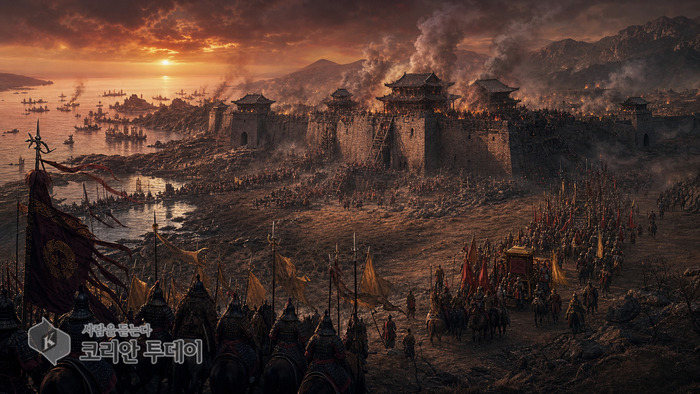
Alliances always have two faces — a shield for one side, a noose for the other.
Long before Yeon Gaesomun died and his sons tore his legacy apart in a succession war, the net that would ultimately strangle Goguryeo had already been woven. In the summer of 660, when the Baekje capital of Sabi burned and King Uija knelt in surrender, the court in Pyongyang finally understood: they were no longer facing a lone Chinese invasion, but a fused pincer of a maritime empire and a peninsular kingdom acting as one.
The fall of Pyongyang eight years later (Episode 19) was already half-written in that summer Baekje disappeared. How could Goguryeo, with its formidable fortresses and battle-hardened army, not escape this fate? The answer lies not on the battlefield, but on the diplomatic map.
🌍 Western Historical Parallel
Almost exactly when Baekje fell in 660 and Goguryeo began fighting on two fronts, the Sassanid Persian Empire — once Rome’s great rival — was being swallowed whole by the rising Rashidun Caliphate, its last king Yazdegerd III killed around 651. Both stories share the same grim arithmetic: an established power, stripped of allies one by one, crushed not by a single blow but by a coalition it could no longer outmaneuver.
◆ The Ancient Landscape
The story begins in 642 CE, when Baekje general Yunchung captured the Silla fortress of Daeya (modern Hapcheon), killing its commander Pumseok and his wife Goveonso — the daughter of the Silla statesman Kim Chunchu. Grief-stricken, Kim Chunchu personally traveled to Goguryeo that same year to plead for military aid, only to be detained by Yeon Gaesomun, who demanded the return of old Goguryeo lands north of Jungnyeong Pass first. An envoy sent to Yamato (Japan) likewise brought no meaningful help. Rejected by both candidates for alliance, Silla had one option left: the Tang Empire across the sea.
In 648, Kim Chunchu traveled to the Tang capital of Chang’an and struck a deal directly with Emperor Taizong. Tang promised that, once Goguryeo and Baekje were subdued, the land “south of Pyongyang” would go to Silla. This sealed the Silla-Tang military alliance. For Silla it was a desperate act of survival — but from Goguryeo’s vantage point, it meant two blades aimed at its throat had just become one.
“If we cannot obtain the army of the great state (Tang), our kingdom will surely perish.”
◆ Same Era, Different Worlds
🏛️ Tang China
Under the newly enthroned Emperor Gaozong (from 649), Tang continued Taizong’s forward policy in Korea, sustaining the alliance with Silla.
🗿 Byzantine Empire
Emperor Constans II struggled to hold territory against the rapidly expanding Arab-Islamic conquests sweeping the Levant and North Africa.
⚔️ Western Europe
Merovingian Francia was fragmenting into competing regional power centers under weak later kings.
🕌 Islamic World
The Rashidun Caliphate was completing its conquest of Sassanid Persia, exactly as Baekje fell on the other end of Asia.
[Image: The Silla-Tang north-south pincer and the fall of Baekje overlaid on modern borders (660 CE)]
⚔️ Scene from That Day
“In the summer of 660, a spirit was said to have appeared on a great rock near Buyeo and buried a message in the earth. When the people dug it up, it read: ‘Baekje is like the full moon, Silla like the crescent moon.’ When King Uija asked a shaman what it meant, she answered: ‘The full moon is destined to wane, while the crescent moon has yet to fill and will only grow.’ Enraged, the king had her executed.”
Days later, Gyebaek’s five thousand at Hwangsanbeol were annihilated, and the gates of Sabi swung open. The omen was never a prophecy — it was only the shadow of scales that had already tipped, much as omens of doom trailed the last Sassanid king before Ctesiphon fell.
◆ Uncovering Historical Truth
In the seventh lunar month of 660, Su Dingfang’s 130,000-strong Tang army and Kim Yu-sin’s 50,000 Silla troops converged on Baekje by sea and land. After the Tanhyeon and Baekgang defense lines broke and Gyebaek’s 5,000-man suicide corps was wiped out at Hwangsanbeol, the capital Sabi fell around the eighteenth day of the seventh lunar month. King Uija, having fled to Ungjin fortress, was betrayed by its commander Ye Sik-jin and handed over to the allied army. Baekje, a kingdom centuries old, was erased in under a month.
For Goguryeo, Baekje’s fall was far more than losing a neighbor. The long-standing buffer built on the Goguryeo-Baekje-Yamato triangle collapsed overnight, and Silla and Tang could now use former Baekje territory as a springboard straight into Goguryeo’s midsection. The very next year, 661, Su Dingfang pushed a large army north and laid siege to Pyongyang itself — a scale of coordinated allied pressure Goguryeo had never faced from Sui or Tang acting alone. Though winter cold and supply shortages forced the siege to lift, the crisis did not end there. In 662, to resupply the starving Tang troops, Kim Yu-sin led a month’s worth of provisions for 50,000 men across the Imjin River (Chiljunghwa) deep into Goguryeo territory — a mission so perilous that his troops evaded pursuing Goguryeo forces only through a decoy trick using oxen, before slipping back to Silla under cover of darkness.
By this point, Goguryeo’s traditional northern allies — the Göktürks and the Xueyantuo — had already been subjugated or destroyed by Tang. The Mohe peoples split, some siding with Goguryeo, others with Tang. A genuine two-front war had begun: Silla and Tang pressing from the south, a multinational Tang-led coalition pressing from the north. Yamato belatedly intervened to support the Baekje restoration movement at the Battle of Baekgang in 663, only to suffer a crushing defeat — extinguishing Goguryeo’s last hope of outside help. When Yeon Gaesomun died around 665 (some sources say 666) and his sons tore the state apart in a succession struggle, it was less the cause of collapse than the final blow landing on a kingdom already isolated by the diplomacy of 648 and the catastrophe of 660.
Period
648-662 CE
Key Figures
Kim Chunchu, Kim Yu-sin, Su Dingfang, King Uija
Key Event
Silla-Tang pact and fall of Baekje
Impact
Two-front war, total isolation
🔍 International Academic Perspectives
Korean/Asian Scholars
The majority view holds the Silla-Tang alliance was essentially Silla’s only viable path to survival against the combined pressure of Goguryeo and Baekje.
Western Historians
Some comparative historians frame it as a classic “ally today, rival tomorrow” pattern — echoed later in the Silla-Tang War of 670-676 — not unlike how wartime coalitions from Rome’s foederati to the WWII Allies frequently fractured once the common enemy fell.
📖 Key Terms Explained
- Silla-Tang Alliance (Nadang Yeonhap)
- The 648 CE military pact between Silla and Tang China that ultimately destroyed both Baekje (660) and Goguryeo (668)
- Hwangsanbeol
- The battlefield near modern Nonsan where general Gyebaek’s 5,000 Baekje troops made their last stand against Silla in 660
- Goguryeo
- Ancient Korean kingdom (37 BCE – 668 CE), one of the Three Kingdoms of Korea
◆ Lessons for Today’s World
Kim Chunchu only turned to Tang in 648 after being rejected by both Goguryeo and Yamato — a reminder that diplomacy is decided not by who knocks first, but by who holds on until the end. Goguryeo, meanwhile, watched its alliances dissolve one by one: Baekje gone, the northern steppe powers subdued, and finally Yamato crushed at Baekgang — a slow accumulation of isolation, not a single catastrophic mistake.
Korea’s position today echoes this ancient geometry: wedged between great powers, dependent on multilateral security cooperation, and increasingly aware that supply-chain and technology alliances determine national fate as much as armies do. The Silla-Tang alliance was survival for one side and a death sentence for the other — proof that the same historical event can be read in opposite directions depending on which side of the alliance you stand.
| Aspect | Goguryeo Era | Modern Parallel |
|---|---|---|
| Geopolitics | Two-front war after losing every regional ally | Balancing diplomacy amid great-power competition |
| Military | Silla-Tang combined pincer operations | US-ROK alliance and multilateral security frameworks |
| Culture | Defiant resistance to the very end | National resilience rediscovered through K-culture and K-defense |
[Image: Goguryeo’s diplomatic isolation (648-668 CE) contrasted with modern multilateral alliance structures]
📚 Diving Deeper
- Fire and destruction layers dated around 660 CE at the Busosanseong and Gwanbuk-ri sites near Buyeo corroborate the sudden fall of Sabi.
- The Chiljungseong fortress area along the Imjin River, identified as Kim Yu-sin’s 662 supply route, remains under archaeological investigation — a Korean parallel to logistics-focused sites like Hadrian’s Wall supply forts.
- Reading the Samguk Sagi’s Silla, Baekje, and Goguryeo Annals alongside the Samguk Yusa reveals how the same 660 CE events were narrated completely differently depending on which kingdom’s scribes recorded them.
The Voice of Living History
What fell first was not the thickness of the walls or the number of soldiers, but a diplomacy that realized far too late it was standing alone.
“A nation with allies survives; a nation in isolation collapses under its own weight.”
Previous Episode
Episode 17: The Death of Yeon Gaesomun — The Beginning of Internal Strife
Next Episode
Episode 19: The Fall of Pyongyang — September 21, 668
The Korean Today “History Lives On” Series
The Goguryeo Chronicle (40 Episodes)
Bridging Ancient East Asia and the Modern World
© 2025 The Korean Today. All rights reserved.
This content is based on historical facts and presents balanced academic perspectives
for international readers.
THE KOREAN TODAY × WIA CODE
이 기사의 WIA Code

WIA Code 스캐너로 비추면 인터넷 없이 발행 사실과 위·변조 여부를 확인할 수 있습니다.
휴대폰 기본 카메라로 찍으면 스캐너 안내 페이지가 열립니다 — 기사 바로 열기

움직이는 코드는 스트림입니다 — WIA Code 스캐너로 약 26초 비추면 기사 전문(사진 포함)이 폰에 저장되어 인터넷 없이도 읽을 수 있습니다.
WIA Code · 코리안투데이






Leave a Reply