
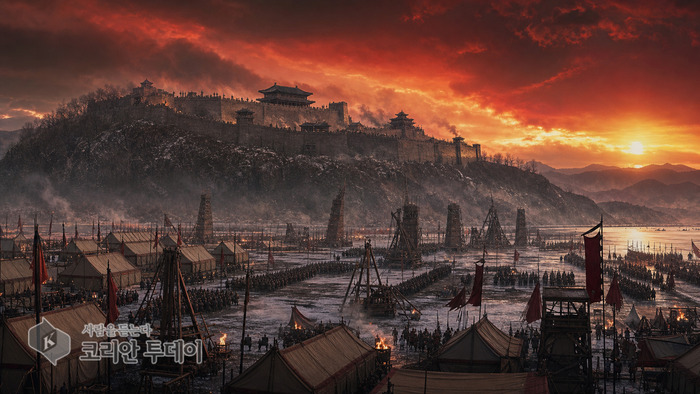
Winning a battle is not the same as winning a war. Even after Goguryeo turned back Emperor Taizong at Ansi Fortress in 645, peace never came.
The victory at Ansi was sweet but inconclusive. Rather than risk another massed frontal assault, Tang Taizong pivoted to a strategy of relentless border raids designed to exhaust Goguryeo over time — and after his death, his son Emperor Gaozong inherited the same playbook. 647, 648, 655, 661: over fourteen years, wave after wave of invasion slowly ground down the kingdom’s strength.
Why does a nation grow weaker even as it keeps winning its battles? When there is no single decisive clash but an endless war of attrition, what actually determines who survives?
🌍 Western Historical Parallel
While Goguryeo absorbed repeated Tang offensives, the Byzantine Empire was locked in its own multi-decade war of attrition against a rising Islamic Caliphate — winning tactical engagements after the catastrophic 636 defeat at Yarmouk, yet steadily bleeding territory and treasury for a generation, much as Goguryeo bled men and grain with every repelled invasion.
◆ The Ancient Landscape
After the failure at Ansi in 645, Tang Taizong refused to abandon the campaign — he simply changed tactics. Small, frequent raiding forces began targeting Goguryeo’s border fortresses to burn granaries and withdraw before a decisive engagement could form, a strategy classical Chinese strategists called “resting while the enemy tires.” In 647, generals Niu Jinda and Li Ji struck the Namso and Seokseong fortresses in Liaodong. In January 648, General Xue Wanche led over 30,000 troops and a fleet of warships across the sea to attack Bakjak Fortress near the mouth of the Yalu River.
Goguryeo general Go Mun counterattacked from the direction of Ogol and Anji fortresses with 30,000 troops, encircling the Tang forces; by August, Xue Wanche’s army retreated after suffering heavy losses. A planned massive invasion in 649 never materialized — Emperor Taizong died before it launched. War resumed in 655 when his son, Emperor Gaozong, sent Cheng Mingzhen and Su Dingfang across the Liao River under the pretext of aiding Silla. Then in 661, Gaozong committed six separate army columns — led by Su Dingfang, Ren Yaxiang, Pang Xiaotai, and others — pushing all the way to Pyongyang itself.
“Su Dingfang laid siege to Pyongyang. Yeon Gaesomun sent his son Namsaeng with tens of thousands of elite troops to hold the Yalu River, and the Tang armies could not cross.”
◆ Same Era, Different Worlds
🏛️ China
Power passed from Taizong to Gaozong, but the campaign against Goguryeo continued unbroken. Tang was simultaneously expanding on other fronts, defeating the Western Turkic Khaganate in 651 — a multi-front empire stretching its resources thin.
🗿 Byzantine Empire
Under Emperor Constans II, Byzantium was losing Syria and Egypt to Arab conquest after the 636 defeat at Yarmouk, while the Sasanian Persian Empire collapsed entirely in 651 — a stark reminder of how attrition could redraw an empire’s map.
⚔️ Western Europe
The Merovingian Frankish kingdoms were fragmenting under weak “do-nothing kings,” with real power shifting to regional mayors of the palace — a slower, internal version of state exhaustion.
🕌 Islamic World
The Rashidun Caliphate was in the middle of its explosive early expansion, absorbing Persia and pressing into Byzantine territory — showing how sustained offensive pressure, not single battles, reshaped seventh-century geopolitics.
[Image: Tang’s four invasion routes and major battle sites, 647-661 CE, overlaid on modern Northeast Asia]
⚔️ Scene from That Day
“Winter, 661 CE. A frost wind sweeps over the frozen Daedong River. Su Dingfang’s camp has sat outside Pyongyang for months, but the walls have not budged. The supply carts have stopped arriving; the soldiers’ straw sandals are long since worn through — a siege as grinding as any Byzantine campaign against a Sasanian fortress.”
“Yeon Gaesomun dispatches his son Namsaeng with elite cavalry to hold the upper Yalu. ‘This is not one decisive clash,’ he tells his commanders. ‘This war is about making them exhausted enough to leave.’ Pang Xiaotai’s Okjeo column is nearly annihilated at the Sasu — the Snake River — and Pang himself falls alongside all thirteen of his sons.”
◆ Uncovering Historical Truth
The wars of 647-661 differ from Ansi in one crucial respect: they were not a single decisive clash but a scattered, sustained campaign along the entire frontier — much like the low-intensity, decades-long border wars fought between Rome and the Sasanian Persians. Tang varied its force size and invasion route each time, ensuring Goguryeo could never concentrate its full defense on one line. The small raids of 647 escalated to the amphibious assault of 648, the Silla-pretext incursion of 655, and finally the six-column total war of 661.
Yet Goguryeo repelled every single one. Archaeological surveys of Liaodong mountain fortresses reveal a layered defense system — Go Mun’s forces at Ogol Fortress, regional garrisons around Sinseong and Ansi, and Yeon Gaesomun’s central army all operating in coordination, not unlike the Byzantine theme system that layered provincial and central forces against Arab raids. The 661 Battle of the Sasu, where Pang Xiaotai’s column was destroyed, stands as proof that even Tang’s largest post-Ansi offensive achieved no decisive breakthrough.
The cost, however, was cumulative. Every mobilization to defend a fortress drained young laborers and grain reserves straight out of Goguryeo’s productive base. Victories piled up even as the treasury emptied. Between 645 and 661 — sixteen years — Goguryeo faced at least five major or minor invasions. This was no longer a purely military problem; it was a stress test of the entire national economy’s endurance.
Period
647-661 CE
Key Figure
Yeon Gaesomun, Yeon Namsaeng
Key Battle
Battle of the Sasu (661)
Impact
Cumulative national exhaustion
🔍 International Academic Perspectives
Korean/Asian Scholars
Traditional scholarship holds that Yeon Gaesomun’s hardline anti-Tang policy invited repeated invasion and accelerated the resource depletion that contributed to Goguryeo’s fall in 668.
Western Historians
Recent reassessments argue Tang’s campaign was already set regardless of the 642 coup, and that Yeon Gaesomun’s layered defense strategy is precisely what bought the kingdom another 23 years — comparable to how Byzantine defense-in-depth prolonged an empire many contemporaries had already written off.
📖 Key Terms Explained
- Goguryeo (고구려)
- Ancient Korean kingdom (37 BCE – 668 CE), one of the Three Kingdoms, controlling much of Manchuria and the northern Korean peninsula
- Yeon Gaesomun (연개소문)
- Goguryeo’s de facto military dictator from 642, who seized power in a coup and led the kingdom’s resistance to Tang for over two decades
- War of Attrition
- A military strategy of wearing down an opponent through sustained losses in manpower and resources rather than seeking one decisive battle
◆ Lessons for Today’s World
A nation that keeps winning battles while growing weaker is not a uniquely ancient problem. Modern states in protracted conflicts pay the same toll regardless of who wins each engagement: defense spending, lost young workers, degraded industrial capacity. National power is measured not by a single victory but by how long a society can sustain the fight.
The Russia-Ukraine war since 2022 illustrates the same dynamic on a modern scale: the outcome hinges less on individual battlefield results than on logistics, sanctions, and the durability of allied support. Just as Goguryeo won at Ansi yet still grew exhausted, the arithmetic of a long war is settled in the rear — in economic and social stamina — not on the front line.
| Aspect | Goguryeo Era | Modern Parallel |
|---|---|---|
| Geopolitics | Isolated resistance under pressure from Silla, Baekje, and Tang simultaneously | Balancing diplomacy and alliance management amid great-power competition |
| Military | Mountain fortress networks and attrition warfare draining Tang armies | Advanced defense industry and deterrence built for the long haul |
| Culture | A martial ethos and mastery of fortress engineering | Global trust in K-Defense and Korea’s defense-industrial base |
[Image: A conceptual gauge showing Goguryeo’s declining national stamina across four repeated victories]
📚 Diving Deeper
- Excavations at Liaodong mountain fortresses (including the suspected site of Bakjak Fortress) reveal a layered, multi-tier defense network
- The account of Pang Xiaotai perishing at the Sasu alongside all thirteen of his sons illustrates the scale of losses within Tang’s own command structure
- Cross-referencing the Old and New Book of Tang’s “Goguryeo Accounts” against the Samguk Sagi’s Goguryeo Annals to reconstruct the true scale of these campaigns
The Voice of Living History
Winning a war and surviving it are not the same thing. Goguryeo won every single engagement in this period — and yet the sum of those victories was national exhaustion. That is the heaviest lesson this era leaves behind.
“The walls never fell. But the years of those who defended them quietly did.”
Previous Episode
Episode 15: The Siege of Ansi – 88 Days of Resistance
Next Episode
Episode 17: The Death of Yeon Gaesomun – The Start of Fratricide
The Korean Today “History Lives On” Series
The Goguryeo Chronicle (40 Episodes)
Bridging Ancient East Asia and the Modern World
© 2025 The Korean Today. All rights reserved.
This content is based on historical facts and presents balanced academic perspectives
for international readers.
THE KOREAN TODAY × WIA CODE
이 기사의 WIA Code

WIA Code 스캐너로 비추면 인터넷 없이 발행 사실과 위·변조 여부를 확인할 수 있습니다.
휴대폰 기본 카메라로 찍으면 스캐너 안내 페이지가 열립니다 — 기사 바로 열기

움직이는 코드는 스트림입니다 — WIA Code 스캐너로 약 25초 비추면 기사 전문(사진 포함)이 폰에 저장되어 인터넷 없이도 읽을 수 있습니다.
WIA Code · 코리안투데이






Leave a Reply