
By Columnist Kim Mi-hee
Why sleep comes so hard to a caregiver’s night
For a caregiver, the day rarely ends completely, even once evening falls. Meals are prepared, medication is checked, a loved one is settled into bed — and still, a corner of the mind stays on duty. Since the worry over what might happen in the night wakes up before the body does, it is only natural that lying down does not bring the tension release. Trouble falling asleep is not a sign of weak will; it is proof of just how long the mind has been working.
Turning off the light and lying down can bring the day’s scenes right back. The moment you answered a bit sharply earlier, the hospital appointment you nearly forgot, the tasks waiting next week — one thought pulls the next along behind it. The body is under the blanket, but the mind is still living the day. It is a scene many will recognize.
That is why sleeping well is not only about the moment you get into bed, but about caring for the evening hours that come well before it. It means gradually loosening, over the course of the evening, the thread of the mind that has been pulled taut all day long. Letting go of it all at once rarely works, but taking it step by step lets both body and mind get ready to follow.
Setting your own boundary to close the day
At some point in the evening, it helps to declare a boundary to yourself: ‘Today’s caregiving ends here.’ This could be the moment you settle your parent into bed and quietly close the door, or the moment you finish the dishes and switch off the kitchen light. At that moment, say to yourself — silently, or in a small voice — ‘That’s it for today. I’ll leave the rest to tomorrow’s me.’ It may seem like a small thing, but a day that is closed with words folds away more easily in the mind as well.
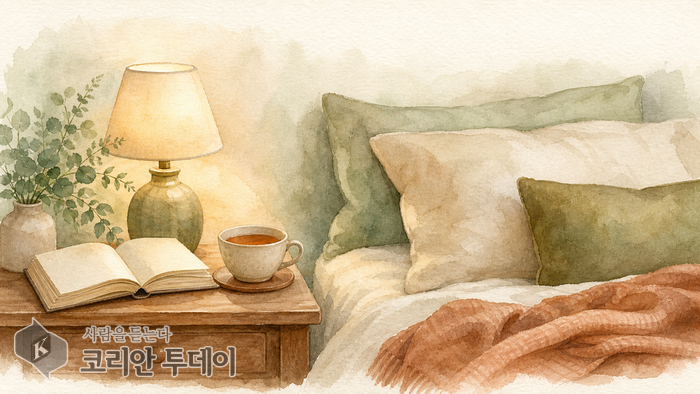
It helps to mark the time after that boundary as time that belongs entirely to you. One way is to dim about half the lights in the house, leaving only the soft glow of a lamp. Under bright light, the mind tends to keep working as if it were still day, but under low light, the body finds it easier to sense that the day has drawn to a close. Things that make the mind busy again, like television news or updates on your phone, can be set aside, at least for this stretch of time.
Of course, in the reality of caregiving, this boundary often gets broken. There will be nights you have to get up again at the sound of a call in the dark. On those nights, instead of blaming yourself for failing to keep the boundary, simply come back and repeat the same words, even briefly. What matters is not keeping it perfectly, but planting your own signal in your mind for closing the day.
Letting the body settle before the mind
The harder you try to stop your thoughts, the louder they tend to grow. At such times, it is far easier to soothe the body first, rather than wrestle with the mind. When the body grows warm and loose, the mind often grows quiet in turn. Simply washing your hands and feet in warm water in the evening, or sitting with a favorite blanket over your knees, is enough to signal to the body that it is time to rest.
Adding slow breathing helps as well. Brew a warm, caffeine-free cup of tea, wrap both hands around the cup, watch the steam rise, and breathe in slowly, then breathe out a little longer than you breathed in. Repeat this just three or four times, and you may feel your shoulders quietly drop. Having worked with scents, I enjoy keeping a soft, favorite fragrance nearby at this hour. Whether it is lavender or the scent of tangerine peel, a scent you love can be a gentle companion, easing a mood stiffened by the day’s tension.
But whether it is scent, tea, or a blanket, none of these things bring on sleep by themselves. They are more like small, kind props that send the body the signal that it is now allowed to rest. Repeating a similar sequence every evening means that simply bringing out these props can be enough to get the body ready to rest — so I encourage you to pick one or two that suit you and make them your own evening ritual.
Moving the worries in your head onto paper
Worrying while lying down rarely resolves anything; it only goes in circles. In the dark, even a small worry can appear far larger than it really is. That is why, before getting into bed, it can help to move what is drifting through your mind onto paper. The mind tries to stay awake all night holding on to ‘things I mustn’t forget’ — but writing them down on paper removes one reason to keep holding on.
The simpler the method, the better. Keep a small notepad and pencil by your bedside, and before sleep, write down just three lines about what is weighing on your mind. These can be tasks, like ‘call the hospital tomorrow’ or ‘check how many days of medication are left,’ or feelings, like ‘it bothers me that I was a bit short with Mother today.’ Once you have written them down, close the notepad and decide: ‘This is for tomorrow’s daytime me to handle.’ This does not erase the worry — it simply moves where the worry is kept, from your head to the notepad.
Since the notepad is already open, it can help to use the last line to write down one moment from the day that was, after all, good. Something small is enough — the look on your parent’s face enjoying a side dish, or a lovely sunset glimpsed through the window. Ending the day’s final line not with worry but with a small comfort can change the mind’s expression a little as you drift off to sleep.
For the nights when sleep still won’t come
Even after carefully closing out the evening, there will be nights when sleep still does not come. On such nights, the thing to avoid most is scolding yourself with ‘why can’t I sleep again.’ Sleep tends to slip away the harder you chase it, and the very anxiety over needing to sleep can leave your eyes more wide awake. Instead of berating yourself for not sleeping, try stepping back and thinking, ‘I suppose my mind still has something left to say today.’
If you find yourself only tossing and turning under the blanket for a long while, it helps to get up for a bit and sit under the low light of a lamp instead. Read a few pages of something undemanding, or wrap yourself in a blanket and sit quietly, breathing slowly, and return to bed once your eyelids grow heavy. The bed should remain a place you return to when sleepy, not a place where you struggle to force sleep — that way, the relationship between you and the night does not go sour.
And please remember this: resting well at night is not some luxury for your own comfort alone — it is the most basic preparation for caring for someone again tomorrow. If you break down, the caregiving falters along with you, so looking after your own sleep is, in its own way, looking after the person you love. So tonight, perhaps give a little more care to the task of putting yourself to sleep.
Today’s Heart-Care Practice
★☆☆Tonight, about an hour before bed, dim about half the lights in your home, leaving only a lamp or small light on. Then say aloud, ‘That’s it for today.’ The low light and closing words send body and mind the signal that the day has ended, which can help you let go of tension.
★★☆Brew a warm, caffeine-free cup of tea and sit holding the cup in both hands. Feeling the warmth in your palms, breathe in slowly through your nose and out a little longer through your mouth, five times. Lengthening the exhale tends to ease the body’s tension, which can help calm the mind.
★★★Keep a small notepad and pencil by your bedside, and before sleep, write down three lines. In the first two lines, write what is on your mind or what you need to do tomorrow; in the last line, write one moment from today that was, after all, good — then close the notepad. Entrusting your worries to paper lightens the load your mind would otherwise carry through the night, which can help you close your eyes with a somewhat lighter heart.
If sleepless nights continue for a long stretch, or if daytime life becomes exhausting to bear, please do not endure it alone — seek counsel at a nearby medical institution. Today’s discussion is not a treatment, but a set of everyday habits for gently closing out the day.
For more heart-care stories, visit the Korea Self-Healing Association.
Kim Mi-hee is an aromatherapist and columnist with the Korea Self-Healing Association. Drawing on her own experience of caring for aging parents, she writes to comfort the hearts of caregivers. The Korean Today, Nam-Incheon.
#WeAssamCaregivingSignal #MindfulCaregiving #EveningRoutine #FamilyCaregiving #SelfCare #KoreanTodayIncheonNamdongBureau
[ Reporter Kim Mi-hee: incheonsouth@thekoreantoday.com ]
Become a Local Ambassador Apply as Branch Director The Korean Today — Nam-Incheon
 |
THE KOREAN TODAY × WIA CODE
이 기사의 WIA Code

WIA Code 스캐너로 비추면 인터넷 없이 발행 사실과 위·변조 여부를 확인할 수 있습니다.
휴대폰 기본 카메라로 찍으면 스캐너 안내 페이지가 열립니다 — 기사 바로 열기

움직이는 코드는 스트림입니다 — WIA Code 스캐너로 약 32초 비추면 기사 전문(사진 포함)이 폰에 저장되어 인터넷 없이도 읽을 수 있습니다.
WIA Code · 코리안투데이






Leave a Reply