
Ongjin-gun County (Governor Chang Jung-min) has launched field training aimed at transforming the character of local agriculture from a production-centered model into a high-value-added industry that combines processing, distribution and experiential programs. The county announced on July 3 that it conducted a tour of advanced farming sites and training to strengthen sixth-industry capabilities for the 11th class of students at the Ongjin-gun Agricultural College in the Paju area of Gyeonggi Province over two days, from July 2 to 3.
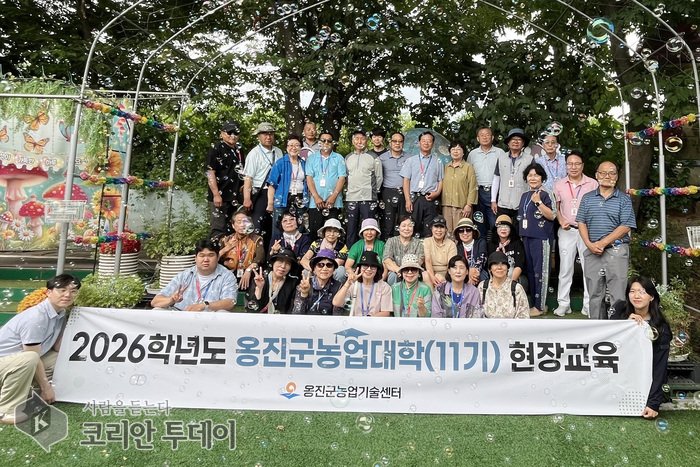 [The Korean Today] 11th-class Paju sixth-industry field training at Ongjin-gun Agricultural College © Reporter Kim Mi-hee |
The sixth industry refers to a model that raises farm income and added value by combining primary production — the cultivation and harvesting of agricultural products — with processing (secondary) and services such as distribution, experiential programs and tourism (tertiary). The training focused on elevating farmers’ expertise by one step while allowing them to move beyond farming practices confined to simple production and to experience firsthand successful sixth-industry cases that link processing, distribution and experiential programs. The aim was to learn on-site the concrete ways in which agricultural products can command fair prices in the market and generate new added value.
On the first day of training, the students visited the Sanmeoru Farm to tour its brewing and processing facilities and examples of experiential farm operations. There, the trainees observed the process of developing agricultural products into processed goods and using the farm as an experiential space, learning value-creation strategies that generate higher profits from the same agricultural products.
The participants then visited the National Institute of Biological Resources and the Duri Mushroom Farm to tour high-quality mushroom cultivation techniques and substrate production processes. By observing firsthand the substrate production process that forms the foundation of mushroom cultivation, they learned methods for stable quality management and improved productivity.
Finally, at the Yulgok Arboretum, they experienced a healing-agriculture program that utilizes forest resources. The students examined a case of convergent operations in which agriculture combines with tourism and services to create new demand, gaining broad exposure to the various forms in which the sixth industry is realized in actual practice.
The president of the 11th class of the Ongjin-gun Agricultural College, who took part in the training, said, “Being able to observe the entire process of processing and distribution firsthand on-site made the direction that Ongjin agriculture should take even clearer,” adding, “I will do my best, together with my classmates, to acquire specialized skills so that we do not fall behind in the rapidly changing farming environment.”
An official from the Agricultural Technology Center said, “This field training was arranged so that farmers can experience firsthand exemplary sixth-industry cases that link processing, distribution and experiential programs beyond production, and strengthen the practical capabilities to apply these to local agriculture,” adding, “We will continue to expand field-centered, effective training and tailored support so that we can enhance farmers’ expertise and strengthen the competitiveness of local agriculture going forward.”
As Ongjin-gun, which consists mostly of island areas, faces limited farming conditions, attention is focused on whether a sixth-industry strategy that raises added value rather than expanding output can lead to a real improvement in income for local farm households. Interest is growing in how this field training, conducted through the agricultural college, will serve as a foundation for shifting the direction of local agriculture.
[ Reporter Kim Mi-hee: incheonsouth@thekoreantoday.com ]
Become a Local Ambassador Apply as Branch Director The Korean Today — Nam-Incheon
 |
THE KOREAN TODAY × WIA CODE
이 기사의 WIA Code

WIA Code 스캐너로 비추면 인터넷 없이 발행 사실과 위·변조 여부를 확인할 수 있습니다.
휴대폰 기본 카메라로 찍으면 스캐너 안내 페이지가 열립니다 — 기사 바로 열기

움직이는 코드는 스트림입니다 — WIA Code 스캐너로 약 50초 비추면 기사 전문(사진 포함)이 폰에 저장되어 인터넷 없이도 읽을 수 있습니다.
WIA Code · 코리안투데이


Leave a Reply