
By Columnist Kim Mi-hee
Why Does a Caregiver’s Breath Grow So Shallow?
Caregiving is always the work of preparing for what comes next. When the tasks line up in your mind — the time for medication, preparing meals, doctor’s appointments, helping to the bathroom — your body naturally stiffens into a state of tension. At such times, our breath rises and falls only high in the chest, short and unnoticed. A shallow, hurried breath, with no room to draw in deeply, continues all day long.
That scene is probably familiar to you. Even in the moment when you help your mother sit down, straighten the rumpled blanket, and turn back to the kitchen to warm the cooled soup, we never once properly catch our breath. Only when evening comes and we finally sink onto the sofa do we feel the tightness in the center of our chest and the ache in our shoulders. That signal from the body may be a quiet plea: ‘Please take care of me, too.’
And so I do not recommend anything grand. Simply noticing your shallowed breath once a day and exhaling a little more deeply can help ease the body’s tension by a small measure. Breath is the comfort we can most easily offer ourselves, with no tools at all.
The Meaning Held in ‘Three Minutes’
There is a reason I suggest three minutes. When you tell caregivers to ‘meditate for 30 minutes’ or ‘start exercising,’ those words often become just one more chore. Comfort that makes you blame yourself for what you couldn’t do is not comfort at all. So three minutes is a length that carries no burden — something you can quietly manage without even resolving to.
Three minutes is time you can find while the soup warms, while the washing machine finishes its last cycle, or while your mother has closed her eyes for a moment. There is no need to go anywhere special. Standing at the kitchen window, or right where you are sitting, you simply lower your eyelids halfway and rest your mind on your breath alone. Because it is short, it is all the easier to continue each day, and because you continue each day, it can gradually settle into your body.
I hope you will receive this time not as something you ‘must accomplish’ but as permission that ‘it is all right to pause for a while.’ In three minutes, the world will not collapse, and your parents will be safe. That brief pause can become the strength to endure the rest of the day.
A Cup of Herbal Tea by the Window, a Time to Soothe the Heart Through Scent
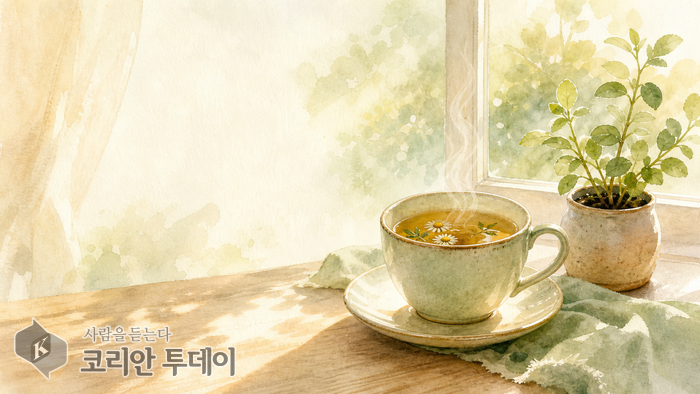
When you catch your breath, having a warm cup of tea beside you makes that time far gentler. I often brew herbal tea like chamomile or peppermint by the window where the morning light comes in. As I quietly watch the steam rising from the cup and slowly draw its faint scent through my nose, I feel my heart loosen a little. Scent does not cure anything; it quietly soothes the mood of this very moment.
It need not be tea. You may lightly rub the leaf of a small potted plant beside you between your fingertips and smell its grassy scent, or spread a favorite hand cream over the back of your hand and linger a moment in its fragrance. What matters is focusing, even briefly, on ‘my own senses.’ It is a time to bring the nerves that have been on edge for others all day back, for a moment, to your own nose and fingertips.
When you add scent and warmth in this way, three minutes of breathing becomes not merely breathing but a small ritual of self-care. As you repeat this time each day in the same spot, with the same scent, simply smelling that scent will let your heart recognize, ‘Ah, now it is time to rest.’ That one familiar signal places a small comma in a weary day.
With a Heart That Says It Is All Right Not to Be Perfect
As you do your three minutes of breathing, all sorts of thoughts will rush in. The words you heard at the hospital today, the things left unsaid among siblings, the tasks to see to tomorrow — they all rise up in a line the moment you close your eyes. At such times, you need not scold yourself, thinking, ‘Why can’t I even do this properly?’ Thoughts arising is entirely natural, and simply bringing your mind back to your breath is enough.
Caregivers are especially hard on themselves. You feel sorry that you couldn’t care for them better, and a single irritable word weighs on your heart for a long time. I know that weight well. But no one can care for another for long while exhausted. Catching your own breath first is not selfish; it is preparation for staying by their side for a long time.
So even if some days your three minutes stop at one, and other days you forget it entirely, do not reproach yourself. You can simply stand at the window again the next day. The goal is not to do it perfectly; the very heart that does not forget yourself and looks back now and then — that itself is today’s practice.
Today’s Heart-Care Practice
★☆☆Right where you are sitting, raise your shoulders up high once and let them drop with a ‘whew.’ Do it just three times. It can help release the tension gathered in your shoulders, leaving your body a little lighter.
★★☆Standing at the window, slowly breathe in through your nose to a count of four, then exhale long through your mouth to a count of six. Repeat this for three minutes. Lengthening the out-breath can help the body’s tension gently unwind.
★★★Brew a favorite herbal tea and set it by the window, and continue the breathing above while feeling the rising steam and scent. Adding scent and warmth can help this time settle into a rest of your own that you want to return to each day.
Enjoy herbal tea or scents lightly, only as much as it soothes your mood, and if you have allergies or take any medication, check with a place where you can comfortably ask before trying a new tea. If your body feels unusually heavy or your spirits stay low for a long time, please do not bear it alone — share what is in your heart with someone close.
For more heart-care stories, visit the Korea Self-Healing Association.
Kim Mi-hee is an aromatherapist and columnist with the Korea Self-Healing Association. Drawing on her own experience of caring for aging parents, she writes to comfort the hearts of caregivers. The Korean Today, Nam-Incheon.
#WeArmSaemMindCareSignal #CaregiverSelfCare #ThreeMinuteBreathing #ACupOfHerbalTea #SoothingAWearyHeart #CaregivingInYour50sAnd60s #ACommaByTheWindow
“Today, a heart that cares for me.”
Korea Self-Healing Association
[ Reporter Kim Mi-hee: incheonsouth@thekoreantoday.com ]
Become a Local Ambassador Apply as Branch Director The Korean Today — Nam-Incheon
 |
THE KOREAN TODAY × WIA CODE
이 기사의 WIA Code

WIA Code 스캐너로 비추면 인터넷 없이 발행 사실과 위·변조 여부를 확인할 수 있습니다.
휴대폰 기본 카메라로 찍으면 스캐너 안내 페이지가 열립니다 — 기사 바로 열기

움직이는 코드는 스트림입니다 — WIA Code 스캐너로 약 30초 비추면 기사 전문(사진 포함)이 폰에 저장되어 인터넷 없이도 읽을 수 있습니다.
WIA Code · 코리안투데이






Leave a Reply