
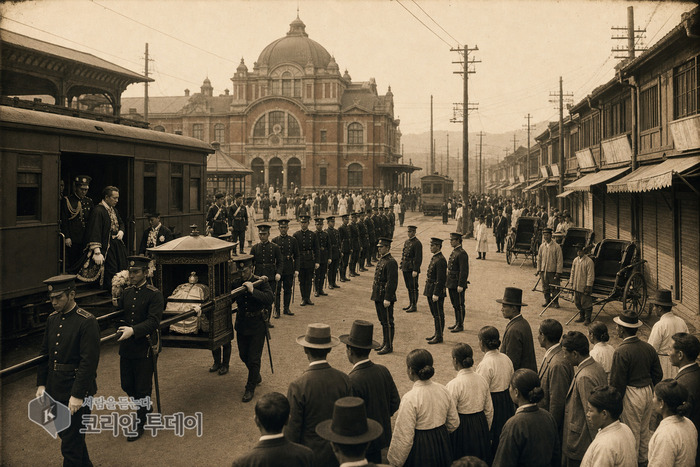
Good evening. It’s 10:10 PM KST (1:10 PM UTC), October 13, 1925 — a Tuesday — one hundred years ago tonight, and this is “100 Years Ago Today.” Under a crisp autumn sky, Gyeongseong (colonial-era Seoul) had been on edge since dawn. Police lined the streets around Gyeongseong Station and Namdaemun-tong. Two days from now, on Namsan mountain, the newly built Chōsen Jingū — the Japanese imperial shrine imposed on occupied Korea — would hold its consecration ceremony. Today, its most sacred cargo was arriving by train.
Korea Under Colonial Rule
The man who stepped off the train at Gyeongseong Station that day was Viscount Sonoike Saneyasu, an imperial envoy dispatched from the Ise Grand Shrine in Japan. He carried with him a mirror and a sword once used by Emperor Meiji, along with the sacred vessel (mitamashiro) believed to hold the spirit of the sun goddess Amaterasu Omikami. Two days later, on October 15, these objects would be formally enshrined at Chōsen Jingū in a consecration rite known as the jinza-sai.
The Gyeonggi Provincial Police Department had been mobilizing since the start of the month. Precinct chiefs had been summoned and assigned zones; plainclothes officers were already stationed throughout the city. On the day of the envoy’s arrival and again on the 15th, every police officer in Gyeongseong was to be put on the street — with instructions to detain anyone who looked even slightly suspicious.
Newspapers of the day reported that market merchants had agreed to close their shops for the day “as a gesture of reverence toward Chōsen Jingū.” It was written up as a voluntary decision. But it was a “voluntary” decision made in the middle of a city placed under total police lockdown — a distinction worth sitting with.
This was not an isolated ceremony. The Government-General had already built shrines large and small across the peninsula, and directives encouraging worship had been issued to government offices and schools throughout the colony. The Namsan shrine now being prepared was the capstone of that campaign — a state religion built for a people who had not chosen it.
East Asia in Turmoil
Colonial Korea’s carefully staged reverence stood in stark contrast to events unfolding elsewhere in East Asia that same week. Just three days earlier, on October 10, the Forbidden City in Beijing — home to the Ming and Qing emperors for five centuries — opened to the public as the Palace Museum, its 1.86 million imperial artifacts now belonging, at least in name, to the Chinese people rather than a throne. In China’s south, the Kuomintang under the late Sun Yat-sen’s successors continued consolidating control over Guangdong following his death in March.
Meanwhile in Korea, the aftermath of catastrophe was still being counted. The great Eulchuk flood of July 1925 had killed 647 people nationwide, destroyed or swept away over 23,000 homes, and left another 46,000 submerged — total damage exceeding 103 million yen, more than half the Government-General’s annual budget. Relief had leaned heavily on newspaper-organized donation drives rather than the colonial state. Yet in October, it was police manpower for a shrine, not flood relief, that commanded Gyeongseong’s full attention.
The World Stage
Across the globe in Locarno, Switzerland, delegates from Germany, France, Britain, Italy, and Belgium were deep in negotiations over a set of treaties meant to guarantee Europe’s postwar borders. The talks, running from October 5 to 16, were led by Germany’s Gustav Stresemann, France’s Aristide Briand, and Britain’s Austen Chamberlain — statesmen from nations that had spent the previous decade at war with one another, now trying, however imperfectly, to build a framework for peace.
It is a jarring juxtaposition: in Europe, former enemies negotiating mutual security as equals; in colonial Korea, a subject population placed under police lockdown to receive the sacred relics of the very empire ruling over it.
Colonial Parallels
Korea was far from alone in living under this kind of imposed authority in 1925. In India, the Swaraj Party — having won seats in the Central Legislative Assembly — was pursuing a strategy of legislative obstruction from within British colonial institutions, refusing cooperation while working inside the system Britain had built. In Ireland, independence achieved in 1922 was still an unfinished settlement; the Boundary Commission process that year would leave the 1920 partition essentially unchanged, disappointing nationalists who had hoped for a different outcome.
Each case looked different on the surface — a shrine ceremony in Seoul, a legislature in Delhi, a border commission in Belfast — but they shared a common thread: colonized peoples negotiating, resisting, or simply enduring institutions imposed from outside, at a moment when the language of self-determination was spreading around the world even as empires worked to entrench themselves.
Person of the Day: Viscount Sonoike Saneyasu
The imperial envoy at the center of this day’s events was no ordinary bureaucrat. As a viscount and a personal representative of the Japanese imperial household, Sonoike’s journey from Ise to Gyeongseong was itself a piece of political theater — the physical transfer of imperial legitimacy from the Japanese homeland to a shrine built on occupied soil. He traveled with the mirror and sword of the deceased Emperor Meiji and the mitamashiro of Amaterasu, objects treated not as symbols but as literal vessels of divine and imperial presence.
For the colonial administration, his arrival was the ceremonial midpoint of a project years in the making: establishing Shinto worship as a unifying, and ultimately coercive, institution across Korea. For ordinary Gyeongseong residents watching police fan out through their neighborhoods that Tuesday, his arrival meant something far more immediate — a day to keep their heads down and their shops, for once, closed.
Understanding Daily Life
What did October 13, 1925 actually feel like on the ground in Gyeongseong? From dawn, officers reported to their assigned precincts and fanned out to designated zones. By midday, plainclothes police were watching the crowds around the station, and a number of Jongno shopkeepers had shuttered their storefronts for the day. Foot traffic near the Umigwan theater — normally one of the busiest entertainment spots in the city — thinned noticeably.
The rice economy carried on regardless: 1925’s average rice price stood at roughly 19 yen 26 jeon per seok, up from 16 yen 23 jeon in 1920, as the colonial government’s rice-production expansion policy continued reshaping the countryside. By evening, patrols were still out, and conversation in the streets — what there was of it, under close watch — turned to what would happen on Namsan in two days’ time.
Century Mirror
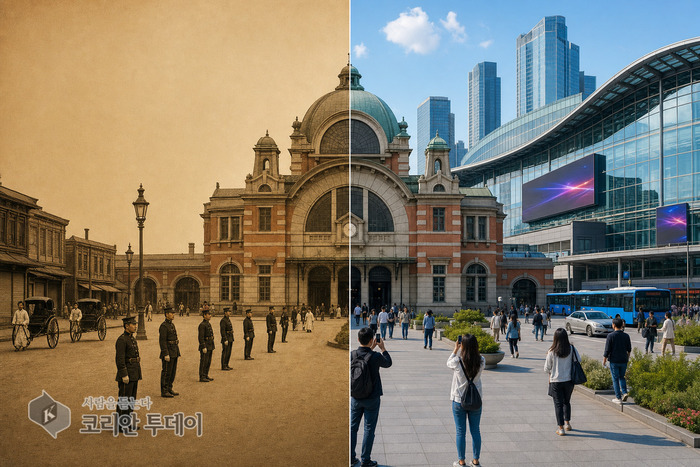
A hundred years ago, a Tuesday in Gyeongseong meant a city placed under total surveillance to receive a foreign imperial relic it had no say in accepting. Shops didn’t close because their owners chose a holiday — they closed because refusing “reverence” under a fully mobilized police force was not a real option.
Today, when Korean authorities deploy security for a state event, it’s calibrated to the occasion, and businesses open or close entirely at their own discretion. National symbols are chosen through public consensus, not installed by an occupying power under armed guard. The word “security” hasn’t disappeared in a century — but who it protects, and from whom, has been completely inverted.
Tomorrow’s Preview
Tomorrow, October 14, is the final day before the Chōsen Jingū consecration. The shrine grounds on Namsan will be in their last stages of preparation, and Gyeongseong’s streets will grow tenser still. Sleep well — we’ll be back tomorrow evening at 10:10 PM KST.






Leave a Reply