
ESG Green Signal · Ep.19
✏️ Changhee Baek | ⏱️ 7 min read
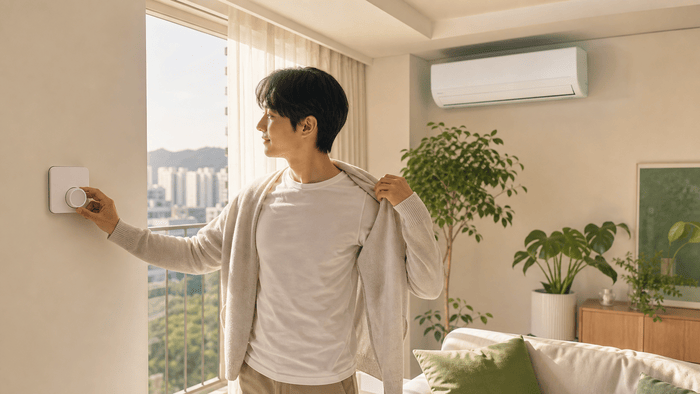
ESG Green Signal Ep.19 · The Power of One Degree
A small thermostat adjustment can make both our homes and the planet more comfortable
On a summer day, many of us reach for the air conditioner remote as soon as we get home. On a winter morning, we may turn up the heat before we are fully awake. Using heating and cooling when we are hot or cold is perfectly natural. Environmental action does not have to begin with enduring discomfort.
Still, we can pause before automatically making a big temperature change. We might adjust the curtains, change what we are wearing, and then reconsider the setting by just one degree. This almost invisible choice can be the beginning of climate action in everyday life.
🌱One Degree Is Fine-Tuning, Not Sacrifice
Heating and cooling require energy, and the way that energy is produced can be connected to climate change. Avoiding unnecessarily high or low indoor settings can therefore help reduce wasted energy. The point is not to endure discomfort at all costs, but to fine-tune the temperature thoughtfully for our bodies and our space.
Even in the same room, comfort changes with sunlight, humidity, airflow, and clothing. In summer, try light, breathable clothes and circulate the air with a fan. In winter, add socks or a light layer and open the curtains when sunlight comes in. These steps may make the room feel more comfortable without an immediate change to the thermostat. Adjusting the surrounding conditions first—and checking the temperature second—is a useful order to remember.
🌱Keep Comfort from Leaking Away
Even hardworking heating and cooling systems struggle to maintain a comfortable room when outdoor air keeps entering through gaps around doors and windows. Close the doors of unused rooms, check for drafts, and use seasonally appropriate curtains or blinds. Cleaning system filters and removing objects that block airflow can also help.
In a shared home, one person should not impose the “right temperature” on everyone else. Ask how each family member feels, and always put the health and safety of children, older adults, patients, and others who are more sensitive to temperature changes first. Environmental action within ESG should not depend on someone else’s discomfort or sacrifice. It should be a process of finding a safe way for everyone to participate.
🌱Choose Habits You Can Repeat
Simply thinking about one degree whenever you touch the remote may not transform your life overnight. But checking the system before leaving home, reducing heating or cooling in empty spaces, and inspecting filters and window gaps as the seasons change can gradually reshape the way you use energy. Instead of asking, “How much discomfort did I endure today?” it is more sustainable to ask, “What did I avoid wasting today?”
It also helps to make the effort collective. Agree on a comfortable range with your family, and politely suggest an adjustment when heating or cooling seems excessive at work. As these small agreements accumulate, temperature settings become more than a personal preference. They become a shared habit of caring for one another and the environment.
💡 Action Guide
★☆☆ Pause for Ten Seconds
Before changing the thermostat, try adjusting your clothing, curtains, and airflow to improve comfort first.
★★☆ Check Empty Spaces
When leaving home or a room for a long time, check whether an empty space is being heated or cooled unnecessarily.
★★★ Make a Home Agreement
Discuss everyone’s health needs and comfort to create heating and cooling guidelines that are safe for the whole family.
⚠️ Watch Out For This
Do not treat a single temperature as a universal answer or force people to endure excessive heat or cold. Heating and cooling needs vary with the building, season, and each person’s health. Likewise, rather than replacing appliances frequently because a product is labeled “eco-friendly,” maintain existing equipment properly and review recognized energy information carefully when a replacement is genuinely needed.
Climate action does not begin only with grand resolutions. The next time you pick up the remote, pause before pressing a button and check how your body and the room actually feel. When we repeat this one-degree adjustment—protecting comfort while reducing waste—the small thermostat in our homes can become a green signal pointing toward a better tomorrow.

Changhee Baek
Gyeonggi-Hanam Branch Chief, The Korean Today
ESG Management Columnist
Sustainability Consultant
Director, WIA Journalists Association
#ESGaction #SustainableLiving #GreenSignal #SmallStepsBigChange
Your story, too, can become a book — together with WIA Book Healing.
 |

THE KOREAN TODAY × WIA CODE
이 기사의 WIA Code

WIA Code 스캐너로 비추면 인터넷 없이 발행 사실과 위·변조 여부를 확인할 수 있습니다.
휴대폰 기본 카메라로 찍으면 스캐너 안내 페이지가 열립니다 — 기사 바로 열기
움직이는 코드(스트림) 한 장에 기사 전문(사진 포함)이 담겨 있습니다 — WIA Code 스캐너로 약 72초 비추면 폰에 저장되어 인터넷 없이도 읽을 수 있습니다. Stream.mp4 도 여기서 받습니다.
WIA Code · 코리안투데이




Leave a Reply