
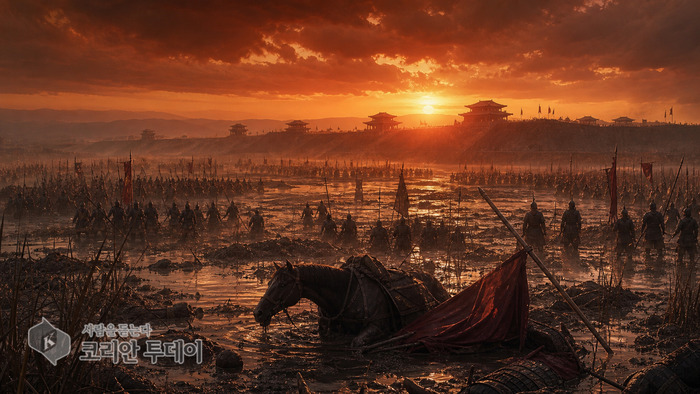
A king was beheaded while his horse floundered in the mud. In that instant, the balance of power in ancient Northeast Asia quietly shifted forever.
In February of 22 CE, King Daeso of Buyeo was killed by the very kingdom founded by a young man he had once driven out of his own palace: Jumong, founder of Goguryeo. Daeso’s father, King Geumwa, had been the one who took in and raised Jumong; it was Daeso himself who forced the talented young man to flee. Two decades later, Daeso’s life ended at the hands of the nation that exile had created.
A story that feels strikingly modern – a large company mistreats a brilliant employee, who leaves to found a rival, and twenty years later that rival threatens the parent company itself – had already played out on the plains of Manchuria two thousand years ago. Why couldn’t Eastern Buyeo hold on to the talent it had raised?
🌍 Western Historical Parallel
When King Daeso fell in 22 CE, Rome’s Emperor Tiberius (r. 14-37 CE) was carefully securing succession by granting his son Drusus tribunician power – the very thing Buyeo’s royal house failed to do, and the failure that shattered it into three pieces within weeks of the king’s death.
◆ The Ancient Landscape
According to the Samguk Sagi and Samguk Yusa, King Haebu-ru of Buyeo relocated his capital to Gaseobwon, “a land by the eastern sea,” after his minister Aranbul relayed a divine command, and the relocated kingdom came to be called Eastern Buyeo (Dongbuyeo). Haebu-ru, childless into old age, prayed at the shores of a pond called Gonyeon and there found a golden frog-shaped infant – this was Geumwa, who succeeded him as king. Under King Geumwa, a woman named Yuhwa, daughter of the river god Habaek, was confined in the palace and gave birth to an egg, from which hatched a boy so skilled with a bow that he was named Jumong.
The trouble was Geumwa’s eldest son, Daeso. Wary of Jumong’s extraordinary talents from an early age, Daeso repeatedly urged his father to eliminate him; when Geumwa refused, Daeso openly demoted Jumong to menial work tending horses. Around 37 BCE, Jumong fled south with a handful of loyal followers and founded Goguryeo at Jolbon. After Geumwa’s death, when Daeso ascended the throne, the relationship between the two states flipped completely – from brother nations to bitter rivals.
“King Daeso’s horse sank into the mire and could not be freed. Thereupon Goeyu, a common soldier of Goguryeo, advanced and struck him down.”
◆ Same Era, Different Worlds
🏛️ China
22 CE fell in the twilight years of Wang Mang’s short-lived Xin dynasty, as the Red Eyebrows and Green Forest rebellions spread and the Later Han restoration (25 CE) loomed. Buyeo and Goguryeo waged their own border war against the backdrop of this Chinese upheaval.
🗿 Roman Empire
That same year, Emperor Tiberius secured his succession by granting tribunician power to his son Drusus – the deliberate contingency planning that Buyeo’s monarchy, undone by Daeso’s sudden death, conspicuously lacked.
⚔️ Western Europe
Germanic tribes beyond the Rhine remained a loose federation of chieftaincies, a decade after Arminius’s destruction of three Roman legions at Teutoburg Forest – still without the centralized kingship that Buyeo and Goguryeo had already built.
🕌 Japanese Archipelago
Japan was still in the late Yayoi period, with small village-based polities only beginning to coalesce – far from the conquest-state model of centralized kingship that Buyeo and Goguryeo had already achieved.
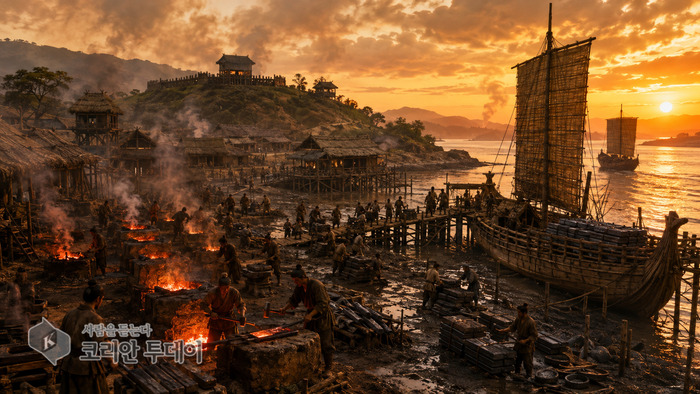
[Image: King Daeso’s death and the fragmentation of Buyeo (21-22 CE)]
⚔️ Scene from That Day
“The horse’s legs churned uselessly in the mud. King Daeso yanked the reins and looked back – his soldiers were trapped in the same mire.”
“As the Goguryeo soldier Goeyu drew his blade and closed in, the king of Buyeo may have remembered, for an instant, the young stable hand he had once humiliated in his own palace two decades earlier. The kingdom that young man built now held its sword at his throat.”
◆ Uncovering Historical Truth
Daeso’s death was no ordinary battlefield casualty – it was the hinge on which regional power pivoted. The Samguk Sagi records that in February of the fifth year of King Daemusin’s reign (22 CE), the Goguryeo king advanced to the Biryu River, where an unprepared Daeso attempted a surprise counterattack, only to have his horse sink into the mud. Tellingly, Buyeo’s army did not collapse after its king’s death – the record notes that Buyeo’s forces surrounded the Goguryeo army so tightly that Daemusin nearly perished, escaping only after his men disguised straw dummies as soldiers under cover of fog. Buyeo’s downfall, in other words, was not a military failure but a leadership vacuum.
The kingdom split into three within weeks of Daeso’s death. A cousin of the fallen king led roughly ten thousand Buyeo subjects in mass surrender to Goguryeo that same year. Meanwhile, Prince Galsa – the youngest of Daeso’s six brothers – sensed the kingdom’s coming ruin and fled south with about a hundred followers. At the Amrok Valley, they killed the visiting king of Haeduguk during a hunting expedition and absorbed his people, founding the new state of Galsaguk on the banks of the Galsa River in April of 22 CE. The Buyeo homeland’s royal court endured, but its power had already fractured into three pieces.
Here the historical irony completes itself. Two decades earlier, Jumong – exiled by Daeso – had founded Goguryeo and grown it by absorbing Buyeo refugees; now, in the very moment Daeso himself created, Prince Galsa was forced to repeat the pattern, founding a splinter state of his own. A talented outsider forced from the center builds a new organization at the periphery, and that organization eventually eclipses the parent – Goguryeo, born of Buyeo’s own exile policy, would in time absorb the whole of Buyeo’s former territory. Galsaguk itself lasted only three generations: in 68 CE, King Dodu, Galsa’s grandson, voluntarily surrendered to Goguryeo, and the splinter state vanished from history.
Period
22 CE (Year 5 of King Daemusin)
Key Figures
King Geumwa, King Daeso, Prince Galsa
Capital Region
Jilin, present-day China
Outcome
Buyeo splits three ways; Goguryeo rises
🔍 International Academic Perspectives
Korean/East Asian Scholars
Relying on the Samguk Sagi and Samguk Yusa, most Korean historians treat the Haebu-ru-to-Geumwa-to-Daeso succession as a factual royal line, and read Daeso’s death in 22 CE as the real turning point in Buyeo’s decline and Goguryeo’s rise.
Textual Critics
Some researchers argue the term “Eastern Buyeo” and the Haebu-ru-Geumwa genealogy may have been retroactively compiled centuries later (after the 3rd century), cautioning against reading early Buyeo history solely through a Goguryeo-centric lens.
📖 Key Terms Explained
- Buyeo (夫餘)
- Ancient kingdom in present-day Manchuria (c. 2nd century BCE – 494 CE), regarded as the ancestral state of Goguryeo and Baekje’s ruling houses.
- Galsaguk (曷思國)
- Short-lived splinter state (22-68 CE) founded by a fleeing Buyeo prince; also called Galsa-Buyeo. Surrendered to Goguryeo after three generations.
- Roman Empire under Tiberius
- Second Roman emperor (r. 14-37 CE), whose contemporaneous succession planning stands in sharp contrast to Buyeo’s leaderless collapse.
◆ Lessons for Today’s World
Translated into the language of modern organizations, the failure of Geumwa and Daeso reads as a textbook case of talent mismanagement and succession risk. When an organization recognizes talent yet still sidelines it because of internal politics, that talent does not disappear – it goes elsewhere and builds something new. And when the parent organization later stumbles at a moment of leadership crisis, the upstart is positioned to strike.
Even more striking is the mass defection of roughly ten thousand Buyeo subjects to Goguryeo the moment their king fell. An entire workforce absorbed by a rival the instant leadership vanished bears an uncanny resemblance to the modern “acqui-hire,” where a startup absorbs a rival’s core team wholesale, or the talent exodus that follows a leadership vacuum at a major corporation today.
| Aspect | Buyeo & Samhan Era | Modern Parallel |
|---|---|---|
| Politics/Security | A king dies suddenly with no succession plan; the kingdom splits three ways | Founder/CEO risk and governance crises from unresolved succession |
| Military/Diplomacy | A rising Goguryeo strikes fast; the established power fails to respond | Market leaders disrupted by agile startups |
| Culture/Spirit | A sidelined talent (Jumong) founds a rival; ten thousand defect in a leadership vacuum | Corporate politics driving talent exodus; team-wide departures and spin-off founding |
[Image: Buyeo’s three-way split as an analogy for modern spin-off founding]
📚 Diving Deeper
- The leading candidate sites for Buyeo’s royal capital – Nong’an county and Yongtan Mountain fortress near Jilin City, China – remain under active excavation, with Iron Age “Paoziyan-type” artifacts used to map the kingdom’s territorial extent.
- King Daemusin’s famed escape – disguising straw dummies as soldiers under cover of fog to break a Buyeo encirclement – is often cited as an early example of the deception tactics that would become a hallmark of Goguryeo warfare.
- Galsaguk’s final king, Dodu, voluntarily surrendered to Goguryeo in 68 CE – a microcosm of how Buyeo-descended statelets were gradually absorbed into the Goguryeo system in the centuries before the Three Kingdoms era proper.
The Voice of Living History
Where King Daeso fell in the mud, Buyeo’s age of dominance ended and Goguryeo’s began. The fate of a kingdom that fails to keep its talent is always the same: it eventually yields its place to the very nation that talent, once exiled, went on to build.
“Buyeo split apart, but its blood and its name lived on within Goguryeo.”
Previous Episode
Episode 3: Yeonggo – Greeting Heaven in the Dead of Winter
Next Episode
Episode 5: The Fallen Capital, the Reclaimed Kingdom – The Restoration under Kings Uiryeo and Uira
The Korean Today “History Lives On” Series
The Buyeo & Samhan Chronicle (13 Episodes)
Bridging Ancient East Asia and the Modern World
© 2025 The Korean Today. All rights reserved.
This content is based on historical facts and presents balanced academic perspectives
for international readers.
THE KOREAN TODAY × WIA CODE
이 기사의 WIA Code

WIA Code 스캐너로 비추면 인터넷 없이 발행 사실과 위·변조 여부를 확인할 수 있습니다.
휴대폰 기본 카메라로 찍으면 스캐너 안내 페이지가 열립니다 — 기사 바로 열기
움직이는 코드(스트림) 한 장에 기사 전문(사진 포함)이 담겨 있습니다 — WIA Code 스캐너로 약 26초 비추면 폰에 저장되어 인터넷 없이도 읽을 수 있습니다. Stream.mp4 도 여기서 받습니다.
WIA Code · 코리안투데이


Leave a Reply