

A kingdom that endured for 705 years vanished from the map in the autumn of 668 CE. Or did it, really?
From the founding by King Jumong at Jolbon in 37 BCE to the fall of Pyongyang Fortress in September 668 CE, Goguryeo endured for 705 years – a span longer than Rome’s transition from Republic to divided Empire and beyond. Across 28 kings, it held the line across Manchuria and the northern Korean peninsula. This series has traced that arc across 39 episodes.
Today we close the final chapter. But as we are about to see, history rarely ends with a full stop – more often, it ends with a comma.
🌍 Western Historical Parallel
In the very year Goguryeo fell (668 CE), Byzantine emperor Constans II died in Sicily and Constantine IV took the throne – just as the young Umayyad Caliphate began its first major push toward Constantinople. Two ancient powers, Goguryeo in the East and Byzantium in the West, faced existential pressure from rising empires in the very same year.
◆ The Ancient Landscape – A 705-Year Epic
Goguryeo grew from a small walled polity on the Yalu River into East Asia’s foremost power under King Gwanggaeto and King Jangsu in the late 4th and early 5th centuries. When the unified Sui and Tang empires rose in China from the late 6th century, Goguryeo held them off for over fifty years – most famously at the Battle of Salsu (612) and the siege of Ansi Fortress (645), where a border garrison outlasted an emperor’s personal army.
Yet when the strongman Yeon Gaesomun died in 665, the ruling house fractured almost immediately. His eldest son Namsaeng lost a power struggle with his younger brothers and defected to Tang, while Yeon Gaesomun’s own brother Yeonjeongto surrendered to Silla. It was internal rupture, not external assault alone, that finally opened the gates. In September 668, the combined Silla-Tang forces took Pyongyang Fortress; King Bojang and the ruling elite were marched off as captives to the Tang capital, Chang’an. By April 669, roughly 38,300 Goguryeo households had been forcibly resettled across Tang territory – the physical end of a 705-year dynasty.
“His grace and favor reached heaven itself; his majesty and might resounded across the four seas.”
◆ Same Era, Different Worlds
🏛️ China
Emperor Gaozong of Tang completed his absorption of Goguryeo in 668, but Tang control over the region proved short-lived, soon contested by Silla and the new state of Balhae.
🗿 Byzantine Empire
Constans II died in Syracuse in July 668; his son Constantine IV inherited a throne under mounting Umayyad naval pressure toward Constantinople.
⚔️ Western Europe
The Frankish kingdoms remained fragmented under Merovingian rule, a patchwork of regional power not unlike the fractured succession that doomed Goguryeo’s final years.
🕌 Islamic World
The Umayyad Caliphate, barely a decade old, launched its first serious campaigns toward Constantinople in 668 – a rising power mirroring Tang’s own ascent in the East.
[Image: Timeline from Goguryeo’s founding (37 BCE) through its fall (668 CE) to Balhae’s founding (698 CE)]
⚔️ Scene from That Day
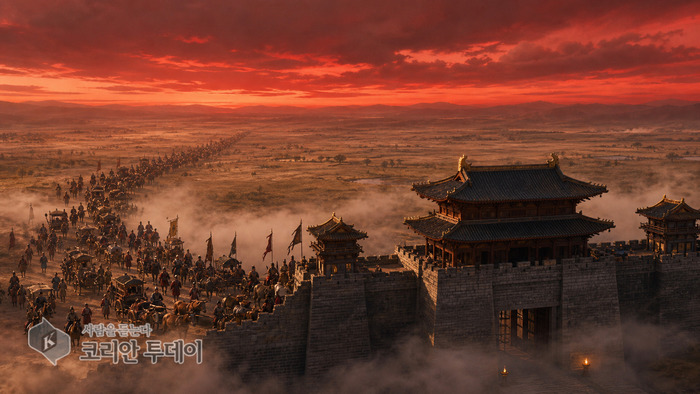
“September 668. Smoke rises above the walls of Pyongyang Fortress. King Bojang holds the surrender document but cannot bring himself to sign it. Below the walls, his own nephew Namsaeng – now a guide for the Tang army – points toward the gate.”
“Thirty years later, at Dongmo Mountain in Manchuria, a former Goguryeo officer named Dae Jo-yeong begins raising earthen walls with a band of refugees and Mohe tribesmen. He does not yet know this settlement will become the kingdom of Balhae. But among his people walk the memories of those who once crossed the Yalu from Pyongyang.”
◆ Uncovering Historical Truth: Life After 668
The fall of Goguryeo is often remembered as a single event in 668, but its aftermath reshaped Northeast Asia for three decades. Resistance movements led by figures like Geommojam and Prince Ansung rose almost immediately, prompting Tang to scatter Goguryeo’s population across distant territories – a deliberate strategy, not unlike Rome’s mass deportations of conquered peoples, to dissolve any rallying point.
In 698 CE, the former Goguryeo officer Dae Jo-yeong exploited a Khitan revolt to lead Goguryeo refugees and Mohe tribes out of Tang-controlled Yingzhou to Dongmo Mountain, founding the state of Jin (Jin-guk). In 713, after being enfeoffed by Tang as “Prince of Balhae,” the kingdom took the name Balhae and explicitly claimed the mantle of Goguryeo’s successor, ruling alongside Silla in what Korean historiography calls the “North-South States Period.” Goguryeo the state had died, but its people and memory became the skeleton of a new kingdom within a single generation.
Politically, Goguryeo’s collapse offers a lesson familiar to students of Rome or Byzantium: internal fracture proved more lethal than any external siege. A state that had withstood two successive Chinese superpowers for over fifty years could not survive a few months of succession infighting at the top – a pattern later East Asian dynasties would study as a cautionary tale.
Duration
37 BCE – 668 CE, 705 years
Kings
28, from Jumong to Bojang
Cause of Fall
Succession feud after Yeon Gaesomun’s death
Successor State
Balhae (founded 698 CE)
🔍 International Academic Perspectives
Korean/Asian Scholars
Most attribute the fall to a combination of decades of attrition against Sui and Tang, agricultural crises, and elite factionalism – with the succession collapse after 665 as the decisive trigger.
Western Historians
Comparative historians often frame Goguryeo alongside Sassanid Persia – a formidable buffer state whose long resistance against a unifying empire ultimately gave way to internal rupture rather than battlefield defeat alone.
📖 Key Terms Explained
- Goguryeo (高句麗)
- Ancient Korean kingdom (37 BCE – 668 CE), the northernmost of Korea’s Three Kingdoms, spanning Manchuria and the northern peninsula.
- Balhae (渤海)
- Successor state founded in 698 CE by former Goguryeo general Dae Jo-yeong, claiming direct continuity with Goguryeo.
- North-South States Period
- Korean historiographical term for the era when Balhae (north) and Unified Silla (south) coexisted, roughly 698-926 CE.
◆ Lessons for Today’s World
Goguryeo’s clearest legacy is proof that a mid-sized state can hold its ground against a superpower – a memory that still underpins South Korea’s approach to security and diplomacy today. But its collapse leaves an equally sharp counter-lesson: internal cohesion, not external strength alone, determines survival.
In the 21st century, South Korea re-demonstrates the “small but formidable” identity through defense exports, semiconductors, and global cultural influence. Yet as Goguryeo’s history warns, that strength has always hinged on internal unity – the same 705 years of glory and the few months of collapse both trace back to the choices of the same people.
| Aspect | Goguryeo Era | Modern Parallel |
|---|---|---|
| Geopolitics | Half a century standing off Sui and Tang | Balancing diplomacy among regional powers |
| Military | Mountain fortress network, victories at Salsu and Ansi | K-defense exports, self-reliant defense industry |
| Culture | Martial ethos, the “damul” ideal of reclaiming lost lands | Global reach of K-Culture |
[Image: Goguryeo’s fortress-defense ethos flowing into Korea’s modern industrial and cultural strength]
📚 Diving Deeper
- The Stele of King Gwanggaeto and the Capital Cities and Tombs of the Ancient Koguryo Kingdom – a UNESCO World Heritage site in Ji’an, China
- Balhae’s Sanggyeong Ruins and the tomb of Princess Jeonghyo – archaeological evidence of Balhae’s self-identification as Goguryeo’s heir
- The short-lived Goguryeo restoration movement under Geommojam and Bodeok Kingdom – a largely forgotten chapter of resistance
The Voice of Living History
What Goguryeo proved across 705 years was not the size of its territory but the size of its will to defend itself. The state fell in 668, but that will flowed unbroken into Balhae – and into us, today.
“Walls may fall. The spirit does not.”
Previous Episode
Episode 39: Lessons of Goguryeo History – Glory and Downfall
Next Episode
The Goguryeo Chronicle Concludes – A New Dynasty Series Begins
The Korean Today “History Lives On” Series
The Goguryeo Chronicle (40 Episodes, Complete)
Bridging Ancient East Asia and the Modern World
© 2026 The Korean Today. All rights reserved.
This content is based on historical facts and presents balanced academic perspectives
for international readers.
THE KOREAN TODAY × WIA CODE
이 기사의 WIA Code

WIA Code 스캐너로 비추면 인터넷 없이 발행 사실과 위·변조 여부를 확인할 수 있습니다.
휴대폰 기본 카메라로 찍으면 스캐너 안내 페이지가 열립니다 — 기사 바로 열기
움직이는 코드(스트림) 한 장에 기사 전문(사진 포함)이 담겨 있습니다 — WIA Code 스캐너로 약 22초 비추면 폰에 저장되어 인터넷 없이도 읽을 수 있습니다. Stream.mp4 도 여기서 받습니다.
WIA Code · 코리안투데이





Leave a Reply