
By Columnist Kim Mi-hee
Why Caregivers Need Scent
Caregiving wears on the heart before it wears on the body. Between keeping track of medication schedules, preparing meals and checking hospital appointments, one’s own emotions are easily pushed aside. As these days accumulate, an unexplained heaviness can remain even on days when nothing especially difficult happened. Scent is a tool that can open up a very small gap in moments like these.
There is something I want to state clearly here: aromatherapy is not medicine, and it does not cure or prevent illness. However, because scent is closely tied to our emotions among all the senses, a brief moment spent inhaling a favorite fragrance is known to help settle one’s mood. So please take today’s discussion not as a treatment, but as a piece of everyday wisdom for briefly caring for yourself amid an exhausting day.
In fact, many people approach aromatherapy for the first time expecting that ‘something should improve’ because of it. But I would rather suggest lowering that expectation somewhat. Scent is not magic that transforms an entire day; it is closer to a quiet tool that carves out one small space for yourself within that day.
Lavender — The Scent of an Evening Wind-Down
Evenings in households with caregiving responsibilities tend to look much the same. After bathing a parent, administering medication and settling them into bed, the clock often reads nine or ten at night before you know it. Many people find that even though their body wants to lie down, their mind grows sharper instead, with the day’s events resurfacing one by one, making it hard to fall asleep easily. Lavender has long been one of the most widely used scents for this kind of day’s-end moment.
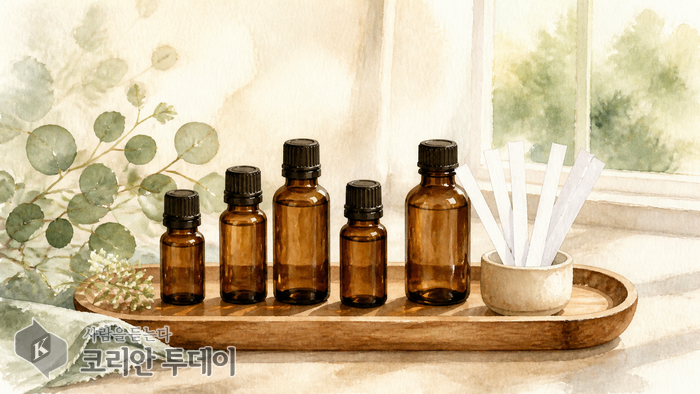
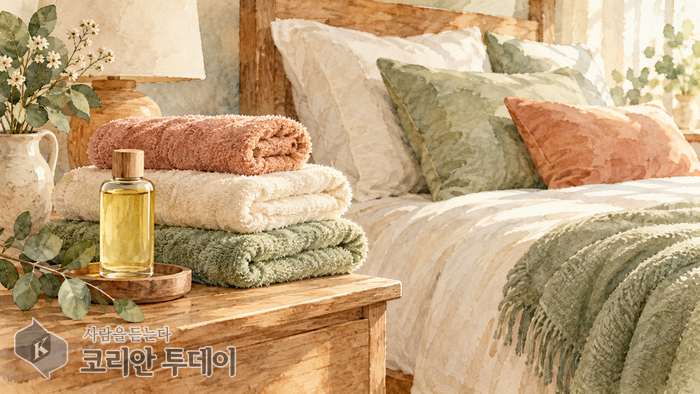
Lavender’s soft, mild herbal scent is not overpowering, so even those sensitive to fragrance tend to find it relatively comfortable. Simply placing two or three drops of lavender oil in a diffuser about thirty minutes before bed, or leaving a scented paper strip beside your pillow, can noticeably calm the atmosphere of a room. What matters is pairing that moment of inhaling the scent with a mindset of telling yourself, ‘That’s enough for today.’ The scent is only a trigger — making that moment fully your own is ultimately up to you.
That said, lavender does not feel equally soothing to everyone. Some people find its scent too heavy, which is a perfectly natural individual difference. Since scent preference is largely a matter of taste, I would say that the process of finding what feels comfortable to you — rather than what others say is good — is itself the beginning of self-care.
Bergamot — When You Need to Refresh Your Mind
On the other hand, there are days when the mind feels particularly heavy in the morning or during the daytime — a day made tense by a parent’s poor condition, an afternoon left unsettled after a call with a sibling, or moments when energy simply dips for no clear reason. On days like these, a scent that opens the mind like a window, rather than one that lulls you down, may suit you better. Bergamot offers a bright impression, blending the characteristic freshness of citrus with a subtle floral note.
Bergamot works well before starting activities or during an afternoon lull in concentration. Placing one or two drops on a handkerchief or scented paper strip nearby, or taking a deep breath of it during a short break while rolling your shoulders a few times, is enough. However, because citrus oils can irritate skin when exposed to light, it is best to avoid applying undiluted oil directly to the skin and then going out into sunlight.
Looking at lavender and bergamot side by side, the standard for choosing a scent ultimately comes down to one question: what does my mind need right now? On a day you want to settle down, choose a calming scent like lavender; on a day you want to lift your spirits, choose a bright scent like bergamot. This is not a fixed formula with a single right answer, but rather a matter of cultivating the sense to read your own day’s rhythm.
How to Choose and Blend for the Situation
Many people feel intimidated at the mention of blending scents, assuming it requires specialized knowledge. But at the level of self-care used at home, there is no need to overthink it. The basic approach is to first decide what situation you want to address, then choose one or two scents suited to that situation and start with a small amount. Rather than mixing several scents at once from the start, it is advisable to become fully familiar with one scent before adding another.
For example, lavender alone is often enough for evening relaxation, but adding one or two drops of a mild woody scent can make it feel deeper and more stable. Conversely, for morning refreshment, adding a touch of a bright citrus note to bergamot can make the scent feel crisper. Since the intensity varies by oil, it is safer to start by adding just one drop of each oil, smelling the result, and gradually increasing from there.
One thing I want to emphasize is that the purpose of blending is not to achieve a ‘better effect.’ Rather, the process of experimenting with different scents itself becomes an experience of devoting time solely to yourself amid a busy caregiving routine. Slowly discovering which scent suits you is exactly the kind of self-care this column truly hopes to recommend.
Today’s Heart-Care Practice
★☆☆Tonight before bed, place just one drop of lavender oil on a handkerchief or tissue, hold it near your nose, and take three deep breaths. Simply telling yourself, ‘That’s enough for today,’ while inhaling the scent can help ease a bit of tension in the body.
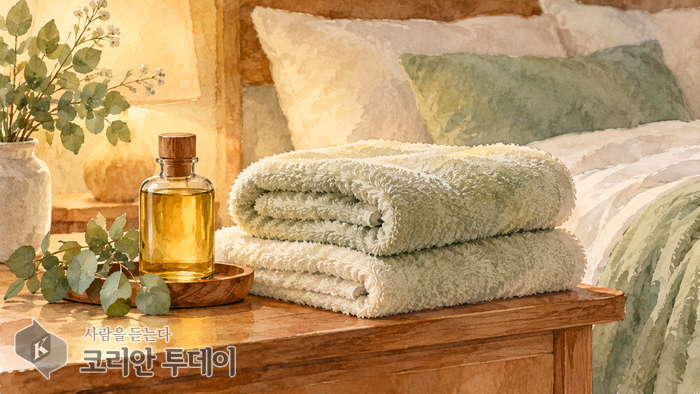
★★☆If you have a diffuser, fill it with water, add two or three drops of lavender oil, and run it in your room thirty minutes before sleep. As the mild scent spreads through the space, put down your phone and close your eyes for a moment — this can become your own small ritual for closing out the day.
★★★On a day when you have a little more time, place lavender and bergamot scented paper strips side by side and alternate smelling them to choose whichever better matches your mood today. As small observations like this connect scent with emotion accumulate, you can build your own personal list of scents for different situations.
Do not apply undiluted essential oil directly to the skin. Before using any scent for the first time, be sure to do a patch test with a small amount on the inside of your arm. If you are pregnant, have an existing medical condition, or live with pets, please consult a professional before use.
For more heart-care stories, visit the Korea Self-Healing Association.
Kim Mi-hee — aromatherapist, social worker, certified care worker, and hospital companion manager — draws on her own experience caring for aging parents to write practical, useful guidance for caregivers in the same situation. The Korean Today, Nam-Incheon.
#WeAreSaemMindCare #Aromatherapy #SelfCare #Lavender #Bergamot #CaregivingFamilies #Mindfulness
[ Reporter Kim Mi-hee: incheonsouth@thekoreantoday.com ]
Become a Local Ambassador Apply as Branch Director The Korean Today — Nam-Incheon
 |
THE KOREAN TODAY × WIA CODE
이 기사의 WIA Code

WIA Code 스캐너로 비추면 인터넷 없이 발행 사실과 위·변조 여부를 확인할 수 있습니다.
휴대폰 기본 카메라로 찍으면 스캐너 안내 페이지가 열립니다 — 기사 바로 열기

움직이는 코드는 스트림입니다 — WIA Code 스캐너로 약 35초 비추면 기사 전문(사진 포함)이 폰에 저장되어 인터넷 없이도 읽을 수 있습니다.
WIA Code · 코리안투데이


Leave a Reply