
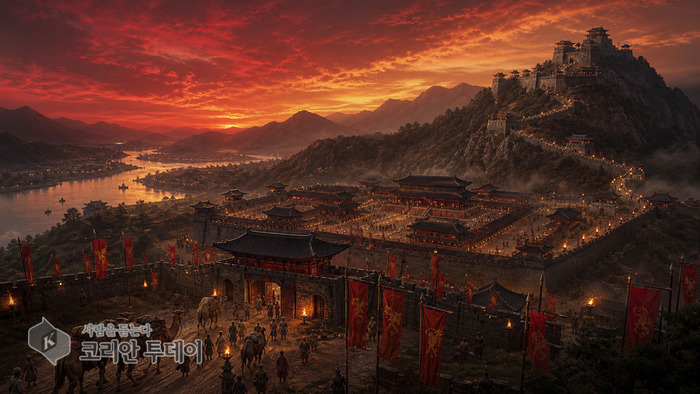
Moving a capital means redesigning an entire state system from the ground up. Sixteen hundred years ago, Goguryeo did it three times.
Modern nations still argue endlessly over where to build a capital – think of Washington D.C.’s original planning, or Brazil’s deliberate relocation to Brasília. Goguryeo faced the same question 1,600 years earlier, and answered it three times: from Jolbon to Gungnaeseong, from Gungnaeseong to Pyongyang’s Anhak-gung, and finally to the fortress city of Jangan-seong. Each move was not a simple relocation but a full redesign of defense strategy, economic base, and the very nature of royal power.
How did a mountain-fortress tribal confederation evolve into a kingdom capable of planning one of East Asia’s great capital cities? The answer lies half-forgotten in the earthen mounds along the Taedong River in present-day Pyongyang.
🌍 Western Historical Parallel
While Goguryeo perfected its dual capital system, Constantinople – founded in 330 CE – was wrestling with its own hilly, irregular terrain, abandoning a full grid plan in favor of the great colonnaded avenue known as the Mese. Neither East nor West achieved a “perfect” grid city; both improvised brilliantly within their geography.
◆ The Ancient Landscape
Every Goguryeo capital came as a matched pair: a flatland city for daily governance, and a mountain fortress for wartime refuge. During the Gungnaeseong period (roughly 3 CE to 427 CE), the walled city of Gungnaeseong (a stone fortress about 2.7 km in circumference, at the confluence of the Tonggou River and the Yalu) handled administration, while Hwando Mountain Fortress, 2.5 km to the northwest, served as the citadel. Excavations at Hwando revealed a massive presumed palace foundation roughly 90 meters on each side, two octagonal building sites, barracks, and a pond – evidence that even by the 3rd century, Goguryeo’s twin-city system already combined administrative and military functions with real sophistication.
The turning point came in the 15th year of King Jangsu’s reign (427 CE), when the capital moved from the mountain-locked basin of Gungnaeseong to the fertile plains of Pyongyang on the Taedong River. The new palace, Anhak-gung (a square earthen-walled compound roughly 2.4 km in circumference), was paired with Daeseong Fortress, Goguryeo’s largest mountain stronghold, standing guard behind it. The king governed from Anhak-gung in peacetime and retreated to Daeseong Fortress in crisis. Then, in the 28th year of King Pyeongwon (586 CE), Goguryeo restructured its capital once more, relocating fully to Jangan-seong – the fortress now known as Pyongyang Fortress. Construction began in 552 and finished in 593; the finished city, roughly 23 km in circumference, was a massive “flatland-mountain hybrid fortress” (pyeongsanseong) with four concentric wall zones large enough to house the entire urban population within its walls.
“King Pyeongwon moved the capital to Jangan-seong.”
◆ Same Era, Different Worlds
🏛️ China
In the 5th century, the Northern Wei unified northern China, moving capitals between Pingcheng and Luoyang while experimenting with strict grid-based city planning – a very different approach from Goguryeo’s twin-fortress model.
🗿 Byzantine Empire
Constantinople never achieved a full grid; its street plan followed the coastline and hills. Meanwhile Rome itself was being sacked and the Western Empire was collapsing under Germanic pressure.
⚔️ Western Europe
Frankish and Anglo-Saxon settlements of this era remained largely unfortified villages – nothing resembling Goguryeo’s planned, walled capital of hundreds of thousands.
🌏 Japan
Japan would not build a comparable planned, Tang-style grid capital (Fujiwara-kyo, Heijo-kyo) until the late 7th-8th centuries – Goguryeo’s urban expertise, transmitted via Baekje, likely helped shape those designs.
[Image: Evolution of Goguryeo’s twin-city capital system – flatland palace (Anhak-gung) paired with mountain fortress (Daeseong)]
⚔️ Scene from That Day
“Late summer, 586 CE. Through the mist off the Taedong River, the walls of the new royal city finally emerge – the fruit of thirty-four years of construction, a project spanning three reigns. Below the walls, camel bells jingle: caravans from far across the continent unloading goods in the market lanes.”
“The Samguk Sagi’s biography of Ondal records that Princess Pyeonggang left the palace to personally select and buy a horse in the marketplace, then raised it into a war-horse for her husband Ondal. That brief anecdote – a princess haggling just outside the palace walls – reveals a marketplace where royalty and commoners physically crossed paths.”
◆ Uncovering Historical Truth
Jangan-seong’s urban core was divided into grid-block districts believed to be modeled on Chinese ward-system (jangbang) planning. The entire fortress was split into four concentric zones – an inner citadel for the palace, a middle city for government offices, an outer city for ordinary residents, and a northern fortress for rear defense – a genuinely planned city where royal authority, administration, civilian life, and military function each had distinct, dedicated space.
This was not a sudden innovation but the culmination of centuries of accumulated practice. Excavations at Hwando Mountain Fortress uncovered a large square building foundation, two octagonal structures, a command platform, barracks, and a pond – evidence that as early as the 3rd century, mountain fortresses already combined administrative and military roles far beyond simple refuges. After the move to Pyongyang, Anhak-gung and Daeseong Fortress inherited this system, and Jangan-seong finally fused the strengths of flatland palace and mountain citadel into a single hybrid “pyeongsanseong” fortress city.
Economically, Pyongyang offered far greater advantages than the mountain-locked Gungnaeseong ever could. The Taedong River plain supported high agricultural yields and enabled riverine and coastal trade. Samguk Sagi records and later sources suggest Goguryeo conducted not only tributary trade with Chinese dynasties but also private caravan commerce linked to the steppe routes – bringing in commodities as exotic as camels. By this period, the marketplace was no longer a mere appendage of the palace city; it was the beating heart of the state’s economy.
Capital Moves
427 CE (King Jangsu) / 586 CE (King Pyeongwon)
Key Sites
Anhak-gung / Daeseong Fortress / Jangan-seong
City Scale
Jangan-seong: ~23 km in circumference
Design Principle
Dual capital: flatland + mountain fortress
🔍 International Academic Perspectives – Is Anhak-gung Truly a Goguryeo Palace?
Korean/Asian Scholars
The mainstream Korean view holds that Anhak-gung was King Jangsu’s Goguryeo palace, built in 427 CE, citing its structural link to Daeseong Fortress and consistency with historical records.
Western/Japanese Historians
Some Japanese scholars, and more recently a subset of Korean researchers, argue – based on excavated roof-tile styles – that Anhak-gung was actually a Goryeo-era palace (possibly linked to King Jeongjong’s abandoned Sogyeong palace project). The debate remains unresolved.
📖 Key Terms Explained
- Goguryeo (고구려)
- Ancient Korean kingdom (traditionally 37 BCE – 668 CE), the northernmost of the Three Kingdoms of Korea
- Pyeongsanseong (平山城)
- A “flatland-mountain hybrid fortress” combining the openness of a plains capital with the defensibility of a mountain stronghold, exemplified by Jangan-seong
- Samguk Sagi (三國史記)
- “History of the Three Kingdoms,” compiled in 1145 CE, the oldest surviving Korean historical record of the Three Kingdoms period
◆ Lessons for Today’s World
Whether it’s Brasília’s purpose-built government core, or modern disaster-resilience planning that separates everyday city functions from emergency infrastructure, the underlying principle is the same one Goguryeo applied 1,600 years ago: keep administrative and economic centers open for daily life, but ensure the whole system can pivot instantly into defense mode when crisis strikes.
Today’s “smart city” discourse – resilience, zoning, functional separation – already had a working prototype in Jangan-seong’s four-zone structure of palace, administration, residence, and defense. In a post-pandemic, disaster-conscious world, this ancient design philosophy feels strikingly contemporary.
| Aspect | Goguryeo Era | Modern Parallel |
|---|---|---|
| Urban Structure | Flatland palace (governance) + mountain fortress (defense) | Administrative cities separated from disaster-response infrastructure |
| Spatial Zoning | Four-zone walls (inner/middle/outer/north), grid-block districts | Modern residential/commercial/industrial zoning |
| Trade & Commerce | Tributary trade + private caravan commerce, palace-adjacent markets | Global supply chains, smart logistics hubs |
[Image: Goguryeo’s functional-separation capital design compared to modern smart-city resilience concepts]
📚 Diving Deeper
- Hwando Fortress’s mysterious octagonal building foundations – a structural puzzle still debated among archaeologists
- The marketplace scene in the biography of Ondal – a vivid glimpse of a capital where royalty and commoners physically mingled
- The ongoing debate over Anhak-gung’s true construction date and its implications for how we read Goguryeo’s capital history
The Voice of Living History
Every time Goguryeo moved its capital, it redesigned from first principles rather than clinging to what already worked. That willingness to rebuild the very seat of power to fit a changing world is a large part of why the kingdom endured for 705 years.
“The earthen walls of Anhak-gung have long since crumbled, but the wisdom of designing for both ordinary days and moments of crisis still runs beneath the cities we build today.”
Previous Episode
Episode 26: Religion in Goguryeo – Buddhism, Daoism, and Indigenous Beliefs
Next Episode
Episode 28: Goguryeo’s Dress – The People Who Wore Trousers
The Korean Today “History Lives On” Series
The Goguryeo Chronicle (40 Episodes)
Bridging Ancient East Asia and the Modern World
© 2025 The Korean Today. All rights reserved.
This content is based on historical facts and presents balanced academic perspectives
for international readers.






Leave a Reply