
Empires rarely fall to their enemies alone — they fall when they stop trusting themselves.
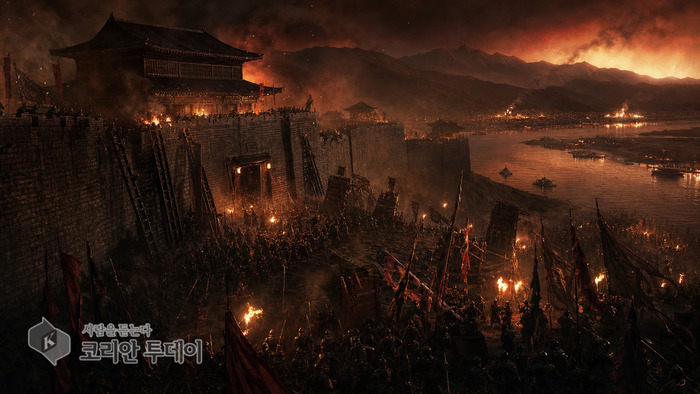
In September of 668 CE, the defenders atop Pyongyang’s walls were running out of more than arrows. The fortress that had once turned back a Tang emperor’s army at Ansi was collapsing not from the enemy’s siege engines, but from a knife fight within its own ruling family. How did the kingdom that humbled a Chinese emperor vanish from history within a single generation?
Historians often say a kingdom survives a hundred external attacks more easily than one internal fracture. Goguryeo’s final night is one of history’s starkest proofs of that old truth.
🌍 Western Historical Parallel
The very same year Pyongyang fell, Byzantine Emperor Constans II was assassinated in Syracuse and his son Constantine IV took the throne facing an emboldened Umayyad Caliphate — a striking reminder that 668 CE was a year of succession crises and encroaching empires on both ends of Eurasia.
◆ The Ancient Landscape
When strongman Yeon Gaesomun died in 666, his three sons — Namsaeng, Namgeon, and Namsan — tore the kingdom’s leadership apart in a struggle for power. The eldest, Namsaeng, was pushed out and defected to Tang with the strategic Gungnaeseong region in hand, handing the Tang court both territory and military intelligence. Tang Emperor Gaozong seized the opening, appointing general Li Ji to lead a massive expedition, while Silla dispatched commanders Kim In-mun and Kim Heum-sun to open a second front from the south.
Through 667-668, Tang forces overran Goguryeo strongholds one by one, including Buyeoseong. In June 668, Silla’s army marched north and crushed Goguryeo defenders at the Sacheon River. On September 21, 668, the advancing Silla forces finally linked up with the Tang army, closing a total siege around Pyongyang. After more than a month under siege, the will to resist inside the walls had already splintered.
“The king sent Yeon Namsan, leading ninety-eight local chieftains, to raise a white flag before Li Ji’s camp and beg for surrender.”
◆ Same Era, Different Worlds
🏛️ China
Under Emperor Gaozong, Tang finally completed a three-generation ambition to subdue Goguryeo, soon establishing the Andong Protectorate at Pyongyang to rule the conquered territory directly.
🗿 Byzantine Empire
Constantine IV ascended after his father’s assassination in 668, immediately confronting mounting Umayyad pressure that would culminate in the first Arab siege of Constantinople within a decade.
⚔️ Western Europe
Anglo-Saxon England, having just unified its church calendar at the 664 Synod of Whitby, was entering an era of rising Mercian power under King Wulfhere.
🌏 Japan
Having watched Baekje and now Goguryeo fall, Emperor Tenji urgently built Korean-style mountain fortresses across Kyushu, fearing the Silla-Tang alliance would turn toward the Japanese islands next.
[Image: Silla-Tang pincer movement against Pyongyang, September 668 CE]
⚔️ Scene from That Day
“After more than a month under siege, night fell over the walls. General Yeon Namgeon still refused to surrender, vowing to fight to the last — unaware that the monk Sinseong, to whom he had entrusted command of the garrison, had already sent a secret messenger to Li Ji’s camp.”
“Days later, before dawn, Sinseong quietly opened the gates and torch-bearing allied troops poured into the city like a flood. Chronicles record that Namgeon, realizing too late what had happened, tried to take his own life with a blade but survived and was captured. King Bojang had already handed over his letter of surrender.”
◆ Uncovering Historical Truth
The fall of Pyongyang was never simply a military defeat. Only twenty-three years after Goguryeo turned back Tang Emperor Taizong’s own army at the fortress of Ansi, the kingdom collapsed — not from overwhelming force, but from a shattered chain of command, much as Rome’s western provinces crumbled less from barbarian strength than from imperial fragmentation.
The cracks ran all the way to the final gate. Hardliner Namgeon and the monk Sinseong, who ultimately opened the city to the enemy, represent a ruling class that never spoke with one voice until the very end. Archaeological traces of hastily reinforced defenses at the Taesong Fortress and Anhak Palace sites near Pyongyang testify to a kingdom mobilizing every remaining resource in a last, desperate stand.
Politically, this was the culmination of more than two decades of Goguryeo-Tang warfare, and the moment the Silla-Tang alliance’s diplomatic encirclement finally paid off — not unlike how coordinated pressure from multiple fronts eventually broke Carthage in the Punic Wars. Tang moved swiftly to establish the Andong Protectorate at Pyongyang, only to face fierce resistance from Goguryeo loyalists before long.
Period
September 668 CE (King Bojang, Year 27)
Key Figures
King Bojang, Yeon Namgeon, Yeon Namsan, Sinseong
Key Event
Fall of Pyongyang, end of Goguryeo
Impact
Turning point toward Silla’s unification; Andong Protectorate
🔍 International Academic Perspectives
Korean/East Asian Scholars
The dominant view holds that the Yeon brothers’ power struggle and Namsaeng’s defection were decisive, with the Silla-Tang alliance exploiting the resulting vacuum.
Comparative Historians
Some scholars frame it structurally, similar to debates on Rome’s fall: decades of continuous warfare against Sui and Tang had already exhausted Goguryeo’s population and resources before the internal split ever occurred.
📖 Key Terms Explained
- Goguryeo (高句麗)
- Ancient Korean kingdom (c. 37 BCE – 668 CE), the northernmost of Korea’s Three Kingdoms, controlling much of Manchuria and the northern peninsula.
- Andong Protectorate (安東都護府)
- A Tang military-administrative outpost set up in former Goguryeo territory after 668, roughly analogous to a Roman frontier province governed by an imperial legate.
- Samguk Sagi (三國史記)
- Korea’s oldest surviving official history (compiled 1145 CE), the primary source for the Three Kingdoms period.
◆ Lessons for Today’s World
The starkest lesson of Goguryeo’s collapse is a failure of crisis management. At the exact moment unity was most needed, the ruling elite placed a personal power struggle above the survival of the state — a pattern visible from the fall of Rome to the collapse of modern institutions under internal division.
Whenever nations today let extreme political polarization fester during genuine security or economic crises, Pyongyang’s last night offers an uncomfortable mirror. Goguryeo paid history’s steepest price to prove that a state’s true defensive wall is internal trust and cohesion, not its fortifications.
| Aspect | Goguryeo Era | Modern Parallel |
|---|---|---|
| Geopolitics | Command paralyzed by the Yeon brothers’ feud | Extreme political polarization eroding national consensus |
| Military | Forced to fight a two-front Silla-Tang pincer alone | Alliance management amid hybrid, multi-front security threats |
| Culture | A martial spirit undone by its own factionalism | Social cohesion as a form of national competitiveness |
[Image: Goguryeo’s internal collapse and the modern challenge of social unity]
📚 Diving Deeper
- Evidence of hastily reinforced fortifications at the Taesong Fortress and Anhak Palace sites near modern Pyongyang
- Chronicled accounts of Yeon Namgeon’s failed suicide attempt before his capture
- Comparative reading of Samguk Sagi Vol. 10 against the Tang-era Jiu Tangshu and Xin Tangshu accounts of Goguryeo
The Voice of Living History
Seven centuries of sovereignty fell not to enemy blades but to a fracture within. A leadership that could not unify in crisis remains a warning that speaks across every age and every nation.
“The gate was opened from within — the oldest lesson left by Goguryeo’s final night.”
Previous Episode
Episode 18: The Silla-Tang Alliance – War on Two Fronts
Next Episode
Episode 20: The Restoration Movement – An Unextinguished Flame
The Korean Today “History Lives On” Series
The Goguryeo Chronicle (40 Episodes)
Bridging Ancient East Asia and the Modern World
© 2025 The Korean Today. All rights reserved.
This content is based on historical facts and presents balanced academic perspectives
for international readers.
THE KOREAN TODAY × WIA CODE
이 기사의 WIA Code

WIA Code 스캐너로 비추면 인터넷 없이 발행 사실과 위·변조 여부를 확인할 수 있습니다.
휴대폰 기본 카메라로 찍으면 스캐너 안내 페이지가 열립니다 — 기사 바로 열기

움직이는 코드는 스트림입니다 — WIA Code 스캐너로 약 22초 비추면 기사 전문(사진 포함)이 폰에 저장되어 인터넷 없이도 읽을 수 있습니다.
WIA Code · 코리안투데이






Leave a Reply