
The Ministry of Health and Welfare (Minister Jung Eun-kyeong) and the Korea Health Promotion Institute (President Kim Heon-joo) released “Standard Guidelines for Tattoo Procedures” on July 31, laying out the hygiene and safety standards tattoo studios must follow ahead of the Tattooist Act, which takes effect on October 29, 2027. The guidelines, which spell out the facilities and environment tattoo parlors must have, the hygiene and safety standards practitioners must observe, and procedures to follow before and after a session, mark the first concrete field guidance issued since the Tattooist Act was enacted.
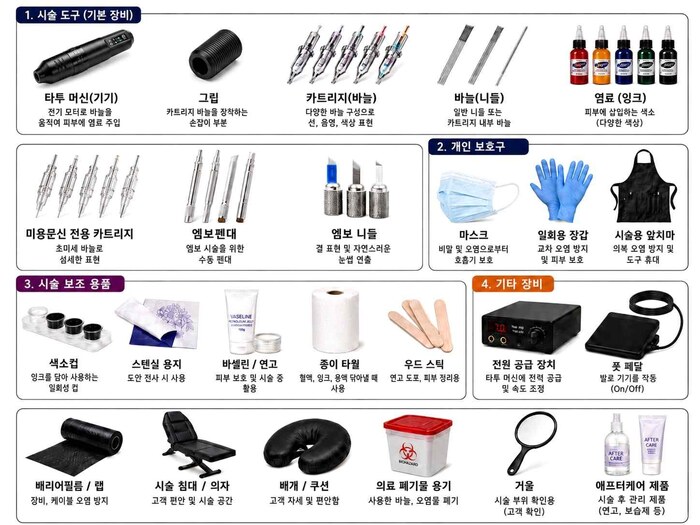 [코리안투데이] Courtesy of the Ministry of Health and Welfare © 송정숙 기자 |
The Tattooist Act was enacted and promulgated on October 28, 2025, and will take effect on October 29, 2027, following a two-year grace period. Because tattooing has long been practiced without a clear legal basis, raising hygiene standards in the field has been seen as a key challenge as the industry is brought under formal regulation. In drafting the standard guidelines, the Ministry of Health and Welfare and the Korea Health Promotion Institute held three rounds of meetings with roughly 40 tattoo organizations, on May 12, June 17 and July 21, to gather input from the field, and consulted with medical and academic experts on June 9 and July 7. Officials said hygiene and safety were treated as the top priority, while also weighing how acceptable and practicable the rules would be in real-world settings.
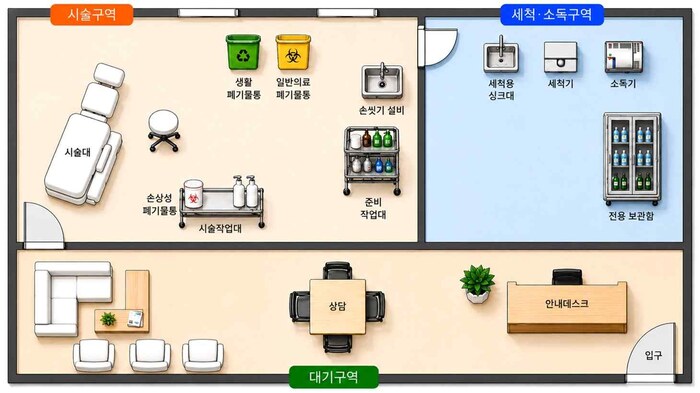 [코리안투데이] Courtesy of the Ministry of Health and Welfare © 송정숙 기자 |
The standard guidelines consist of four chapters — overview; facilities, tools and hygiene management; compliance and implementation methods for key procedures; and statutory obligations and prohibited acts — organized into 10 main sections and 37 detailed subsections. The guidelines define 55 terms in detail, including distinguishing tattoo work into calligraphy/pictorial tattoos and cosmetic tattoos, and require tattoo studios to be divided into waiting, procedure and cleaning/disinfection zones, which may be separated either by walls or by partitions. Instruments used in procedures must in principle be sterilized and single-use, discarded immediately after use; if reuse is unavoidable, cleaning and disinfection are mandatory while sterilization is recommended. High-risk consumables such as pigment cups and gauze must be sterilized, single-use items, and sterile gloves must be worn during procedures.
On user safety, the guidelines provide sample forms for a pre-procedure consent form and a tattoo procedure record, which practitioners are required to prepare and maintain. In particular, a client health status confirmation form must be used to determine whether a procedure can proceed, and for clients with a history of blood-borne infectious diseases such as hepatitis B or C, the decision on whether to proceed must be made only after consultation and examination at a medical institution and confirmation of a physician’s opinion. The guidelines also explain, in accessible terms, obligations and prohibited acts that are set out in the law but easily overlooked in practice, so that practitioners can fully familiarize themselves with the relevant rules before the law takes effect.
The Ministry of Health and Welfare is distributing the standard guidelines through local governments and tattoo organizations, while also making them available for direct download on the websites of the Ministry and the Korea Health Promotion Institute, along with a set of key questions and answers to aid understanding. Minister Jung Eun-kyeong said, “Now that the Tattooist Act has been enacted after lengthy discussion, it is more important than ever that tattoo procedures be carried out safely within the formal regulatory system.” She added, “Through the release of these standard guidelines, we ask that practitioners familiarize themselves with and comply with the overall hygiene management guidelines for tattoo procedures so that the public can use these services with greater peace of mind, and that they thoroughly prepare and inspect their facilities and environment ahead of the law’s implementation.”
송정숙 기자 (한국통합치유협회장) | gangseo@thekoreantoday.com
 |
 |
THE KOREAN TODAY × WIA CODE
이 기사의 WIA Code

WIA Code 스캐너로 비추면 인터넷 없이 발행 사실과 위·변조 여부를 확인할 수 있습니다.
휴대폰 기본 카메라로 찍으면 스캐너 안내 페이지가 열립니다 — 기사 바로 열기

움직이는 코드는 스트림입니다 — WIA Code 스캐너로 약 84초 비추면 기사 전문(사진 포함)이 폰에 저장되어 인터넷 없이도 읽을 수 있습니다.
WIA Code · 코리안투데이



Leave a Reply