
The Incheon Metropolitan Government (Mayor Park Chan-dae) conducted its 2026 Emerging and Re-emerging Infectious Disease Crisis Management Response Drill on the 11th in the main conference hall of City Hall. The exercise was carried out in a high-intensity, near-realistic format, assuming a scenario in which a patient infected with Ebola virus disease abroad enters the country.
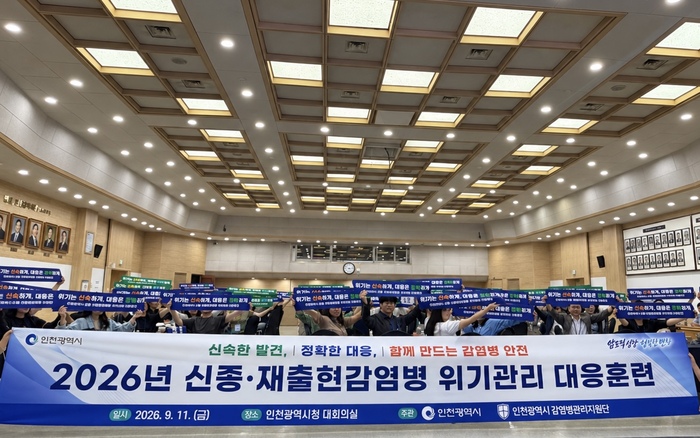 [코리안투데이] Incheon’s Emerging and Re-emerging Infectious Disease Crisis Management Response Drill © 장형임 기자 |
Emerging and re-emerging infectious diseases are difficult to predict in terms of when and in what form they may appear. To prevent a single person’s entry from spreading into a risk for the entire community, the key lies in an early response that runs from detection to isolation and investigation. The drill conducted by Incheon on the 11th was designed to test this initial response capacity and the cooperative system among relevant agencies in conditions close to a real situation.
Held under the slogan ‘Swift Detection, Accurate Response, Infectious Disease Safety Built Together,’ the drill drew broad participation from key agencies involved in infectious disease response, including the Korea Disease Control and Prevention Agency (KDCA), the National Incheon Quarantine Station, the Incheon city government, public health centers in 11 districts and counties, the Institute of Public Health and Environment, major regional medical institutions, educational institutions, and fire, police and military units. Its significance lies in the fact that the entire regional disease-control network, rather than any single agency, gathered in one place to strengthen an all-out response system.
The drill opened with a special lecture by Professor Shi Hye-jin of the Division of Infectious Diseases at Gachon University Gil Medical Center. Professor Shi explained the domestic and international incidence of Ebola virus disease, along with its clinical characteristics and response methods. This was followed by action-based training and discussion-based training. Beginning with the occurrence and reporting of a patient, the participating agencies jointly explored situation-specific responses and methods of inter-agency cooperation, covering epidemiological investigation, patient transport and isolation, contact tracing and management, testing, and infection control within medical institutions.
In particular, the discussion-based training presented not only common scenarios but also individual situations tailored to each agency’s role, as well as unexpected contingencies. Conducted in a manner where participating agencies shared their views and worked out response measures together, it focused on enhancing the judgment, communication and inter-agency cooperation skills needed in an actual crisis.
Hands-on field practice was also given considerable weight. In the ‘personal protective equipment donning and doffing drill,’ conducted together with training by Kang Hyun-ju, team leader of the Infection Control Office at Gil Medical Center, participants practiced the correct methods of putting on and taking off protective gear firsthand. They also checked basic protective measures to prevent on-site infection, such as using fluorescent material to verify contamination.
Incheon said the drill allowed it to review each agency’s roles and response procedures and to confirm the cooperative system among relevant agencies, adding that it would continue to conduct practical, scenario-based drills to strengthen field response capabilities and minimize harm to citizens from infectious diseases.
Kim Min-jung, director-general of the city’s Health and Welfare Bureau, said, ‘Because emerging and re-emerging infectious diseases are hard to predict in terms of when and in what form they will occur, it is important to build response capacity through routine surveillance and preparedness as well as repeated drills.’ She added, ‘Using this drill as a turning point, we will further strengthen the cooperative system among relevant agencies and do our utmost to protect citizens’ safety from infectious diseases through swift detection and accurate response.’
Meanwhile, Ebola virus disease is an acute febrile, hemorrhagic illness transmitted through direct or indirect contact with the blood or bodily fluids of infected animals or people. In Korea it is designated and managed as a Class 1 infectious disease. After an incubation period of 2 to 21 days following infection, early symptoms such as fever, loss of appetite, weakness and rash appear.
지역 홍보대사 신청 기자양성과정 신청 코리안투데이 지부장 신청 코리안투데이 인천강화
THE KOREAN TODAY × WIA CODE
이 기사의 WIA Code

WIA Code 스캐너로 비추면 인터넷 없이 발행 사실과 위·변조 여부를 확인할 수 있습니다.
휴대폰 기본 카메라로 찍으면 스캐너 안내 페이지가 열립니다 — 기사 바로 열기
움직이는 코드(스트림) 한 장에 기사 전문(사진 포함)이 담겨 있습니다 — WIA Code 스캐너로 약 34초 비추면 폰에 저장되어 인터넷 없이도 읽을 수 있습니다. Stream.mp4 도 여기서 받습니다.
WIA Code · 코리안투데이



Leave a Reply