
As the Taehwagang Station tram era moves closer to reality, the center of Ulsan’s urban transportation structure is rapidly shifting toward the northern part of the city. With the completion of major transit system improvements designed to support the introduction of a tram network, Taehwagang Station is emerging as a core transportation hub for northern Ulsan. The Ulsan Metropolitan Government held a completion ceremony on January 20, 2026, at Taehwagang Station to mark the successful conclusion of the second phase of the station’s traffic system improvement project, officially unveiling infrastructure designed for the upcoming tram era.
The Taehwagang Station tram-linked traffic system improvement project was 추진 aimed at reorganizing transportation functions across northern Ulsan, with Taehwagang Station designated as the future terminus of Tram Line 1. Beginning in 2023, the city invested a total of KRW 5.5 billion entirely from municipal funds to comprehensively upgrade internal roads and transfer routes around the station. Roads that previously allowed two-way access from Industrial Road were restructured into a one-way system measuring 220 meters in length and 30 meters in width, significantly improving traffic flow efficiency and overall capacity.
Spatial reconfiguration centered on the future tram service formed the core of the project. Based on an analysis of rail and public transit usage patterns, the city newly installed bus platforms and a pedestrian overpass. As a result, access to rail services has been noticeably improved, and transfer routes have become more streamlined. These changes are widely seen as a turning point that fundamentally enhances the public transportation environment in northern Ulsan.
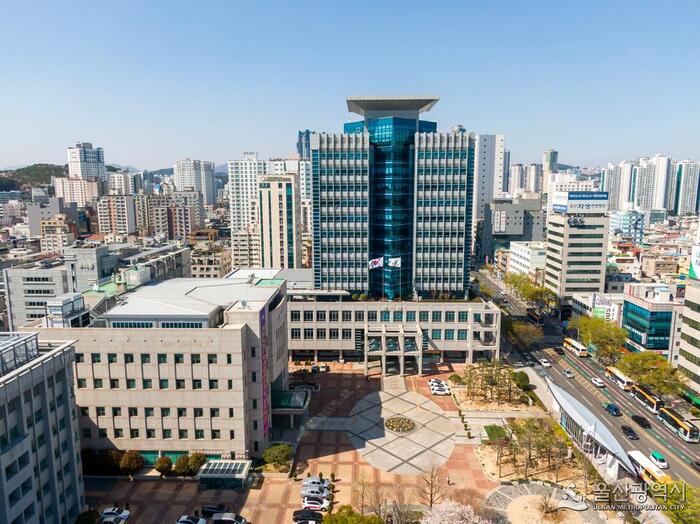 [The Korean Today] Exterior view of Ulsan Metropolitan Government City Hall. © By Soyoung Jeong |
Construction began in December 2024 and was completed approximately one year later without interrupting station operations. Throughout the project, the city focused on minimizing inconvenience to passengers by maintaining strict construction management and safety standards. Phased construction was carried out to reduce congestion in and around the station, and this approach is expected to serve as a model for future infrastructure projects at key transportation nodes in northern Ulsan.
The development of the Taehwagang Station tram system goes beyond a simple upgrade of transportation facilities. It is widely interpreted as a signal of a broader reorganization of urban functions in northern Ulsan. Once railways, trams, buses, taxis, and private vehicles are fully integrated around Taehwagang Station, the area is expected to naturally assume a central role in regional transportation. The city anticipates that these improvements will increase public transit usage while simultaneously easing traffic congestion and reducing carbon emissions.
Ulsan Mayor Kim Doo-gyeom stated at the ceremony, “The second phase of the Taehwagang Station traffic system improvement project marks the starting point of transportation innovation in northern Ulsan as we prepare for the tram era.” He added that the city will continue to expand smart transportation infrastructure to enhance both mobility convenience for residents and the city’s overall competitiveness. Ulsan plans to gradually expand the integrated transit network centered on Taehwagang Station in line with the finalization of tram routes.
The transportation system upgrades preparing Taehwagang Station for the tram era demonstrate that northern Ulsan is positioning itself as a new center of urban growth. Changes in transportation infrastructure are likely to lead to broader shifts in residential patterns, industrial activity, and daily living areas. Attention is now focused on how this transformation, driven by northern Ulsan, will contribute to strengthening the city’s overall competitiveness. Further details on transportation policies and related projects are available on the official Ulsan Metropolitan Government website.
[ By Soyoung Jeong | Ulsan Gangbuk | ulsangangbuk@thekoreantoday.com ]
 |



Leave a Reply