
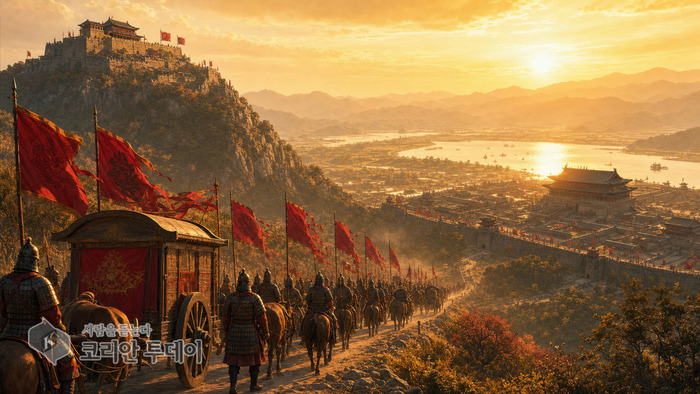
In 427 CE, King Jangsu turned his back on the ancestral tombs and shrines of Gungnae and moved his court to the open plains along the Daedong River. It was not a retreat — it was a bet on the next two centuries.
Relocating a capital is one of the highest-stakes decisions any state can make, then and now. Just as debates over moving South Korea’s administrative capital to Sejong still divide the nation today, sixteen centuries ago Goguryeo’s court was split between nobles who wanted to defend the old mountain capital and a king determined to build anew.
His father, King Gwanggaeto, had expanded Goguryeo into an empire stretching across Manchuria and northern Korea. So why did the son abandon a fortress capital that had held for over two centuries in favor of an open river plain?
🌍 Western Historical Parallel
A century earlier, in 330 CE, Emperor Constantine moved the Roman capital from Rome to a new city on the Bosphorus — Constantinople — for strikingly similar reasons: better access to trade routes, distance from an entrenched old elite, and a strategic position facing the empire’s real frontiers. Jangsu’s Pyongyang was Goguryeo’s Constantinople.
◆ The Ancient Landscape
When King Gwanggaeto died in 413 CE, his son Georyeon — later King Jangsu — inherited an empire whose military conquests far outran its administrative capacity. Gungnae, tucked in the mountains along the Yalu River (near today’s Ji’an, China), was easy to defend but short on farmland, and its old five-clan nobility still held real power that constrained the throne.
Across the Yellow Sea, China was fractured into the Northern and Southern Dynasties: the Northern Wei was consolidating the north under Emperor Taiwu, while the Southern Song held the Yangtze basin. Jangsu played both sides with careful diplomacy, stabilizing his northern and western borders. Then, in 427 CE — his fifteenth year on the throne — he moved the capital to Pyongyang.
“In the fifteenth year, the capital was moved to Pyongyang (十五年, 移都平壤).”
◆ Same Era, Different Worlds
🏛️ China
Northern Wei’s Emperor Taiwu was pushing to unify northern China, while the Southern Song held the south — the opening chapter of a division that would last over a century.
🗿 Byzantine Empire
Theodosius II was fortifying Constantinople with new walls, while the Western Roman Empire was collapsing under Germanic invasions, just decades from its formal end in 476 CE.
⚔️ Western Europe
Frankish and other Germanic kingdoms were carving up the collapsing Western Roman frontier, forming the political map that would become medieval Europe.
🌏 Korean Peninsula
Baekje and Silla were beginning to explore a defensive alliance against their increasingly powerful northern neighbor — the Naje Alliance that would define the century ahead.
[Image: The 427 CE capital relocation and the direction of Goguryeo’s southern campaigns]
⚔️ Scene from That Day
“The creak of ox-carts filled the Yalu valley for weeks. Ancestral tablets from the royal shrine, court archives, treasury chests — an endless column moving south. Old nobles looked back once more at their family tombs and said nothing.”
“When the young king reached the Daedong plain, he dismounted and stood at the water’s edge. A kingdom once boxed in by mountains was about to reach the sea — and the lands beyond it.”
◆ Uncovering Historical Truth
The first driving force was economic. The Daedong River basin carried centuries of accumulated urban infrastructure from the old Lelang commandery era, plus far more fertile floodplain than the mountains around Gungnae could offer. A direct river route to the Yellow Sea also gave Goguryeo a decisive edge in trade and diplomacy with the Southern Dynasties — much as the Bosphorus gave Constantinople command of trade between Europe and Asia.
The second was royal authority. Gungnae’s five noble clans had entrenched power built up over centuries — not unlike Rome’s senatorial aristocracy, whom Constantine also sidestepped by building a new capital from scratch. By relocating, Jangsu bypassed their regional base and rebuilt a centralized court around the throne. Royal power visibly stabilized afterward, and Jangsu went on to reign for an unmatched 79 years.
The move came with two new fortifications: Daeseongsan Fortress, a mountain stronghold over 7 kilometers in circumference built to shelter the royal family and population in wartime, and Anhak Palace on the plain below, the seat of everyday government — a mountain-fortress-and-lowland-palace pairing comparable to how medieval European rulers paired a hilltop citadel with a working administrative seat. This arrangement anchored Goguryeo’s government for over 150 years, until King Pyeongwon moved the capital again to Jangan Fortress in 586 CE.
Period
427 CE, King Jangsu’s 15th year
Key Figure
King Jangsu (Georyeon)
Key Structures
Daeseongsan Fortress · Anhak Palace
Direct Impact
Southern expansion, fall of Hanseong in 475 CE
🔍 International Academic Perspectives
Korean/Asian Scholars
The mainstream view holds that consolidating royal authority against the Gungnae nobility and staging for southward conquest were the primary drivers of the move.
Alternative Readings
Some scholars stress Pyongyang’s ancient status as a center dating back to Gojoseon, framing the move as a claim to older legitimacy, or as a defensive repositioning in response to pressure from the Northern Wei.
📖 Key Terms Explained
- Gungnae (國內城)
- Goguryeo’s mountain capital from the 3rd century until 427 CE, located near present-day Ji’an, China, on the Yalu River.
- Daeseongsan Fortress & Anhak Palace
- The paired mountain-fortress and flatland-palace complex built at the new capital of Pyongyang in 427 CE — comparable in function to a medieval citadel paired with a royal court.
◆ Lessons for Today’s World
South Korea’s ongoing debate over moving administrative functions to Sejong City echoes the resistance Jangsu faced from the Gungnae nobility sixteen centuries ago. Relocating a capital is never just logistics — it decides who controls state resources and which direction national power will be projected.
Jangsu chose the possibilities of a new capital over the safety of an old one, and the payoff came in 475 CE with the fall of Baekje’s capital, Hanseong. The lesson holds for any state weighing a capital move today: national strategy is built not by defending the familiar, but by shifting the center of gravity toward where growth actually lies.
| Aspect | Goguryeo Era | Modern Parallel |
|---|---|---|
| Politics | Sidestepping entrenched nobility, building a royal-centered new capital | Easing capital-region overconcentration, administrative relocation debates |
| Military | Securing a sea route via the Daedong River, balanced diplomacy with North and South China | Maritime and port strategy, balanced diplomacy among regional powers |
| Culture | Claiming continuity with the ancient Gojoseon heartland | Balanced regional development and redefining national identity |
[Image: The lineage of capital relocations from Gungnae to Pyongyang, Hanyang, and Sejong]
📚 Diving Deeper
- The excavated foundations of Anhak Palace span roughly 620 by 620 meters — a scale that offers a rare window into 5th-century East Asian palace architecture, comparable in ambition to contemporary Byzantine and Sasanian palace complexes.
- Archaeologists have identified over 170 reservoirs and water-storage features inside Daeseongsan Fortress, evidence of meticulous planning for prolonged sieges — not unlike the cisterns built into Constantinople’s own defenses.
- Further reading: comparative studies of East Asian capital relocations in the Cambridge History of Ancient East Asia.
The Voice of Living History
Without the courage to leave the familiar behind, Goguryeo might have remained a formidable mountain kingdom — but never the empire that commanded the lands north of the Han River.
“The mountains of Gungnae held the tombs of ancestors; the river at Pyongyang flowed toward the future.”
Previous Episode
Episode 10: The 100 Years of King Jangsu – Record of the Longest Reign
Next Episode
Episode 12: The Revival of King Munjamyeong – An Alliance with the Gokturks
The Korean Today “History Lives On” Series
The Goguryeo Chronicle (40 Episodes)
Bridging Ancient East Asia and the Modern World
© 2025 The Korean Today. All rights reserved.
This content is based on historical facts and presents balanced academic perspectives
for international readers.






Leave a Reply