
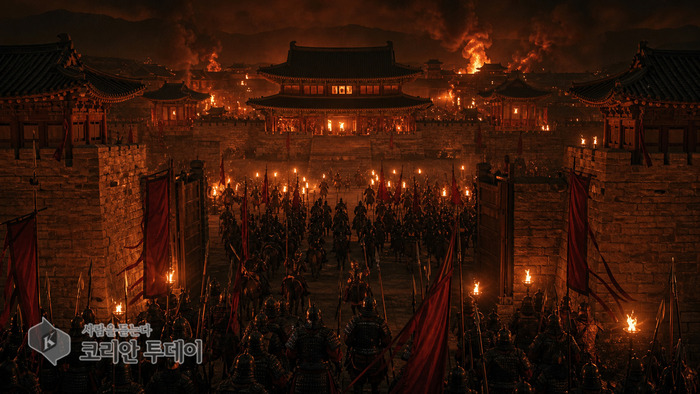
In October 642 CE, at a military review outside the Goguryeo capital Pyongyang, over a hundred court ministers were cut down before their wine cups were empty. From that night on, Goguryeo still had a king – but a different hand held the reins.
The name Yeon Gaesomun carries two faces at once. To some, he was the general who refused to bow to Tang China’s pressure and saved his kingdom. To others, he was the man who murdered his king and built a lifelong dictatorship. The very gap between these verdicts is proof of how deeply his coup reshaped Goguryeo’s fate.
How can a decisive strongman-saves-the-nation story and a power-hungry-usurper story both grow out of the same event? Think of Sulla marching on Rome, or Cromwell dissolving Parliament – the same tension between crisis leadership and unchecked power. Let’s step into that night in Pyongyang.
🌍 Western Historical Parallel
642 CE was a year of dynastic turmoil across the Old World. In Constantinople, Emperor Heraclius had died the previous year, and after a brief power struggle, the eleven-year-old Constans II was proclaimed sole Byzantine emperor – a transition just as violent, in its way, as Pyongyang’s. That same year, Byzantine Alexandria fell to the armies of the Rashidun Caliphate, permanently ending Roman rule over Egypt.
◆ The Ancient Landscape
East Asia in the early 7th century was in flux. After the Sui Dynasty collapsed in 618, the new Tang Dynasty forced Goguryeo’s court to choose a strategy. King Yeongnyu favored accommodation – paying tribute to Tang and avoiding open confrontation, much as smaller medieval kingdoms paid Danegeld to Viking raiders to buy peace. In 631, citing Tang pressure and border defense, he began building the “Thousand-Li Wall,” a fortified line stretching from the Buyeo region to the Bohai coast – and placed its construction under the command of a rising frontier commander: Yeon Gaesomun.
But Gaesomun’s power kept growing, and alarmed by his brutality and independence, King Yeongnyu and his ministers began plotting to remove him – much as the Roman Senate once conspired against an overmighty general. Gaesomun struck first. In October 642, he staged a lavish banquet under the pretext of reviewing the wall’s conscript laborers. There, over a hundred ministers (some sources say up to 180) were slaughtered. His troops then stormed the palace, captured the fleeing King Yeongnyu, killed him, and dismembered his body, dumping it in a ditch.
“Gaesomun was of imposing stature and bold spirit, always wearing five swords at his side, so that none among his retainers dared look him in the eye. He made himself Grand Chancellor, holding military and state power in one hand.”
◆ Same Era, Different Worlds
🏛️ China
Emperor Taizong of Tang was presiding over the “Reign of Zhenguan,” a golden age of Chinese expansion. He seized on Yeongnyu’s murder as a pretext to invade Goguryeo three years later.
🗿 Byzantine Empire
A child-emperor, Constans II, had just taken the throne after a bloody succession crisis, while the empire hemorrhaged its richest province, Egypt, to the advancing Caliphate.
⚔️ Japan
Just three years later in 645, Japan had its own palace bloodbath – the Isshi Incident – when the powerful Soga no Iruka was assassinated in front of the empress, kicking off the Taika Reform. Three East Asian courts, three coups, within a single decade.
🕌 Islamic World
The Rashidun Caliphate, barely a decade removed from Muhammad’s death, was in the middle of one of history’s fastest territorial expansions, absorbing Byzantine Egypt in 642.
[Image: The path of power on the night of the coup, from the military review ground to the royal palace]
⚔️ Scene from That Day
“The banquet tables gleamed. Word had gone out that Gaesomun wished to review the wall’s laborers, and the ministers took their seats without suspicion. Before the wine had gone twice around, the clash of blades sounded outside the door – and Gaesomun’s sword moved first.”
“His cavalry rode straight for the palace. King Yeongnyu found nowhere to hide. Captured, he begged for his life – a scene not unlike a deposed Roman emperor pleading before a general’s guard – but the coup’s blade knew no mercy. By morning, Pyongyang knew the name of its new master.”
◆ Uncovering Historical Truth
Gaesomun’s coup was not simple personal ambition; it was the explosion of a fault line within Goguryeo’s ruling elite over how to handle Tang China. King Yeongnyu’s faction favored low-profile diplomacy to buy time – not unlike Byzantine emperors who paid off Avar or Persian armies rather than fight. Gaesomun’s faction saw this as humiliating submission. After the coup, he installed King Yeongnyu’s nephew Bojang as a figurehead king while concentrating real power in a newly created supreme office, Dae Mangniji, which he held for life – combining military command and civil administration in a single, hereditary-in-practice post, comparable to a Roman “dictator perpetuo” or a Praetorian-installed puppet regime.
Most historians agree King Bojang never wielded genuine authority during his reign. The fact that the Samguk Sagi’s biography of Gaesomun largely copies the Tang dynasty’s own histories is itself cited as evidence that later chroniclers – writing after Goguryeo’s fall – filtered his regime through a hostile Tang lens.
After the coup, Gaesomun resumed attacks on Silla and refused to soften his stance toward Tang. The consequence arrived three years later, in 645, when Emperor Taizong personally led an invasion of Goguryeo. The successful defense of Ansi Fortress was a genuine triumph, but the fact that Gaesomun’s own hardline policy had helped provoke the war in the first place is exactly why his foreign policy remains so contested today – a debate that echoes how historians still argue over whether Winston Churchill’s wartime defiance was pure necessity or partly self-fulfilling brinkmanship.
Period
642 CE (Yeongnyu’s 25th year)
Key Figures
Yeon Gaesomun, King Yeongnyu, King Bojang
Key Event
Banquet massacre, regicide, seizure of Dae Mangniji
Impact
Hardline Tang policy locked in, invasion of 645
🔍 International Academic Perspectives
South Korean Mainstream View
Scholars such as Professor No Tae-don (Seoul National University) describe Gaesomun as a “reckless hardliner and brutal power-holder,” arguing that his lifelong monopoly on power deepened elite division rather than unity, laying groundwork for the fratricidal succession crisis that helped bring Goguryeo down in 668.
Nationalist and North Korean View
Following early 20th-century nationalist historian Shin Chae-ho, and echoed in North Korean historiography, Gaesomun is reframed as the patriot who purged appeasers and led Goguryeo to victory at Ansi Fortress against a superpower’s invasion.
📖 Key Terms Explained
- Goguryeo (고구려)
- Ancient Korean kingdom (37 BCE – 668 CE), the northernmost of the Three Kingdoms of Korea, controlling much of Manchuria and the northern Korean peninsula
- Dae Mangniji (대막리지)
- “Grand Chancellor” – a supreme office created by Yeon Gaesomun in 642, combining supreme military command and civil administration, roughly analogous to a Roman dictator perpetuo or a Japanese shogun ruling behind a figurehead emperor
- Tang Dynasty
- Chinese empire (618-907 CE), roughly contemporary with the later Byzantine Heraclian dynasty and the rise of the Islamic Caliphate
◆ Lessons for Today’s World
Concentrated power always delivers a trade-off. Gaesomun’s regime showed real decisiveness, repelling a Tang emperor’s personal invasion at Ansi Fortress – but power with no check on it eventually fractures at succession. His sons tore the state apart fighting over his legacy, a civil war that historians view as a decisive factor in Goguryeo’s collapse just three years after his death. The lesson echoes modern debates from Rome to today’s authoritarian states: strong leadership and a durable system of government are not the same thing.
The line between a decisive wartime leader and an unchecked strongman remains one of the oldest and most unresolved questions in politics – as relevant to modern debates over emergency powers and executive overreach as it was in seventh-century Pyongyang. A crisis calls for a strong hand; whether the system that hand builds survives the crisis is an entirely separate question.
| Aspect | Goguryeo Era | Modern Parallel |
|---|---|---|
| Geopolitics | Coup ousts the appeasement faction, hardliners take power | Hawks vs. doves debates during great-power confrontation |
| Military | Hardline stance toward Tang provokes Taizong’s 645 invasion | Deterrence policy risks provoking the very war it aims to prevent |
| Culture | Lifetime monopoly on power, no institutional checks | Constitutional checks and balances against power concentration |
[Image: The 642 lifetime-monopoly model contrasted with modern checks-and-balances governance]
📚 Diving Deeper
- After seizing power, Gaesomun promoted Taoism imported from Tang China as a counterweight to Buddhist clergy aligned with the old aristocracy – a religious realignment comparable to how Henry VIII used the English Reformation to break noble and clerical power blocs.
- Tomb murals and fortress ruins near Pyongyang are cited by archaeologists as physical evidence of the military tension defining 7th-century Goguryeo, much as Hadrian’s Wall attests to Rome’s frontier anxieties.
- The succession war among Gaesomun’s sons – Namsaeng, Namgeon, and Namsan – directly enabled the Silla-Tang alliance’s capture of Pyongyang in 668, ending Goguryeo forever.
The Voice of Living History
Yeon Gaesomun’s sword defended his kingdom, but because only one hand held it, the kingdom trembled the moment that hand was gone. Power can hold back a crisis – but power with no check on it is already preparing the next one.
“The Grand Chancellor’s sword defended Pyongyang – but he never found a hand steady enough to pass it to.”
Previous Episode
Episode 13: King Yeongyang and Eulji Mundeok – Heroes of the Battle of Salsu
Next Episode
Episode 15: The Siege of Ansi Fortress – 88 Days of Defiance
The Korean Today “History Lives On” Series
The Goguryeo Chronicle (40 Episodes)
Bridging Ancient East Asia and the Modern World
© 2025 The Korean Today. All rights reserved.
This content is based on historical facts and presents balanced academic perspectives
for international readers.
THE KOREAN TODAY × WIA CODE
이 기사의 WIA Code

WIA Code 스캐너로 비추면 인터넷 없이 발행 사실과 위·변조 여부를 확인할 수 있습니다.
휴대폰 기본 카메라로 찍으면 스캐너 안내 페이지가 열립니다 — 기사 바로 열기

움직이는 코드는 스트림입니다 — WIA Code 스캐너로 약 24초 비추면 기사 전문(사진 포함)이 폰에 저장되어 인터넷 없이도 읽을 수 있습니다.
WIA Code · 코리안투데이






Leave a Reply