
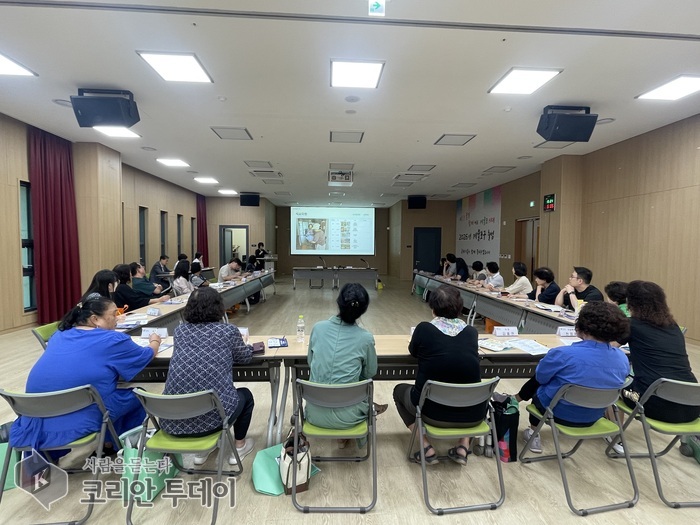
Seoul’s Gangseo-gu (Mayor Jin Kyo-hoon) has launched its first ‘Fresh & Healthy Table Cooking Class’ this year to help low-income households develop healthier eating habits. The nutrition education program is designed to help households receiving government agri-food vouchers learn to properly select and cook fresh ingredients on their own, and will run twice a month from August through December at the Gangseo-gu Public Health Center.
The agri-food voucher program supports the purchase of fresh produce for households receiving basic livelihood benefits with income at or below 32% of the median, specifically those that include pregnant women, infants, children or young people. Applications opened on July 1, and 1,109 households in Gangseo-gu alone are currently benefiting from the program. Through the cooking class, the district aims to go a step further than simply subsidizing food purchases, helping target households put healthy eating into actual practice.
The classes will be led by instructor Jeong Ji-seon, who holds multiple credentials including a dietitian’s license and has worked extensively in food education. The curriculum covers food components, nutrients, and cooking methods that minimize nutrient loss — practical knowledge households can apply immediately at home. Notably, it emphasizes recipes that naturally reduce sodium and sugar intake by using aromatic vegetables and umami flavors instead of relying on strong salty or sweet tastes. The program was designed with the recognition that many households know they should eat a low-salt, low-sugar diet but are unsure how to actually achieve that in their cooking.
The specific menus, each newly planned around seasonal ingredients, include stir-fried beef in gochujang sauce with assorted mushroom namul (August 4), eggplant hotpot rice with balloon flower and cucumber salad (August 18), carrot rapé sandwiches (September 8), skewered pancakes with dried radish salad (September 22), tofu whole-grain poke bowls (October 6), root vegetable rice with persimmon salad (October 20), boiled pork with radish salad (November 10), Chuncheon-style spicy stir-fried chicken (November 24), and tomato ragu sauce with homemade pickled vegetables (December 8). Classes are held on the second and fourth Tuesday of each month, in two sessions — 1 p.m. to 3 p.m. and 4 p.m. to 6 p.m. — in the fourth-floor conference room of the Gangseo-gu Public Health Center (561 Gonghang-daero), free of charge. However, each session is capped at 16 participants, so spots may fill on a first-come, first-served basis.
Gangseo-gu Mayor Jin Kyo-hoon said, “The agri-food voucher program is nutrition education that goes beyond simply supplying ingredients — it helps residents build proper eating habits and take charge of their own health.” He added, “We will continue to expand our food and nutrition programs so residents can address nutritional imbalances and enjoy healthier lives.”
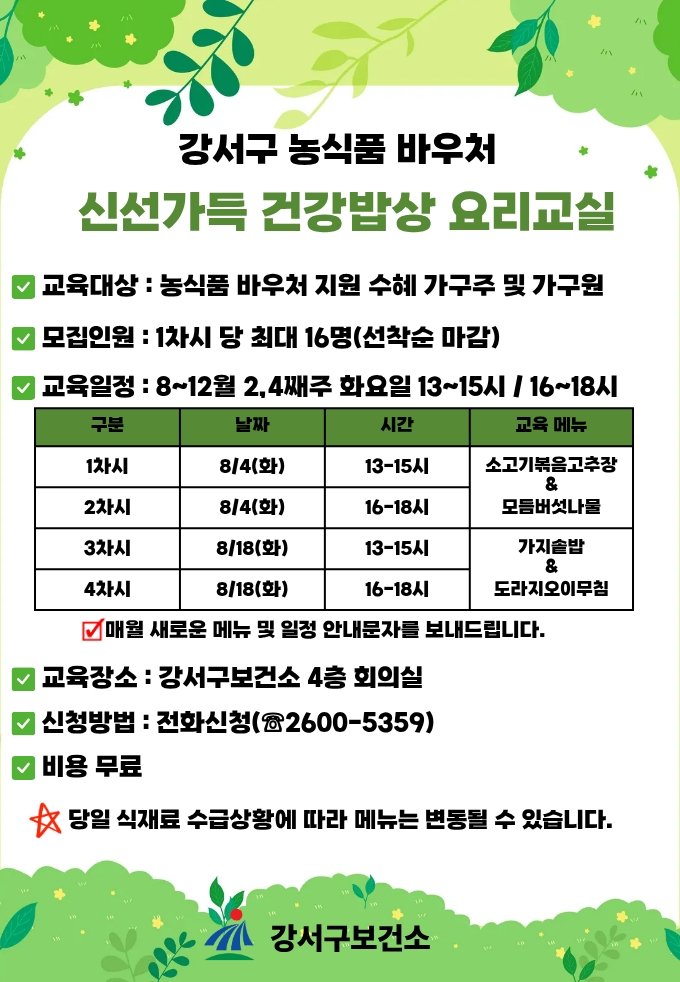 [코리안투데이] Promotional material © 송정숙 기자 |
Low-income households often have less access to fresh food and tend to rely more on processed foods that are relatively cheap but high in sodium and sugar. Given this reality, the cooking class can be seen as more than a simple recipe tutorial — it combines financial support with hands-on education in an effort to narrow the health gap. Still, since this is the program’s first year, how participation rates translate into actual changes in eating habits remains to be seen.
Residents interested in joining the cooking class can call the Gangseo-gu Public Health Center’s Medical Affairs Division (☎02-2600-5359, 7661) for further information.
송정숙 기자 (한국통합치유협회장) | gangseo@thekoreantoday.com
 |
 |
THE KOREAN TODAY × WIA CODE
이 기사의 WIA Code

WIA Code 스캐너로 비추면 인터넷 없이 발행 사실과 위·변조 여부를 확인할 수 있습니다.
휴대폰 기본 카메라로 찍으면 스캐너 안내 페이지가 열립니다 — 기사 바로 열기

움직이는 코드는 스트림입니다 — WIA Code 스캐너로 약 65초 비추면 기사 전문(사진 포함)이 폰에 저장되어 인터넷 없이도 읽을 수 있습니다.
WIA Code · 코리안투데이


Leave a Reply