
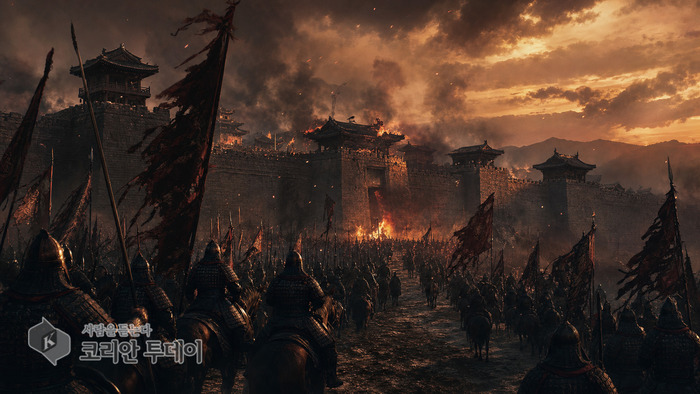
Power held by one man for twenty-five years vanished in a single death — and the kingdom split in two before the mourning was even over.
He had crushed Tang Taizong’s army at the Siege of Ansi and kept the Silla-Tang alliance at bay for decades. As long as Yeon Gaesomun lived, Goguryeo seemed unbreakable. But in 665 CE, the moment he closed his eyes, the story took a sharp and fatal turn.
A kingdom that no foreign sword could pierce collapsed within three years — brought down not by an enemy, but by a quarrel among three brothers. It is a question echoing through history from the fall of Rome’s succession crises to today’s corporate boardrooms.
🌍 Western Historical Parallel
Just four years earlier, in 661 CE, the Islamic world had gone through its own succession catastrophe: the assassination of Caliph Ali ended the First Fitna and gave rise to the Umayyad Caliphate under Mu’awiyah. And in 668 — the very year Pyongyang fell — Byzantine Emperor Constans II was assassinated in Sicily, plunging Constantinople into its own leadership crisis. Across three civilizations, the same fault line: what happens when a strongman dies without a plan.
◆ The Ancient Landscape
After a 642 coup that killed King Yeongnyu, Yeon Gaesomun ruled Goguryeo for over two decades as Grand Minister (Daemakrichi), effectively sidelining the throne. Neither Tang Taizong’s 645 CE invasion nor the repeated campaigns that followed could break through Goguryeo’s defenses under his command. Yet his one-man rule left no real plan for what would come after him.
When Yeon Gaesomun died in 665 CE (some chronicles place it in 666), his eldest son Namsaeng inherited the title of Grand Minister and command of the military and state affairs. The transition looked smooth on the surface. But while Namsaeng was away inspecting provincial fortresses, his younger brothers Namgeon and Namsan seized Pyongyang and staged a coup against him.
“Namsan and Namgeon turned violent and treacherous overnight, raising troops to resist from within. Fearing them, Namsaeng fled to Guknae Fortress to hold his ground, and sent his son Heonseong to Tang to plead for rescue.”
◆ Same Era, Different Worlds
🏛️ China
Emperor Gaozong of Tang reigned nominally, while Empress Wu Zetian was already shaping state policy. Tang welcomed Namsaeng’s defection and used him as a guide into Liaodong.
🗿 Byzantine Empire
Constans II ruled until his assassination in 668, the same year Pyongyang fell — his son Constantine IV would soon face the first Arab siege of Constantinople.
⚔️ Western Europe
Merovingian Francia was entering its own era of fractured royal authority, where sons dividing a father’s realm routinely triggered civil war.
🕌 Islamic World
Mu’awiyah had just consolidated the Umayyad Caliphate in 661 after the First Fitna, proving succession could just as easily forge unity as destroy it.
[Image: The three brothers’ power split and the Silla-Tang alliance’s final offensive, 665-668 CE]
⚔️ Scene from That Day
“Atop the walls of Guknae Fortress, Namsaeng stares toward Pyongyang. Months earlier he had mourned his father alongside these same brothers. Now they hunted his life.”
“His hand trembles as he writes to the Tang court, begging for rescue. To escape his brothers’ spears, he was knocking on the gates of the very empire his father had spent a lifetime holding back — a betrayal as consequential as any in the Wars of the Roses.”
◆ Uncovering Historical Truth
Yeon Gaesomun’s twenty-five-year rule was formidable but structurally fragile. Because he had neutralized the monarchy and built a hereditary dictatorship around the Grand Minister title, his death created an immediate vacuum at the very top of the state — much like a Roman emperor dying without naming a clear heir.
The Epitaph of Cheon Namsaeng, excavated near Luoyang, China, is a rare first-hand epigraphic source — even earlier than the Samguk Sagi — describing how Namsaeng fled to Guknae Fortress the moment he learned of his brothers’ coup while away inspecting the provinces.
Namsaeng’s defection was not simply personal betrayal. It handed Tang the fortresses, garrisons, and military intelligence of the entire northern frontier. Compounding the disaster, Yeon Gaesomun’s own brother Yeon Jeongto defected to Silla — meaning Goguryeo’s defenses collapsed not from external assault but from fractures within its own ruling family.
Period
665-668 CE
Key Figures
Namsaeng, Namgeon, Namsan
Key Event
Fratricidal civil war, defection to Tang
Consequence
Decisive factor in Goguryeo’s fall (668)
🔍 International Academic Perspectives
Korean/Asian Scholars
Yeon Gaesomun’s one-man dictatorship was itself the structural cause of the succession crisis — his death merely triggered an already-inevitable collapse.
Western Historians
Some scholars, citing the Cheon Namsaeng epitaph’s earlier 665 date, argue Tang actively exploited espionage and diplomacy to widen the brothers’ rift — a deliberate divide-and-conquer strategy comparable to Byzantine diplomacy toward its rivals.
📖 Key Terms Explained
- Daemakrichi (Grand Minister)
- Goguryeo’s highest military-political office, comparable to a Roman dictator or Japanese shogun ruling behind a nominal monarch
- Cheon Namsaeng Epitaph
- A stone epitaph excavated near Luoyang; the Yeon clan name was recorded as “Cheon” in Chinese sources to avoid the naming taboo of Tang founder Li Yuan
◆ Lessons for Today’s World
We still watch family-run conglomerates fracture into shareholder wars the moment a founder dies without a succession plan. The stronger the founding leader, the less room the next generation often has to build a cooperative structure of its own.
What Namsaeng handed Tang was not an army — it was the map of Guknae Fortress. That is precisely what happens today when internal conflict drives a key executive to a rival firm, taking trade secrets and strategy out the door with them.
| Aspect | Goguryeo Era | Modern Parallel |
|---|---|---|
| Politics/Security | Power vacuum after the Grand Minister’s death broke the chain of command | Founder/leader risk destabilizing nations and corporations alike |
| Military/Diplomacy | Internal strife handed intelligence directly to Tang | Insider leaks and rival defections expose trade secrets |
| Culture | A militarized kingdom destroyed by fraternal rivalry | Sustainable global brands depend on succession governance |
[Image: What Goguryeo’s fraternal collapse teaches modern organizational succession]
📚 Diving Deeper
- The epitaphs of Cheon Namsaeng and his son Cheon Heonseong, unearthed near Luoyang, are rare first-person accounts from a Goguryeo noble family that sided with Tang.
- The Yeon clan appears as “Cheon” in Chinese records purely due to naming-taboo customs avoiding Tang founder Li Yuan’s given name — a detail as revealing as Sutton Hoo’s clues about Anglo-Saxon kingship.
- Namgeon held out in Pyongyang until a monk’s betrayal opened the gates in 668 — continued in the next episode.
The Voice of Living History
No foreign spear broke a kingdom that had stood for seven hundred years. Distrust between brothers cracked its walls first.
“The strongest fortress falls from within — Pyongyang’s warning to the present.”
Previous Episode
Episode 16: Tang’s Renewed Invasion – A War Without End
Next Episode
Episode 18: The Silla-Tang Alliance – War on Two Fronts
The Korean Today “History Lives On” Series
The Goguryeo Chronicle (40 Episodes)
Bridging Ancient East Asia and the Modern World
© 2025 The Korean Today. All rights reserved.
This content is based on historical facts and presents balanced academic perspectives
for international readers.
THE KOREAN TODAY × WIA CODE
이 기사의 WIA Code

WIA Code 스캐너로 비추면 인터넷 없이 발행 사실과 위·변조 여부를 확인할 수 있습니다.
휴대폰 기본 카메라로 찍으면 스캐너 안내 페이지가 열립니다 — 기사 바로 열기

움직이는 코드는 스트림입니다 — WIA Code 스캐너로 약 22초 비추면 기사 전문(사진 포함)이 폰에 저장되어 인터넷 없이도 읽을 수 있습니다.
WIA Code · 코리안투데이






Leave a Reply