
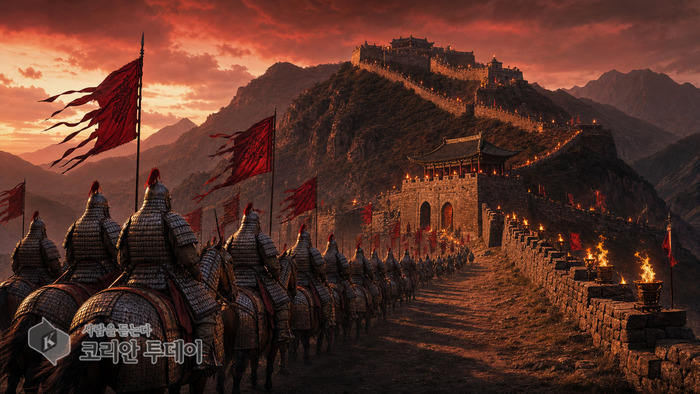
A kingdom of a few million people twice turned back armies of over a hundred thousand. The secret wasn’t a single hero — it was a system.
In 612 CE, General Eulji Mundeok lured a Sui detachment of 305,000 soldiers to the Salsu River and let barely 2,700 return home. In 645 CE, an unnamed commander of Ansi Fortress held off Emperor Taizong of Tang’s army for over two months, derailing his entire conquest campaign. Both episodes are often told as tales of a single genius — but they were really the product of a military system Goguryeo had refined over nearly seven centuries.
A five-district structure that switched instantly from peacetime administration to wartime mobilization, a grassroots school called the gyeongdang that trained commoners in both letters and archery, heavy cavalry warriors carrying 70kg of iron armor, and a web of mountain fortresses arranged so that when one fell, the next still held. What we now call “national defense capability” already existed, in embryonic form, in ancient Goguryeo.
🌍 Western Historical Parallel
While Goguryeo’s gaemamusa thundered across the Liaodong plains, the Byzantine Empire was fielding its own iron-clad cataphract cavalry and organizing its provinces into military “themes” for instant mobilization — the same logic of turning administrative geography into standing defense, arrived at independently on opposite ends of Eurasia.
◆ The Ancient Landscape
Goguryeo’s territory was organized into five districts — East, West, South, North, and Central. This was not mere administration; it doubled as the kingdom’s military backbone. Each district received both a military governor called a yoksal (褥薩), ranked just below the king, and a civil administrator, the cheoryeogeunji. Governance and mobilization moved as one body, so that any district could raise troops and merge them into the central army the moment war broke out.
In Goguryeo’s early centuries, royal authority centered on the Gyeru tribe coexisted with the semi-autonomous power of the other founding tribes, and major state decisions passed through a council of chieftains known as the jega hoeui. As the state matured, the five districts gradually hardened into centralized military-administrative units, forming a standing mobilization network that stretched from Liaodong across the Yalu River to Pyongyang.
“Your uncanny strategies plumbed the workings of heaven; your subtle calculations spanned the patterns of earth. Your victories in battle have already won you great merit — knowing when enough is enough, I hope you will now be content to stop.”
◆ Same Era, Different Worlds
🏛️ China
Sui and Tang China mobilized nationwide armies against Goguryeo. Defeats at Salsu (612) and Ansi Fortress (645) contributed to the Sui dynasty’s collapse and forced Tang Taizong to abandon his conquest.
🗿 Byzantine Empire
Emperor Heraclius-era Byzantium relied on cataphract heavy cavalry and the theme system, splitting provinces into military districts under a general — a strikingly parallel solution to the same strategic problem.
⚔️ Western Europe
Frankish kingdoms were still centuries from Charlemagne’s empire, relying on loosely organized levies far less centralized than Goguryeo’s district-based standing mobilization.
🌏 Japan
In 645 CE, the same year as the Battle of Ansi Fortress, Japan’s Taika Reform began building centralized rule and military organization modeled partly on Goguryeo and Baekje precedents.
[Image: Concept map of Goguryeo’s ring-shaped fortress defense from Liaodong to Guknaeseong]
⚔️ Scene from That Day
“Summer, 645 CE, atop the walls of Ansi Fortress. After two months of siege, the earthen ramp the Tang army had labored to raise finally collapsed. Before the dust settled, defenders surged out and seized the fallen ramp itself, turning the enemy’s own siegework into a new defensive line.”
“Below the walls, Emperor Taizong watched his campaign unravel and finally ordered a withdrawal. Tradition holds that as his army departed, the fortress commander bowed from the ramparts — and the emperor, in grudging respect, sent up bolts of silk. A single fortress had stopped an empire’s ambitions in their tracks.”
◆ Uncovering Historical Truth
The first secret of Goguryeo’s military strength was education. In local gyeongdang halls scattered across the countryside, unmarried commoner youths gathered day and night to read the classics and practice archery. Where Silla’s hwarang trained a small elite, the gyeongdang — expanded after the 427 CE move of the capital to Pyongyang — brought basic literacy and combat skill to the commoner class at scale, functioning less like a military academy and more like a nationwide civic education system built for war.
The second secret was the gaemamusa, Goguryeo’s heavy cavalry. Tomb murals at Anak Tomb No. 3, Palcheong-ri, and Daean-ri Tomb No. 1 repeatedly show riders and horses alike encased head to hoof in iron plate, leading the vanguard of every procession. Estimates put rider armor at roughly 20kg and horse barding at roughly 40kg, with lance and gear pushing the total load near 70kg — a slow-moving but nearly unstoppable shock force that anchored King Gwanggaeto’s conquests, much as cataphracts anchored Sassanid and Byzantine armies further west.
The third secret was the fortress network itself. Goguryeo paired lowland capitals — Guknaeseong, later Pyongyang — with mountain citadels held in reserve (Hwandoseong), while the Liaodong frontier bristled with massive strongholds like Liaodong Fortress, Baekamseong, and Bisaseong. Because each ring of fortresses still held when an outer one fell, invading armies were forced to bleed time and troops on siege after siege. Both the 612 CE Battle of Salsu and the 645 CE Battle of Ansi Fortress were ultimately decided by this network grinding down the invader’s advance and supply lines before a single decisive field battle ever occurred.
Period
5th–7th century CE
Key Figures
Eulji Mundeok, Commander of Ansi Fortress
Key Events
Battle of Salsu (612), Ansi Fortress (645)
Legacy
East Asia’s most resilient defense system
🔍 International Academic Perspectives
Korean/Asian Scholars
The mainstream view holds that the five districts evolved from tribal confederations into centralized military-administrative units as royal power consolidated, and that the gyeongdang was formally institutionalized after the Pyongyang relocation to extend wartime mobilization to commoners.
Alternative Readings
Other historians argue the districts retained meaningful local autonomy well into Goguryeo’s later centuries, and that the gyeongdang’s nationwide rollout should be dated later, to the intensified wars of the 6th–7th centuries, rather than to 427 CE itself.
📖 Key Terms Explained
- Yoksal (褥薩)
- A military governor ranked just below the king, dispatched to command each of Goguryeo’s five districts
- Gyeongdang (扃堂)
- A local hall where unmarried commoner youths studied the classics and practiced archery — Goguryeo’s grassroots military-literacy school
- Gaemamusa (鎧馬武士)
- Fully armored heavy cavalry, roughly analogous to Byzantine cataphracts or later European knights
- Tang Dynasty
- Chinese empire (618–907 CE) whose Emperor Taizong was repelled at Ansi Fortress in 645 CE, roughly contemporary with Byzantine Emperor Heraclius
◆ Lessons for Today’s World
What makes Goguryeo’s military system remarkable is that it bet its survival on structure rather than a single hero. The gyeongdang proved that peacetime investment in education becomes wartime capability; the fortress network proved that layered defense in depth can offset a raw disadvantage in numbers.
Modern South Korea’s world-class defense technology, its reserve-forces and territorial defense systems, and its emphasis on civic education alongside conscription all trace back to the same underlying logic — much as NATO members today combine standing forces, reserves, and layered air defense rather than relying on any one asset. Fourteen centuries later, the lesson still holds: against a numerically superior foe, it is preparation, terrain, and a trained citizenry — not luck — that decide the outcome.
| Aspect | Goguryeo Era | Modern Parallel |
|---|---|---|
| Geopolitics | Five-district system fusing civil rule and military command | Local government linked to reserve forces and territorial defense |
| Military | Gaemamusa heavy cavalry; concentric fortress defense | Advanced deterrence; multi-layered missile defense |
| Culture | Gyeongdang’s blend of scholarship and martial training | K-Defense industry and civic security awareness |
[Image: The gaemamusa’s heavy-cavalry spirit echoed in Korea’s modern defense system]
📚 Diving Deeper
- Tomb murals at Anak Tomb No. 3 and Palcheong-ri — the clearest surviving depictions of gaemamusa armor, comparable in historical value to England’s Sutton Hoo find
- Surviving fortress ruins at Liaodong’s Baekamseong and Bisaseong, showing the concentric defense layout in the field
- Samguk Sagi accounts of the Battle of Salsu and the Battle of Ansi Fortress, in the Goguryeo Annals and Biographies sections
The Voice of Living History
Goguryeo did not hold back empires with a single hero. It held them back with education, organization, and a deep knowledge of its own terrain. Strength, it turned out, was never an accident — it was the product of preparation.
“A nation ready down to its last fortress and its last soldier — Goguryeo’s martial spirit still runs through this land.”
Previous Episode
Episode 24: Ondal and Princess Pyeonggang – A Love Beyond Rank
Next Episode
Episode 26: Religion in Goguryeo – Buddhism, Taoism, and Native Beliefs
The Korean Today “History Lives On” Series
The Goguryeo Chronicle (40 Episodes)
Bridging Ancient East Asia and the Modern World
© 2025 The Korean Today. All rights reserved.
This content is based on historical facts and presents balanced academic perspectives
for international readers.
THE KOREAN TODAY × WIA CODE
이 기사의 WIA Code

WIA Code 스캐너로 비추면 인터넷 없이 발행 사실과 위·변조 여부를 확인할 수 있습니다.
휴대폰 기본 카메라로 찍으면 스캐너 안내 페이지가 열립니다 — 기사 바로 열기

움직이는 코드는 스트림입니다 — WIA Code 스캐너로 약 26초 비추면 기사 전문(사진 포함)이 폰에 저장되어 인터넷 없이도 읽을 수 있습니다.
WIA Code · 코리안투데이






Leave a Reply