
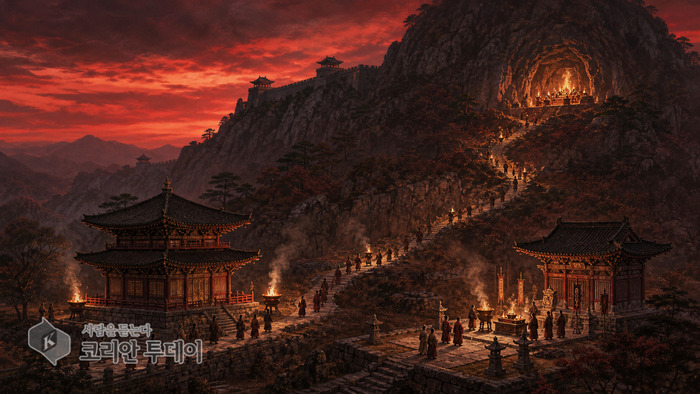
Imagine a kingdom where a Buddhist temple, a Taoist shrine to Laozi, and a sanctuary to a sky-born founder king all stood within the same city walls.
That kingdom was Goguryeo. Buddhism arrived from China in 372 CE, Taoism received state patronage from the 7th century, and beneath both lay an indigenous cult of the founder-king Dongmyeong and his mother Lady Yuhwa that endured for over four centuries. None of the three displaced the others — each was layered onto the last as royal needs shifted.
To modern eyes trained on the separation of church and state, this looks strange. So why did Goguryeo’s kings repeatedly import new religions as tools of statecraft, yet never discard the old faith beneath them?
🌍 Western Historical Parallel
When Goguryeo formally accepted Buddhism in 372 CE, Rome was less than sixty years removed from the Edict of Milan (313 CE), which had legalized Christianity, and only eight years from making it the empire’s official religion under Theodosius I in 380 CE. Both empires, half a world apart, were discovering that a universal faith could be harnessed to unify a fractious, multi-ethnic realm.
◆ The Ancient Landscape
In June 372 CE, in the second year of King Sosurim’s reign, Fu Jian, ruler of the Former Qin state that had just unified northern China, sent an envoy accompanied by the monk Sundo, bearing Buddhist statues and scriptures. Two years later, the monk Ado arrived as well, and in 375 CE Sosurim built the temples Chomunsa and Ibullansa to house them — the first officially recognized Buddhist temples on the Korean peninsula.
Notably, this was no isolated religious event. In the same window Sosurim founded the Taehak, a Confucian academy for aristocratic youth, and in 373 CE promulgated a formal legal code. Buddhism, Confucian education, and codified law arrived as a single package to shore up centralized royal authority. Nearly 250 years later, in 624 CE, Tang Emperor Gaozu sent a Taoist priest bearing an image of the Celestial Worthy and the Tao Te Ching, formally introducing Taoism at the state level. By 643 CE, the powerful minister Yeon Gaesomun petitioned the king to promote Taoism further — explicitly to weaken the Buddhist-aligned aristocracy — and several temples were even converted into Taoist monasteries.
“King Fu Jian of [Former] Qin sent an envoy together with the monk Sundo, bearing Buddhist images and scriptures; the king in turn sent envoys with tribute in reply.”
◆ Same Era, Different Worlds
🏛️ China
In 372 CE, north and south China were split between the Former Qin and Eastern Jin — a Northern-Southern Dynasties world where courts everywhere leaned on Buddhism to legitimize rule.
🗿 Byzantine Empire
In 372 CE, Rome was ruled by brothers Valentinian I and Valens, just decades before the eastern half of the empire — soon to be “Byzantine” — would make Christianity its official faith.
⚔️ Western Europe
Rome’s frontier provinces faced growing pressure from Germanic peoples in the 370s CE, the same decade Goguryeo was consolidating central authority through Buddhism and law.
🕌 Islamic World
Right around 624 CE, when Taoism reached Goguryeo, the earliest Muslim community was consolidating in Medina, just two years after the Hijra of 622 CE.
[Image: Goguryeo’s religious landscape — the sacred cave, the Buddhist temple, and the Taoist shrine coexisting]
⚔️ Scene from That Day
“Late summer, 372 CE, the courtyard of the Guknae Fortress palace. Behind the Former Qin envoy’s procession walks a man in unfamiliar robes, cradling a gilt-bronze Buddha and a rolled scripture. King Sosurim studies the object in silence as murmurs ripple through his court.”
“That same October, the king personally offers rites at the shrine of the founder-king Dongmyeong on the western outskirts. Hands that had burned incense before a new Buddha bow, three days later, before the sky-born ancestor. To him, the two acts were not a contradiction — both were sources of strength for the state.”
◆ Uncovering Historical Truth
The single word that best explains Goguryeo’s religious policy is “pragmatism.” The 372 CE recognition of Buddhism was less an act of faith than an import of statecraft technology. Literate monks could draft diplomatic correspondence and interpret continental politics, and the doctrine that “the king is a Buddha” was a potent way to sanctify royal authority in a society still marked by tribal-confederate structures. It is no coincidence that the Taehak academy, the legal code, and Buddhist recognition all clustered between 373 and 375 CE — together they formed a single policy package meant to restabilize a throne shaken by the death of King Gogugwon in battle against Baekje in 371 CE.
Tomb murals serve as a time capsule of this shifting religious landscape. Earlier murals, such as those in Anak Tomb No. 3 or the Deokheung-ri tomb from around the 5th century, emphasize portraits of the deceased, processional scenes, and Buddhist lotus motifs symbolizing rebirth. By the 6th and 7th centuries, mural themes narrow almost exclusively to the Four Guardian Deities — the Azure Dragon, White Tiger, Vermilion Bird, and Black Tortoise — set against backgrounds dense with Taoist symbolism: sun and moon, the Big Dipper, and immortal sages. This shift maps precisely onto the political story of state patronage moving from Buddhism toward Taoism.
And yet the indigenous cult was never fully displaced. Rites at the shrines of founder-king Dongmyeong and his mother Lady Yuhwa — personally performed by King Taejo around 121 CE and by later monarchs — remained a bedrock of state ritual, and the sky-worship ceremonies held at the great cave east of the capital continued until the kingdom’s fall. If Buddhism and Taoism were interchangeable “governance software” the throne swapped in as circumstances demanded, the founder cult functioned more like the “operating system” underlying the state’s very identity.
Period
4th – 7th century CE
Key Figures
King Sosurim, King Yeongnyu, Yeon Gaesomun
Key Events
Buddhism recognized (372), Taoism imported (624)
Legacy
Centralized rule, pluralistic religious culture
🔍 International Academic Perspectives
Mainstream View
Most historians read Yeon Gaesomun’s 643 CE promotion of Taoism as a calculated political move to weaken a Buddhist-aligned aristocracy, rather than an act of personal devotion.
Alternative View
Some scholars argue Tang China’s export of Taoism doubled as a strategy to sow division inside Goguryeo’s court, raising questions about how much agency Goguryeo truly held in the exchange.
📖 Key Terms Explained
- Goguryeo (고구려)
- Ancient Korean kingdom (37 BCE – 668 CE), one of the Three Kingdoms of Korea
- Dongmyeong (동명왕)
- Goguryeo’s founder-king, venerated as a sky-descended ancestor alongside his mother Lady Yuhwa
- Four Guardian Deities (사신도)
- A Taoist-derived set of four cosmic animal guardians — dragon, tiger, phoenix-like bird, and tortoise-serpent — painted on tomb walls
◆ Lessons for Today’s World
Modern South Korea has no state religion and constitutionally separates church and state, yet remains one of the world’s most striking examples of religious pluralism, with Buddhism, Protestantism, Catholicism, indigenous shamanism, and new religious movements coexisting within a single city block. That coexistence has deep roots — in a kingdom that welcomed new faiths without ever being wholly consumed by them.
Yeon Gaesomun’s example is also a cautionary tale: when religion becomes a weapon in a power struggle, entire faith communities can be taken hostage by factional politics. As modern debates continue over religious institutions being drawn into political battles, Goguryeo’s 1,400-year-old successes and failures remain strikingly relevant.
| Aspect | Goguryeo Era | Modern Parallel |
|---|---|---|
| State-Religion Ties | Crown selectively patronized Buddhism and Taoism as tools of rule | Constitutional separation, freedom of religion |
| Religious Landscape | Buddhism and Taoism layered atop an enduring indigenous cult | Multi-faith coexistence, no single dominant religion |
| Risk Factor | Religion weaponized in 7th-century aristocratic power struggles | Religious institutions drawn into contemporary political disputes |
[Image: How Goguryeo’s triple religious legacy flows into today’s religious pluralism]
📚 Diving Deeper
- Compare Buddhist and Taoist iconography directly by examining murals in Anak Tomb No. 3, the Deokheung-ri tomb, and the Great Tomb of Gangseo.
- The Samguk Sagi’s Goguryeo Annals record royal rites at the founder shrine and the Taehumyo (Queen Mother’s Shrine) across multiple reigns.
- The great cave east of Guknae Fortress, near modern Ji’an, is traditionally identified as the stage for Goguryeo’s sky-worship ceremonies.
The Voice of Living History
Goguryeo never feared new faiths, yet it never forgot who it was. That balance was one more force holding a 700-year dynasty together.
“Between the temple of the Buddha and the shrine of Laozi, the founder’s altar still burned incense.”
Previous Episode
Episode 25: Goguryeo’s Military System – Secrets of the Strongest Army
Next Episode
Episode 27: Goguryeo’s Cities – From Gungnae to Pyongyang
The Korean Today “History Lives On” Series
The Goguryeo Chronicle (40 Episodes)
Bridging Ancient East Asia and the Modern World
© 2025 The Korean Today. All rights reserved.
This content is based on historical facts and presents balanced academic perspectives
for international readers.
THE KOREAN TODAY × WIA CODE
이 기사의 WIA Code

WIA Code 스캐너로 비추면 인터넷 없이 발행 사실과 위·변조 여부를 확인할 수 있습니다.
휴대폰 기본 카메라로 찍으면 스캐너 안내 페이지가 열립니다 — 기사 바로 열기

움직이는 코드는 스트림입니다 — WIA Code 스캐너로 약 24초 비추면 기사 전문(사진 포함)이 폰에 저장되어 인터넷 없이도 읽을 수 있습니다.
WIA Code · 코리안투데이






Leave a Reply