
The Ministry of Health and Welfare (Minister Jung Eun-kyeong) and the Ministry of Employment and Labor (Minister Kim Young-hoon) signed a memorandum of understanding titled “Building Safe Hospitals Where People Want to Work” at Inha University Hospital in Incheon at 9:30 a.m. on Aug. 13, together with the Korean Hospital Association, the Korean Nurses Association, the Labor-Management Development Foundation and the Korea Labor Education Institute. The agreement comes amid a series of cases in which health care workers have suffered under workplace harassment and excessive workloads, and aims to bring about fundamental change in hospital organizational culture and working conditions.
Behind the agreement lies a finding that harassment is markedly more prevalent in the health and welfare sector than in other industries. In a 2024 survey, the health and welfare sector recorded the highest rate of reported harassment at 25 percent, and in 2025 the sector also accounted for the largest share of workplace harassment complaints filed, at 16 percent. Officials point to the nature of work that involves responsibility for patients’ lives and safety, which brings high workloads and levels of accountability and leaves staff exposed to constant tension and psychological strain.
The signatory organizations will form a Health Care Workplace Innovation Council to review implementation every six months and will pursue three tasks together. The first is on-site assessment. Through a harassment survey tailored to the health care industry that the Ministry of Employment and Labor has been conducting since June, the government will examine the incidence of harassment at small and mid-sized hospitals and clinics in provincial areas, along with existing support and remedy measures, while gathering a broad range of views from the medical and nursing communities. For nursing staff, a separate survey will be conducted under the newly enacted Nursing Act, covering working conditions and human rights violations by institution, occupation and region, as well as training and treatment.
The second task is improving organizational culture and working conditions. Intensive support will be provided through “workplace innovation cooperative consulting” designed specifically for hospitals, and hospitals recommended by the Korean Hospital Association will enter assessment and consulting immediately through a fast track, without separate screening. Employers will be exempt from cost-sharing for the organizational culture component, and a tailored special diagnosis will also be carried out for junior nurses to examine potential drivers of harassment such as hierarchical workplace culture. Harassment prevention training reflecting the specific conditions of hospital work will be expanded, and a standard manual for improving organizational culture that can be used on site will be produced and distributed.
Support for reducing actual working hours to ease workloads will also be broadened. The “Work-Life Balance +4.5 Project,” which currently gives priority support to life- and safety-related fields within the health care industry, is already in operation, and the government plans to extend eligibility to health care workers such as nurses at university hospitals, who have been identified as falling outside existing support.
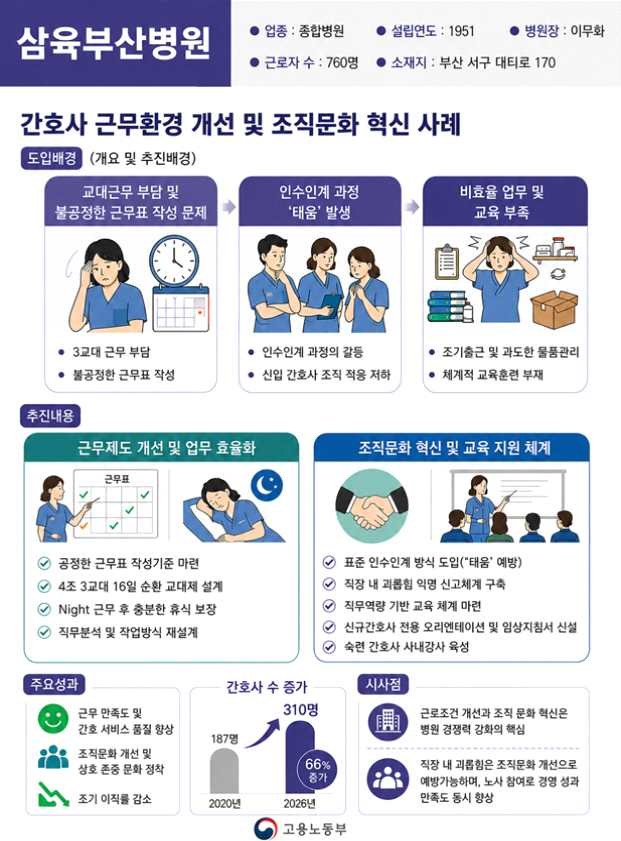
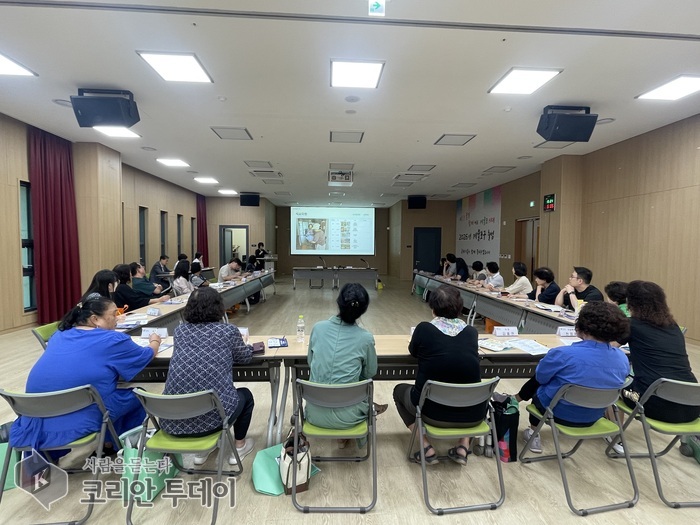
Labor and management representatives from Inha University Hospital and Sahmyook Busan Hospital also took part in the on-site discussion held that day. Inha University Hospital was presented as a case of an institution that sought out consulting after struggling with turnover among newly hired nurses. Sahmyook Busan Hospital, which took part in consulting several years ago over the same concern, shared its experience of sharply reducing turnover after restructuring nurses’ shift systems and carrying out efforts to improve organizational culture. The example illustrated that consulting can go beyond declarations of intent and translate into actual staff retention.
The third task is building a response system that runs from complaint to labor inspection. So that health care workers do not have to face harassment alone, the Ministry of Health and Welfare and nursing workforce support centers will strengthen counseling and support channels, including the Nurse SOS support desk, and the ministry and the Korean Nurses Association will establish a route for passing information on problem workplaces identified in the field to the Ministry of Employment and Labor for labor inspection. The labor ministry is currently carrying out nationwide targeted inspections of hospitals where harassment complaints have been filed, and from July 15 to Aug. 14 it is checking compliance with labor laws at 14 small and mid-sized hospitals that have drawn a high number of complaints over the past three years. The Ministry of Health and Welfare is also pursuing improvements to working conditions, including institutionalizing appropriate nurse staffing levels, through its First Comprehensive Nursing Plan.
Health and Welfare Minister Jung Eun-kyeong said a workplace where nurses and other health care professionals are respected translates directly into patient safety. “It is difficult for any single ministry to resolve the problems in health care settings on its own,” she said. “The government will improve working conditions so that appropriate nurse staffing can be put in place, and medical institutions must work in parallel to improve their organizational culture, led by hospital directors.”
Employment and Labor Minister Kim Young-hoon said it should never be the case that the hands that save patients’ lives are harassed at work and left without protection. “Through workplace innovation cooperative consulting and support for reducing actual working hours, we will build hospitals where health care workers can work safely,” he said. Using the agreement as a starting point, the government plans to link assessment, prevention and consulting, and complaint and inspection responses more closely in order to create hospitals where health care workers can do their jobs with peace of mind.
Photo caption: Courtesy of the Ministry of Health and Welfare
 [코리안투데이] Courtesy of the Ministry of Health and Welfare © 송정숙 기자 |
송정숙 기자 (한국통합치유협회장) | gangseo@thekoreantoday.com
 |
 |
THE KOREAN TODAY × WIA CODE
이 기사의 WIA Code

WIA Code 스캐너로 비추면 인터넷 없이 발행 사실과 위·변조 여부를 확인할 수 있습니다.
휴대폰 기본 카메라로 찍으면 스캐너 안내 페이지가 열립니다 — 기사 바로 열기

움직이는 코드는 스트림입니다 — WIA Code 스캐너로 약 67초 비추면 기사 전문(사진 포함)이 폰에 저장되어 인터넷 없이도 읽을 수 있습니다.
WIA Code · 코리안투데이


Leave a Reply