
In 918 CE, a new dynasty reached back 250 years to resurrect the name of a fallen kingdom. Why did it choose that name — and why does the world still call Korea by it today?
When Pyongyang fell in 668 CE, Goguryeo seemed to vanish from history. Yet 250 years later, a local lord from Songak named Wang Geon founded a new state and named it “Goryeo” — not Silla, not Later Baekje, but the resurrected name of an extinct empire.
A dynasty’s chosen name is a declaration of which history it claims as its own. Why did Wang Geon insist on “Goryeo,” and how did that choice shape the new kingdom’s foreign policy and territorial ambitions for centuries to come — indeed, into the very name “Korea” used worldwide today?
🌍 Western Historical Parallel
Just as Wang Geon invoked Goguryeo’s name to legitimize his new dynasty, Otto I of East Francia revived the title “Roman Emperor” in 962 CE, founding the Holy Roman Empire on the borrowed prestige of ancient Rome — a strikingly similar strategy of political legitimacy through historical continuity.
◆ The Ancient Landscape
By the late 9th century, Silla had crumbled into the chaos of the Later Three Kingdoms period. In 901, Gungye founded “Later Goguryeo,” explicitly claiming Goguryeo’s legacy — but his brutal rule cost him support. In 918, his own general Wang Geon led a coup, backed by nobles including Sin Sung-gyeom and Bok Ji-gyeom, and founded a new state.
Wang Geon named it “Goryeo,” adopting the era name “Cheonsu.” He inherited Gungye’s Goguryeo-succession claim while distancing himself from tyranny to build fresh legitimacy. Between 918 and the fall of Silla (935) and the absorption of Later Baekje (936), Wang Geon unified the peninsula and made recovering Goguryeo’s lost northern territory the cornerstone of state policy.
“Seogyeong’s water virtue flows smoothly and forms the very root of our nation’s earth-veins — a land destined to sustain the royal enterprise for ten thousand generations. The king must reside there for a hundred days during each of the four mid-seasons to secure the realm’s peace.”
◆ Same Era, Different Worlds
🏛️ China
The Tang Dynasty had collapsed in 907, plunging China into the Five Dynasties and Ten Kingdoms chaos. The Khitan Liao, founded in 916, destroyed Balhae in 926 and became Northeast Asia’s dominant power.
🗿 Byzantine Empire
The Macedonian dynasty was at its height, projecting power across the Mediterranean.
⚔️ Western Europe
Otto I rose to the East Frankish throne in 936, laying groundwork for the Holy Roman Empire founded in 962 — reviving Rome’s name much as Wang Geon revived Goguryeo’s.
🌏 Japan
The Heian period saw the Fujiwara clan’s regency politics approaching its peak.
[Image: Goryeo’s unification and Balhae refugee migration centered on Seogyeong (918-943 CE)]
⚔️ Scene from That Day
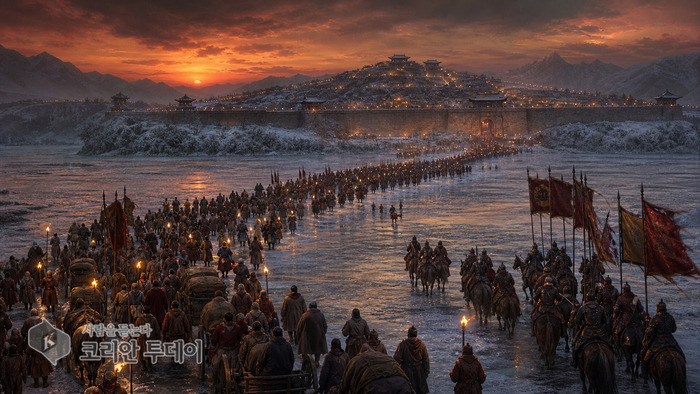
“In the winter of 934, a column stretching beyond the horizon crossed the frozen Yalu River. Balhae’s last crown prince, Dae Gwang-hyeon, led tens of thousands of refugees on foot toward the Goryeo capital, carrying little more than fragments of a fallen royal house.”
“Wang Geon received him personally, granting him the royal surname Wang and the name Gye, and entered him into the dynastic register — not merely an act of asylum, but a symbolic absorption of Balhae’s own claim to Goguryeo’s legacy.”
◆ Uncovering Historical Truth
Wang Geon’s choice of “Goryeo” was no accident. Records suggest that as early as King Jangsu’s reign in the 5th century, Goguryeo itself had already shortened its own name to “Goryeo.” Wang Geon was not inventing a new identity but reviving one Goguryeo had already claimed at its height — a potent political asset for a ruler needing to unify a fractured peninsula, much as Charlemagne and later Otto I drew legitimacy from Rome’s memory.
This was more than rhetoric. Wang Geon rebuilt the ruined city of Pyongyang as “Seogyeong” (Western Capital), resettled it with people from Hwanghae province, and personally patrolled the northern frontier repeatedly. As a result, Goryeo’s border expanded to a line running from the Cheongcheon River to Yeongheung Bay. When the Khitan destroyed Balhae in 926, tens of thousands of Balhae royals and refugees fled south into Goryeo, and Wang Geon welcomed them. In 942, in the so-called “Manbugyo Incident,” he exiled Khitan envoys to an island and starved fifty camels they had brought as gifts to death beneath Manbu Bridge — a deliberate refusal to reconcile with the destroyer of Balhae.
The chosen name, the near-relocation to Seogyeong, the embrace of Balhae refugees, and open hostility toward the Khitan were all threads of a single narrative: Goryeo as Goguryeo’s heir. It was both Wang Geon’s personal conviction and a calculated state strategy to weld a scattered populace into one nation.
Period
Early 10th century (918-943 CE)
Key Figures
King Taejo Wang Geon, Crown Prince Dae Gwang-hyeon of Balhae
Key Events
Founding of Goryeo (918); absorption of Balhae refugees (926-934)
Legacy
Northern expansion policy; prolonged rivalry with the Khitan
🔍 International Academic Perspectives
Korean/East Asian Scholars
The mainstream view holds that Wang Geon’s Goguryeo-succession claim was a genuine state ideology, substantiated by concrete policies such as prioritizing Seogyeong and absorbing Balhae refugees, not mere rhetoric.
Revisionist Historians
Some scholars argue Wang Geon’s clan, a maritime trading family from the Yeseong River basin, had no verifiable blood ties to the Goguryeo royal house, making “Goryeo” more a borrowed symbol of legitimacy than a literal succession.
📖 Key Terms Explained
- Goryeo (高麗)
- Korean dynasty (918-1392 CE), founded by Wang Geon, from which the English name “Korea” derives
- Seogyeong (西京)
- “Western Capital,” Goryeo’s name for rebuilt Pyongyang, the former Goguryeo capital, and the center of its northern expansion policy
- Ten Injunctions (訓要十條)
- Wang Geon’s political testament to his successors, issued in 943 CE, recorded in the Goryeosa
◆ Lessons for Today’s World
How a nation or organization frames its origins remains a powerful identity strategy today. Just as Wang Geon unified a scattered population under the name “Goryeo,” modern states and brands still build trust and belonging through historical symbolism.
That the name “Goryeo” survives today as “Korea” — the country’s name across the globe — shows just how durable a millennium-old branding strategy can be.
| Aspect | Goryeo Era | Modern Parallel |
|---|---|---|
| Geopolitics | Standoff with Khitan and Jurchen, frontier defense centered on Seogyeong | Balancing diplomacy among neighboring great powers |
| Military/Diplomacy | Severed ties with Khitan after the Manbugyo Incident | Values- and principle-based foreign policy |
| Culture | National identity unified through Goguryeo-succession ideology | Nation branding rooted in history and tradition |
[Image: The lineage of identity and naming from Goguryeo through Balhae to Goryeo]
📚 Diving Deeper
- Archaeological surveys continue at Pyongyang (Seogyeong), where Wang Geon repeatedly patrolled and rebuilt fortifications and palace structures.
- Crown Prince Dae Gwang-hyeon’s granted name, “Wang Gye,” survives in Goryeo’s royal genealogy — evidence that Balhae’s royal descendants were absorbed into the Goryeo ruling class.
- The original text of the Ten Injunctions survives in the Goryeosa’s Taejo annals, offering a direct primary-source window into Wang Geon’s worldview on Seogyeong and the Khitan.
The Voice of Living History
To inherit a name is to declare oneself the bearer of both its memory and its responsibility. The name Wang Geon revived, “Goryeo,” survives today as “Korea” — proof that Goguryeo’s spirit never truly ended in 668 CE.
“Goguryeo did not vanish. It only rose again under a new name.”
Previous Episode
Episode 31: Balhae – Successor to Goguryeo
Next Episode
Episode 33: The Gwanggaeto Stele – Rediscovered After 1,500 Years
The Korean Today “History Lives On” Series
The Goguryeo Chronicle (40 Episodes)
Bridging Ancient East Asia and the Modern World
© 2025 The Korean Today. All rights reserved.
This content is based on historical facts and presents balanced academic perspectives
for international readers.
THE KOREAN TODAY × WIA CODE
이 기사의 WIA Code

WIA Code 스캐너로 비추면 인터넷 없이 발행 사실과 위·변조 여부를 확인할 수 있습니다.
휴대폰 기본 카메라로 찍으면 스캐너 안내 페이지가 열립니다 — 기사 바로 열기

움직이는 코드는 스트림입니다 — WIA Code 스캐너로 약 26초 비추면 기사 전문(사진 포함)이 폰에 저장되어 인터넷 없이도 읽을 수 있습니다.
WIA Code · 코리안투데이






Leave a Reply