
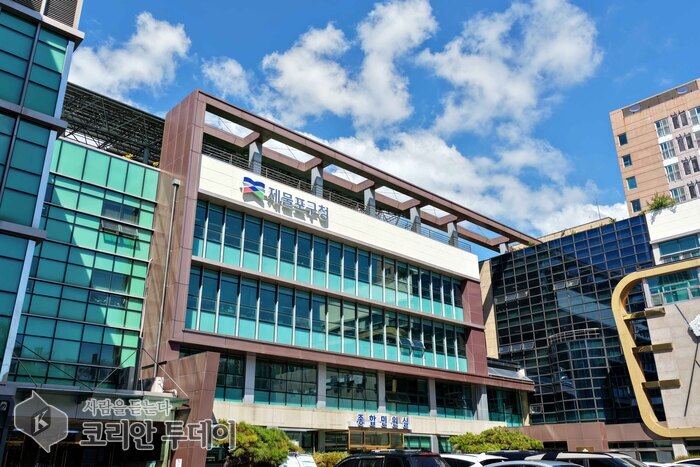
Jemulpo-gu District (Mayor Kim Chan-jin) in Incheon has finished installing additional “road dust collection systems” along Injung-ro and Yeomjeon-ro, where truck traffic is heavy. Performance evaluations conducted this year at each installation site showed that the systems cut resuspended road dust by about 53 percent. Based on these results, the district plans to keep adding the facilities to protect residents’ health from fine dust.
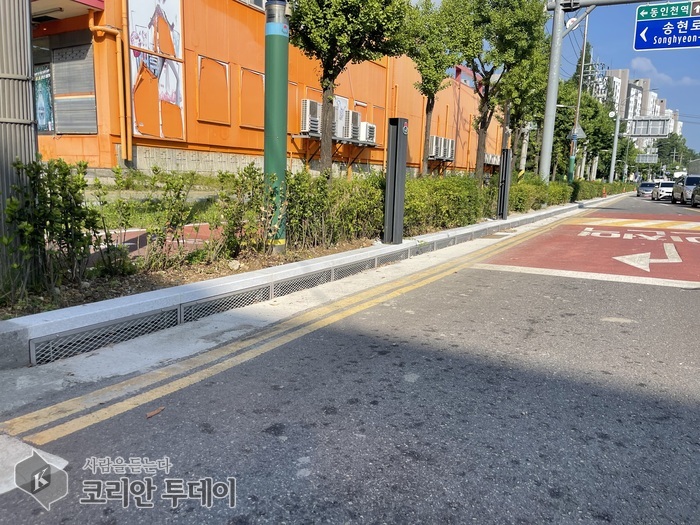 [The Korean Today] Road dust collection system installed along Injung-ro © Reporter Kim Mi-hee |
The project targets road dust, also called resuspended dust: dust that has settled on the road surface and is lifted back into the air each time a vehicle passes. Dust builds up on roads from vehicle exhaust and from particles produced as tires and brake pads wear down. It is a major pollution source, accounting for about 39 percent of Incheon’s total fine dust emissions.
This year, the district spent a total of 650 million won to install the systems along 861 meters of major arterial roads, including the section of Injung-ro from Songhyeon Intersection to Hwadojin Middle School and the section of Yeomjeon-ro around Songnim Gymnasium. Roads where frequent large truck traffic stirs up heavy dust were given priority.
The expansion draws on experience from earlier pilot installations. The district had previously installed and operated the same facilities on a trial basis on Jemulryang-ro in front of Manseok Elementary School and on part of Injung-ro in front of Songhyeon Dongbu Centreville Apartments.
The system works on a relatively simple principle. A “linear drainage channel-integrated dust collector” is installed along the road curb so that dust carried by the natural airflow of passing vehicles gathers inside the drainage channel. Collected dust is washed into the sewer when it rains or when water trucks clean the road. As a result, the system can continuously reduce resuspended dust without separate maintenance costs.
The results have been confirmed with data. Performance evaluations at each installation site this year found that resuspended road dust fell by about 53 percent. The systems are expected to reduce the amount of dust inhaled by residents living along arterial roads, pedestrians and students attending nearby schools.
Building on these results, the district will continue the project next year. It plans to identify sections vulnerable to high concentrations of fine dust through preliminary field surveys and keep extending the collection systems to more areas.
“Along with operating our existing road-sweeping vehicles, we will continue to expand the areas where road dust collection systems are installed to effectively reduce resuspended road dust,” Jemulpo-gu District Mayor Kim Chan-jin said. “We will do our best to achieve practical improvements in air quality that residents can feel.”
Adding low-maintenance systems that reduce dust around the clock to the district’s road-sweeping operations is seen as a realistic way to improve air quality for residents living along arterial roads in the old downtown area, where truck traffic is heavy.
[ Reporter Kim Mi-hee: incheonsouth@thekoreantoday.com ]
Become a Local Ambassador Apply as Branch Director The Korean Today — Nam-Incheon
 |
THE KOREAN TODAY × WIA CODE
이 기사의 WIA Code

WIA Code 스캐너로 비추면 인터넷 없이 발행 사실과 위·변조 여부를 확인할 수 있습니다.
휴대폰 기본 카메라로 찍으면 스캐너 안내 페이지가 열립니다 — 기사 바로 열기
움직이는 코드(스트림) 한 장에 기사 전문(사진 포함)이 담겨 있습니다 — WIA Code 스캐너로 약 47초 비추면 폰에 저장되어 인터넷 없이도 읽을 수 있습니다. Stream.mp4 도 여기서 받습니다.
WIA Code · 코리안투데이


Leave a Reply