
Koo Hyuk-chae, First Vice Minister of the Ministry of Science and ICT (MSIT; led by Deputy Prime Minister and Minister of Science and ICT Bae Kyung-hoon), met in Seoul on October 1 with Kristina Kallas, Estonia’s Minister of Education and Research, who is visiting Korea, to discuss ways of sharing policy in advanced science and technology and strengthening international cooperation between the two countries. The meeting focused on bolstering research and development (R&D) cooperation in cutting-edge fields such as energy technology and post-quantum cryptography, and on expanding multilateral joint research projects linked to Horizon Europe.
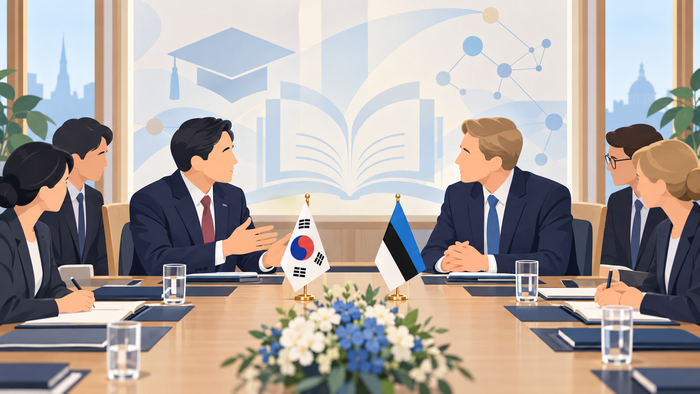 [코리안투데이] First Vice Minister of MSIT Koo Hyuk-chae meets with Estonian Minister of Education and Research Kristina Kallas © 장형임 기자 |
The meeting was arranged at the request of Estonia, which is regarded as a leading technology-innovation nation among the three Baltic states. Working through Estonia’s Ministry of Education and Research, which oversees the country’s national R&D, the two sides shared their policies and R&D status in key advanced-technology fields including energy technology, quantum, post-quantum cryptography and artificial intelligence (AI).
In particular, the two sides agreed that, amid conditions in which developing strategic technologies independently is difficult, securing strategic autonomy in technology through international cooperation is essential, and they jointly explored practical avenues of cooperation in advanced technology. This aligns with a broader trend of reducing dependence on a small number of technological powers and of diversifying the supply chains and research capabilities for core technologies, going beyond mere exchange.
The two sides also agreed that, with Korea’s participation as an associate member of Horizon Europe, they would develop their cooperation beyond the digital and industrial joint tasks currently under way into larger-scale joint projects. Horizon Europe is the European Union’s (EU) large-scale research and innovation funding program, and it serves as a channel through which Korean researchers and companies can take part in major projects alongside European partners.
In addition, the two sides agreed to keep communicating in order to invigorate the network between the relevant dedicated agencies and National Contact Points (NCPs) of both countries, to identify Horizon Europe call topics, and to devise ways of matching partners among researchers and companies. The aim is to broaden the practical foundation on which research sites and industry can actually find cooperation partners and participate in joint tasks.
First Vice Minister Koo Hyuk-chae said, ‘Building a cooperation network with Estonia’s Ministry of Education and Research will be a great opportunity for researchers in both countries,’ adding, ‘I hope that today’s meeting will create opportunities to connect the two countries’ research capabilities and innovation ecosystems in core technology fields.’


Leave a Reply