
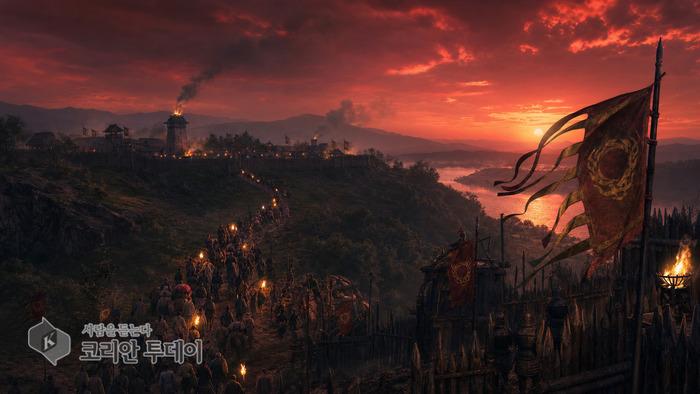
Even after the kingdom fell, people raised the banner again.
In September 668, Pyongyang Fortress fell and King Bojang was taken captive to Tang China. Nearly 200,000 Goguryeo people were forcibly resettled into Tang territory, and the seven-century-old kingdom appeared to have vanished from history. But the fall was not the end. Across the ruined homeland, scattered survivors began regrouping — much as displaced peoples across history, from Anglo-Saxon thegns after Hastings to Visigothic nobles after the Muslim conquest of Iberia, have tried to reconstitute a lost order in exile.
Why do people raise a flag again after their nation is gone — and by whose hand does that flame eventually go out?
🌍 Western Historical Parallel
When Goguryeo loyalists rallied around Prince Ansung in 670, the Byzantine Empire was bracing for the Umayyad Caliphate’s first great siege of Constantinople (674-678) — another ancient power fighting to survive on a shrinking foothold while a new imperial order rose around it.
◆ The Ancient Landscape
In February 669, the year after Pyongyang’s fall, the Goguryeo royal Ansung defected to Silla with roughly 4,000 households. Across the former kingdom, pockets of unbowed refugees still resisted Tang rule, waiting for a rallying figure.
In April 670, a Goguryeo noble named Geommojam raised an army from Suim Fortress, gathering the scattered survivors. He met Ansung on the small island of Sayado and installed him as king, then in June established their base at Hansong (漢城, believed to be near modern Jaeryong, Hwanghae Province). Silla’s King Munmu formally recognized Ansung as “King of Goguryeo.” That same March, Silla troops and Goguryeo refugee forces had already crossed the Yalu to strike Tang preemptively — the opening move of the Silla-Tang War. For Silla, embracing the Goguryeo remnant as a buffer state and ally against Tang was, much like Rome’s use of Germanic foederati along its frontiers, a matter of hard strategic calculation.
“Mojam, the great elder of Suim Fortress, gathered the surviving people, killing Tang officials and the monk Beopan from Gungmo Fortress to south of the Pae River. Heading toward Silla, he reached Sayado in the Western Sea, where he met Ansung, son of the Goguryeo minister Yeon Jeongto, and brought him to Hansong to be honored as their lord.”
◆ Same Era, Different Worlds
🏛️ China (Tang)
In July 670, Tang forces suffered a catastrophic defeat to the Tibetan Empire at the Battle of Dafei River, losing the Anxi garrisons. Fighting on two fronts, Tang could no longer devote full strength to crushing the Goguryeo remnant.
🗿 Byzantine Empire
Emperor Constantine IV held Constantinople through the first Arab siege (674-678), the empire’s population and territory shrunk to a fraction of Justinian’s era — survival through contraction, not conquest.
⚔️ Western Europe
The Frankish kingdoms under the fading Merovingian dynasty were themselves fragmenting into regional power centers, foreshadowing the rise of the Carolingians decades later.
🕌 Japan
After the Jinshin War of 672 brought Emperor Tenmu to power, Japan exchanged envoys with Bodeok-guk under the title “Mission to Goguryeo” — the name of a fallen kingdom still functioning in diplomatic protocol.
[Image: The revival movement’s migration route — Hansong (670) → Bodeok-guk at Geummajeo (674) → Gyeongju (683)]
⚔️ Scene from That Day
“On a wave-battered islet in the Western Sea, Geommojam knelt before the young royal Ansung and laid down Goguryeo’s last banner. ‘My lord, the people are waiting.’ In that moment, it seemed enough.”
“But when word reached Hansong that a great Tang army was marching south, the two men’s eyes turned to different horizons. Geommojam wanted to march back and reclaim Pyongyang. Ansung wanted to fall back on Silla’s protection. Where the road split, only one of the men who had raised the revival’s banner together would survive to walk it.”
◆ Uncovering Historical Truth
The Goguryeo revival was not a single event but a two-act drama. The first act was the “Hansong Goguryeo state” founded in 670, a dual structure in which Geommojam held real military command while Ansung served as a symbolic figurehead — not unlike the tension between warlord and puppet monarch that recurred across post-Roman successor kingdoms. When Tang’s General Gao Kan marched a large army south, the two leaders split violently over how to respond: Geommojam’s hardline push to retake Pyongyang against Ansung’s pragmatic pivot toward Silla’s protection.
Ansung ultimately killed Geommojam and led the remaining forces into Silla territory. The chronicles do not record the precise circumstances, but it is clear the strategic rift tore the revival movement in two. King Munmu of Silla settled them at Geummajeo (modern Iksan, North Jeolla Province) and, in 674, re-titled Ansung “King of Bodeok” (報德王). Bodeok-guk maintained Goguryeo’s five-tribe administrative structure and rank system, fought alongside Silla forces in the ongoing war against Tang, and even dispatched its own envoys to Japan — surviving for nearly a decade.
In 683, however, Silla’s King Sinmun summoned Ansung to the capital Gyeongju, granting him the Kim surname and the rank of sopan, absorbing him into Silla’s own hereditary aristocracy — effectively dissolving the Bodeok royal house. The following year, 684, Ansung’s kinsman Daemun led a rebellion at Geummajeo against Silla rule; it was crushed, and Sinmun dispersed the surviving refugees to provinces across southern Silla. The sixteen-year resistance that began with Pyongyang’s fall in 668 had reached its final chapter.
Period
670-684 CE
Key Figures
Prince Ansung, Geommojam
Key Event
Hansong Goguryeo → Bodeok-guk
Impact
Course of the Silla-Tang War
🔍 International Academic Perspectives
Korean/Asian Scholars
Long treated Silla’s sponsorship of Ansung as a purely instrumental wartime alliance — useful while Tang was the common enemy, and systematically dismantled once that need passed in 683-684, echoing the “cunning hare, cooked dog” pattern in Chinese strategic thought.
Recent Reassessments
Newer scholarship emphasizes Bodeok-guk’s semi-autonomous character — its own administrative ranks and independent diplomacy with Japan — reframing Daemun’s 684 rebellion not as a doomed uprising but as a final act of self-determination.
📖 Key Terms Explained
- Bodeok-guk (報德國)
- A vassal statelet (674-684 CE) established by Silla for Goguryeo loyalists at Geummajeo, roughly analogous to a medieval client kingdom under a suzerain’s protection.
- Silla-Tang War
- The conflict (670-676) in which Silla, once Tang’s ally against Goguryeo and Baekje, turned against its former partner to drive Tang forces off the peninsula.
◆ Lessons for Today’s World
The story of people who kept a name alive after their nation fell would echo again in Korean history 1,300 years later. The Provisional Government of the Republic of Korea, established in Shanghai in 1919, likewise tried to preserve national legitimacy from beyond occupied soil — much as the Hansong and Bodeok statelets survived not as full sovereign powers but as symbols that outlasted their limited autonomy.
The rift between Geommojam and Ansung still poses a live question: when a weakened community fights to survive, does it hold to principle or bend to circumstance? There was no clean answer then, and there rarely is now — but the choices made along the way built the memory of resistance that endures today.
| Aspect | Goguryeo Revival Era | Modern Parallel |
|---|---|---|
| Geopolitics | Client kingship under Silla’s patronage, sovereign in name only | The Shanghai Provisional Government’s unrecognized fight for legitimacy |
| Military/Diplomacy | Fought alongside Silla against Tang; independent envoys to Japan | Independence forces securing recognition from allied powers abroad |
| Culture/Spirit | Kept the Goguryeo name and rank system alive for sixteen years | A national identity preserved through resistance and memory |
[Image: The line of resistance from the Goguryeo revival to modern Korea’s independence movement]
📚 Diving Deeper
- Geummajeo, Bodeok-guk’s capital in modern Iksan, sits amid Baekje- and Silla-era heritage sites like Mireuksa Temple — yet direct archaeological traces of Bodeok-guk itself remain scarce compared to the textual record, an open research gap.
- Japan’s Nihon Shoki records envoys from Bodeok-guk under the label “Mission to Goguryeo,” showing the fallen kingdom’s name persisted in East Asian diplomatic language for years after its actual defeat — much as “Byzantine” envoys long continued calling themselves Roman.
- Korean historiography on the Geommojam-Ansung split increasingly frames it not as a simple power struggle but as a genuine strategic disagreement over how a defeated nation should rebuild.
The Voice of Living History
Neither the Hansong statelet nor Bodeok-guk ever restored Goguryeo. But their sixteen years of resistance proved a truth that recurs across every civilization: a people who lose their nation do not simply disappear.
“A kingdom may fall, but its embers pass to the next generation’s hands.”
Previous Episode
Episode 19: The Fall of Pyongyang Fortress – September 21, 668 CE
Next Episode
Episode 21: The Goguryeo Diaspora
The Korean Today “History Lives On” Series
The Goguryeo Chronicle (40 Episodes)
Bridging Ancient East Asia and the Modern World
© 2025 The Korean Today. All rights reserved.
This content is based on historical facts and presents balanced academic perspectives
for international readers.
THE KOREAN TODAY × WIA CODE
이 기사의 WIA Code

WIA Code 스캐너로 비추면 인터넷 없이 발행 사실과 위·변조 여부를 확인할 수 있습니다.
휴대폰 기본 카메라로 찍으면 스캐너 안내 페이지가 열립니다 — 기사 바로 열기

움직이는 코드는 스트림입니다 — WIA Code 스캐너로 약 21초 비추면 기사 전문(사진 포함)이 폰에 저장되어 인터넷 없이도 읽을 수 있습니다.
WIA Code · 코리안투데이






Leave a Reply