
A commander whose name history never recorded held off the emperor who had unified China — for nearly three months.
In the summer of 645 CE, Emperor Taizong of Tang — the ruler who had built one of history’s great empires —
personally led an army of roughly 200,000 men into Goguryeo, succeeding where the mighty Sui dynasty had
failed three times a generation earlier. City after city on the Liaodong peninsula fell before him.
Then his advance stopped cold at a small fortress called Ansi. Its commander’s name never even made it
into the official histories. What made an unnamed governor and his townspeople stand their ground against
the most powerful army in the world?
🌍 Western Historical Parallel
While Taizong besieged Ansi in 645, the Byzantine Empire under Constans II was reeling from the loss of
Egypt and Syria to the rapidly expanding Rashidun Caliphate — a reminder that this was a century when even
the era’s mightiest empires were repeatedly checked by fortified frontier defenses they could not overrun.
◆ The Ancient Landscape
By the 640s, Tang China under Taizong had subdued the Gokturks and was hailed as “Heavenly Khan”
across the steppe — a status roughly comparable to a Carolingian-style hegemon commanding tribute
from surrounding peoples. Only Goguryeo, controlling the Liaodong corridor between Manchuria and
the Korean peninsula, remained beyond Tang’s reach.
In 642, the Goguryeo general Yeon Gaesomun seized power in a coup, killing King Yeongnyu — a pretext
Tang used to launch its invasion. By June 645, Tang forces of roughly 60,000 by land and 40,000 by
sea had taken Kaimo, Biysha, Liaodong and Baiyan fortresses in succession. Then they reached Ansi,
near modern Haicheng in Liaoning province, and stopped.
“That fortress lord could truly be called an extraordinary hero — and yet it is a bitter shame
that the histories failed to preserve even his name.”
◆ Same Era, Different Worlds
🏛️ China
Taizong’s reign is remembered as the “Reign of Zhenguan,” a golden age of good governance — yet Ansi stands as his only major failed foreign campaign.
🗿 Byzantine Empire
Constans II struggled to hold Byzantine North Africa and Anatolia against Arab raids, echoing Tang’s own struggle to hold a distant frontier.
⚔️ Western Europe
Frankish kingdoms under the late Merovingians were fragmented, with regional strongmen defending local strongholds much as Goguryeo’s fortress lords did.
🕌 Islamic World
The Rashidun Caliphate, just a decade after Muhammad’s death, was overrunning Sassanid Persia and Byzantine territory at breathtaking speed.
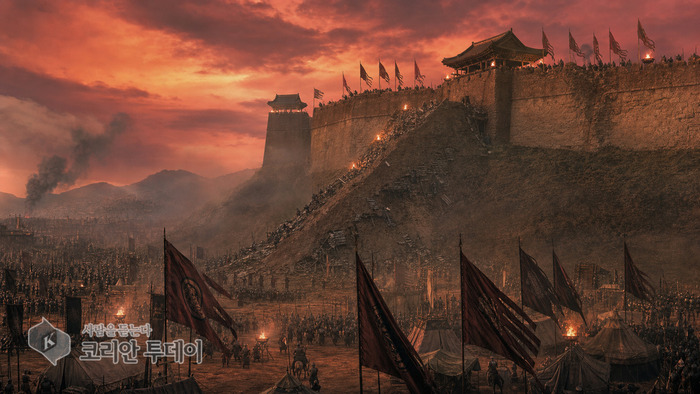
[Image: Siege positions at Ansi — the walls, the siege ramp, and the two armies]
⚔️ Scene from That Day
“Arrows rain down from the walls like a monsoon. For weeks, tens of thousands of Tang laborers have hauled
earth day and night, raising a ramp meant to finally overtop the fortress. As the ramp nears completion,
a section suddenly gives way with a roar, collapsing against the very walls it was meant to breach.”
“What crumbles is not the fortress but Tang’s momentum. Goguryeo soldiers pour through the gap and seize
the ramp itself — the emperor’s own siege engine now a Goguryeo strongpoint. Taizong’s face hardens;
rumor spreads that an arrow from the walls came within reach of the emperor himself.”
◆ Uncovering Historical Truth
The siege unfolded in three phases. First, in June 645, Goguryeo dispatched a relief army of roughly
150,000 under generals Go Yeonsu and Go Hyejin. Tang lured them into a trap on high ground southeast
of Ansi and forced their surrender — a maneuver not unlike how Roman legions repeatedly baited Germanic
or Sassanid armies into unfavorable terrain. Ansi was now completely isolated. It still did not fall.
The second phase was two months of direct assault. Tang deployed the full range of contemporary siege
technology — battering rams, catapults, siege towers — comparable in sophistication to what Byzantine
engineers used against Sassanid or Arab besiegers. None broke through. Taizong’s final gambit was an
artificial earthen ramp built to overtop the walls; just before completion, part of it collapsed and
was seized by the defenders — evidence, historians argue, of a garrison hardened by long practice in
siege defense, not mere luck.
The third phase was retreat. Early Manchurian winter, dwindling supplies, and a war of attrition that
had already absorbed a 150,000-man relief force without breaking a single small fortress crushed Tang
morale. On September 18, Taizong lifted the siege. Chinese court histories record the campaign tersely
as “unsuccessful” — a silence that itself speaks to how painfully the defeat was felt at court.
Period
645 CE (King Bojang’s 4th year)
Key Figure
The Lord of Ansi (later legend: Yang Manchun), Emperor Taizong
Duration
88 days of active siege, June–September
Outcome
Tang withdrawal; Goguryeo’s survival extended by decades
🔍 International Academic Perspectives
Korean/Asian Scholars
The name “Yang Manchun” appears only in mid-Joseon-era folk histories, not in the Samguk Sagi or Tang court records — most historians treat the commander as genuinely anonymous. Ansi’s exact site, likely near modern Haicheng in Liaoning, remains unconfirmed archaeologically.
Western Historians
Some Western and Chinese scholars question whether Tang’s force truly reached 200,000, suggesting political exaggeration; comparative studies increasingly frame the siege as a case study in how fortified frontier networks — echoing Roman limes or Byzantine kastra — can stall imperial campaigns regardless of raw numbers.
📖 Key Terms Explained
- Goguryeo (고구려)
- Ancient Korean kingdom (37 BCE–668 CE), one of the Three Kingdoms, controlling much of Manchuria and the northern Korean peninsula
- Tang Dynasty
- Chinese empire (618–907 CE), a rough contemporary of the early Byzantine and Umayyad states
- Yang Manchun (양만춘)
- Traditional name given in later folklore to the anonymous Lord of Ansi; not found in any contemporary source
◆ Lessons for Today’s World
Ansi is a reminder that a nation’s survival often hinges not on its capital or its central army, but
on the resilience of a single, unheralded local community. Neither the Goguryeo king nor the powerful
minister Yeon Gaesomun saved the kingdom that summer — an anonymous fortress lord and his townspeople did.
For modern readers, the parallel is with local resilience and civic leadership in the face of crises
too large for any single hero to solve alone — whether a natural disaster or a security threat, it is
often collective, unrecorded endurance, not a single commanding figure, that determines the outcome.
| Aspect | Goguryeo Era | Modern Parallel |
|---|---|---|
| Geopolitics | A central court balanced against semi-autonomous fortress lords holding the frontier | Central government crisis response paired with strong local/municipal capacity |
| Military | A mountain-fortress network built for prolonged, attritional defense | Asymmetric deterrence and alliance-based defense strategy |
| Culture | A martial ethos in which unnamed commoners were expected to defend the state | A civic spirit of ordinary citizens rallying to defend their community in crisis |
[Image: How Ansi’s spirit of resistance connects to modern civic and local leadership]
📚 Diving Deeper
- The Yingchengzi ruins near modern Haicheng, Liaoning, are the leading candidate for Ansi’s actual site, though excavation remains limited.
- The Yang Manchun legend first appears in Joseon-era scholarly writings, including references in Park Ji-won’s famous travel diary Yeolha Ilgi — a case of folk memory filling gaps left by official records, comparable to how Arthurian legend grew around thin historical traces of post-Roman Britain.
- The 2018 South Korean film “The Great Battle” dramatizes the siege but fills historical gaps with invented detail — useful as narrative, not as a primary source.
The Voice of Living History
The wall that the ruler of a unified continent could not cross was not held by a legendary sword,
but by 88 days of ordinary people who refused to open the gate.
“To be absent from the history books is not the same as being absent from history.”
Previous Episode
Episode 14: King Yeongnyu and Yeon Gaesomun — A Change of Power
Next Episode
Episode 16: Tang’s Second Invasion — A War Without End
The Korean Today “History Lives On” Series
The Goguryeo Chronicle (40 Episodes)
Bridging Ancient East Asia and the Modern World
© 2025 The Korean Today. All rights reserved.
This content is based on historical facts and presents balanced academic perspectives
for international readers.
THE KOREAN TODAY × WIA CODE
이 기사의 WIA Code

WIA Code 스캐너로 비추면 인터넷 없이 발행 사실과 위·변조 여부를 확인할 수 있습니다.
휴대폰 기본 카메라로 찍으면 스캐너 안내 페이지가 열립니다 — 기사 바로 열기

움직이는 코드는 스트림입니다 — WIA Code 스캐너로 약 23초 비추면 기사 전문(사진 포함)이 폰에 저장되어 인터넷 없이도 읽을 수 있습니다.
WIA Code · 코리안투데이






Leave a Reply