
The Ministry of Health and Welfare (Minister Jung Eun-kyeong) is introducing a new emergency support procedure for the Short-Term Intensive Service for Discharged Patients under the Tailored Elderly Care Program, aimed at speeding up the return to community life for elderly patients in urgent need of care after leaving the hospital. Under the measure, which takes effect Monday, July 27, the time between application and the start of service will be shortened to a maximum of three to seven days, allowing elderly patients who had faced care gaps immediately after discharge to receive the support they need much more quickly.
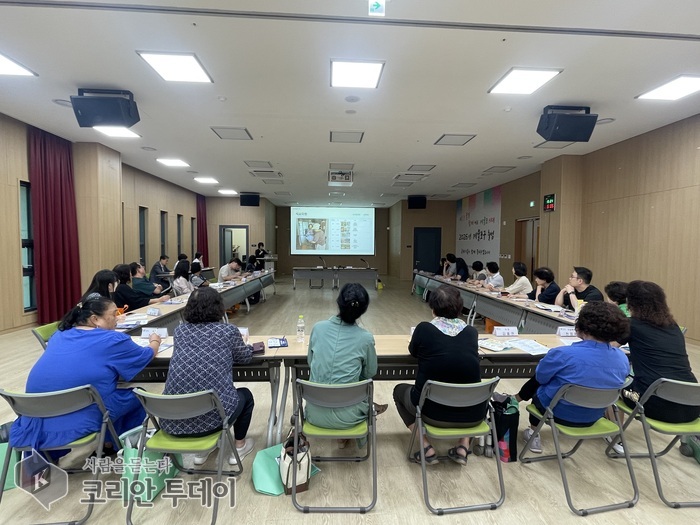
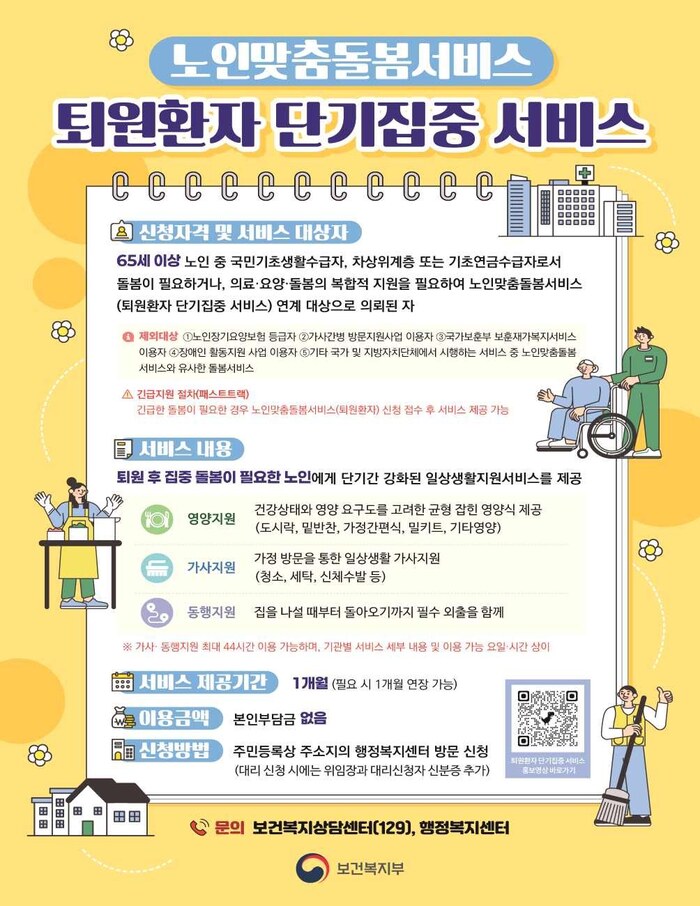 [코리안투데이] Photo courtesy of the Ministry of Health and Welfare © 송정숙 기자 |
The Short-Term Intensive Service for Discharged Patients has been in operation since March this year alongside the rollout of integrated medical and long-term care. The program provides nutrition support, housekeeping assistance and companion services to elderly people who need help returning to daily life after leaving the hospital, and as of July 17 had been used by 1,392 people. The service is provided for one month (44 hours) through 276 designated Tailored Elderly Care Service institutions, including senior welfare centers nationwide, with the option of a one-month extension if needed.
In the field, concerns had been raised that the process of applying through the integrated care system — from application to assessment to the actual start of service — could take more than a month, creating a gap in care precisely during the period right after discharge, when it is needed most. Difficulty securing service personnel in time also raised worries that elderly patients could miss the critical window for returning to community life. In response, the ministry, reflecting feedback from the field, has established an emergency support procedure that allows service to begin through a simplified confirmation process even before a person is formally selected for the integrated care system.
The emergency support procedure takes effect July 27. Elderly people aged 65 or older who are recipients of the National Basic Livelihood Security System, near-poverty class recipients, or elderly living alone or elderly couples receiving the basic pension can apply at their local town or neighborhood community center within 14 days of discharge and, after a confirmation process, receive service within three to seven days. The services provided under emergency support are the same as those offered under the existing short-term intensive service — nutrition support, housekeeping assistance and companion services — meaning only the procedure has been simplified while the substance of the support remains unchanged. If more complex services are needed during emergency support, or if support is required for longer than a month, the case can be referred through the service institution to the integrated care system for more in-depth care. The ministry has also laid the groundwork for flexible staffing, allowing regions to draw on part-time short-term workers, dedicated hires, or overtime by existing life-support workers depending on local conditions.
The introduction of this emergency support procedure is an extension of the government’s national policy initiative, “Integrated Care Where You Live Now.” With South Korea heading toward becoming a super-aged society, the aim is to reduce unnecessary hospital readmissions caused by care gaps after discharge and to build a tighter support system that allows elderly people to continue their daily lives stably in the places where they have lived. In particular, sharply cutting the time between application and the start of service is seen as a substantive change that will be felt on the ground, given that whether an elderly patient recovers well often hinges on the first few days after discharge. The ministry plans to monitor field responses after the system takes effect and prepare additional supplementary measures as needed.
Eun Seong-ho, head of the Ministry of Health and Welfare’s Population and Social Services Policy Bureau, said, “The recovery period right after discharge is a critical time for helping elderly patients return quickly to their communities without a social readmission.” He added, “We will continue improving the system to provide timely care so that elderly people can return safely to their daily lives.”
송정숙 기자 (gangseo@thekoreantoday.com)
지역 홍보대사 신청 기자양성과정 신청 코리안투데이 지부장 신청 코리안투데이 강서
코리안브랜드대상 신청 최고경영인대상 신청 소비자만족도대상 신청
보도자료·배너광고 유료송출 의뢰(전국 40+ 지부 동시송출)
 |


Leave a Reply