
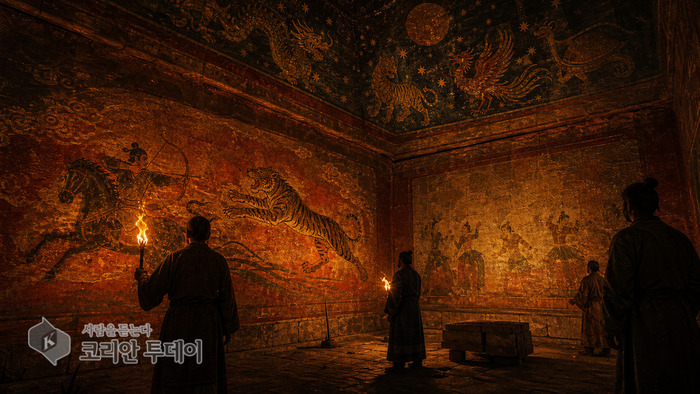
In a sealed stone chamber, two wrestlers are still locked in a grip. Sixteen centuries on, neither has won.
Beneath a low hill near Ji’an in China’s Jilin province, people who left no photographs painted their own world in mineral pigment on stone: hunting, dancing, wrestling, feasting. While written chronicles record kings and wars, these murals record the gestures and garments of people history otherwise forgot.
In 2004, UNESCO inscribed these mural tombs as World Heritage. Few outside the region know that North Korea, South Korea, and China each pursued a different framing of the same tombs when that listing happened. How did a painting sealed inside a burial chamber become a live geopolitical dispute in the 21st century?
🌍 Western Historical Parallel
While Goguryeo painters were covering burial chambers with guardian deities in the late 6th century, artisans in Ravenna, Italy were completing the mosaics of Emperor Justinian at the Basilica of San Vitale — two civilizations, half a world apart, using wall art to seal a ruler’s power into eternity.
◆ The Ancient Landscape
Across roughly 300 years, from the 4th to the 7th century CE, Goguryeo nobility built stone-chamber tombs around present-day Ji’an (China) and Pyongyang/Nampo (North Korea) and decorated their interior walls and ceilings. Of more than 10,000 Goguryeo tombs identified across China and the Korean peninsula, only about 90 contain surviving murals — a privilege reserved for royalty and the highest nobility.
The subject matter shifted decade by decade. Mid-4th-century tombs, like Anak Tomb No. 3, feature genre scenes of daily life — a 250-figure procession is its centerpiece. By the 5th century, tombs like Gakjeochong (the “Wrestling Tomb”) and Muyongchong (the “Dance Tomb”) near Ji’an peaked with dynamic depictions of wrestling, dancing, and mounted hunting. By the late 6th and 7th centuries, human figures vanished almost entirely, replaced by the Four Guardian Deities covering entire walls, as seen at Gangseodaemyo near Nampo. Over three centuries, the Goguryeo gaze moved from depicting earthly life to depicting the cosmic order of the afterlife.
“The people love singing and dancing; in every village, at night, men and women gather in groups to sing and make merry together.”
◆ Same Era, Different Worlds
🏛️ China
During the Northern and Southern Dynasties, Buddhist murals were being painted in the Mogao Caves at Dunhuang around the same centuries — but Goguryeo murals center on indigenous cosmology and daily life rather than Buddhist iconography.
🗿 Byzantine Empire
The reign of Justinian I (527-565) produced Ravenna’s imperial mosaics just as Goguryeo’s Four Guardian Deities style matured — both cultures used sacred wall imagery to project eternal authority.
⚔️ Western Europe
Frankish and Anglo-Saxon elites of this period were buried with grave goods (as at Sutton Hoo, c. 625 CE) rather than painted chambers — a contrasting way of memorializing status after death.
🌏 Japan
The Takamatsuzuka Tomb in Nara (late 7th-early 8th century) contains mural figures scholars consider directly influenced by Goguryeo painting style.
[Image: The Four Guardian Deities at Gangseodaemyo, arranged north/south/east/west, with sun, moon, and stars on the ceiling]
⚔️ Scene from That Day
“A single oil lamp lights the narrow stone chamber. The painter kneels, brush never still. On the west wall a mounted hunter already twists backward in the saddle to loose an arrow at a charging tiger — the horse at full gallop, the rider’s torso turned against its motion, the so-called ‘Parthian shot.'”
“‘The late king rode these hills just like this,’ murmurs the master painter watching over his apprentice’s shoulder. In days the chamber will be sealed forever. But the arrow on the wall will keep flying at that tiger for a thousand years and more.”
◆ Uncovering Historical Truth
Gakjeochong, the “Wrestling Tomb” near Ji’an, is named for the mural on its eastern wall: two wrestlers gripping each other’s belts, an elderly referee leaning on a staff beside them. The technique closely resembles modern Korean ssireum wrestling — physical proof that the sport’s roots run back at least 1,600 years.
Muyongchong, right beside it, is richer still: a reception scene on the north wall shows the tomb owner receiving what appears to be a Buddhist monk; the east wall shows dancers in long sleeves moving in formation; the west wall shows a hunting scene of riders chasing deer and tiger across open hills. That mounted hunter is arguably the single most recognizable image to survive from Goguryeo — reproduced in textbooks, on stamps, and even in the 2018 PyeongChang Winter Olympics opening ceremony.
Earlier still, mid-4th-century Anak Tomb No. 3 depicts a kitchen, a well, a mill, and stables — evidence that murals were never mere decoration but expressions of the belief that a tomb owner’s abundance in life should continue unbroken into the afterlife. Its 250-figure procession alone testifies to the scale of Goguryeo aristocratic power. The progression from 4th-century genre painting to 5th-century dynamic figural scenes to 6th-7th-century abstract cosmology traces a shift in Goguryeo’s own vision of the afterlife — from concrete replication of earthly life to an abstract cosmic order.
Period
Mid-4th to early 7th century CE
Key Sites
Gakjeochong, Muyongchong, Gangseodaemyo
Core Motifs
Four Guardian Deities, hunting, wrestling
Status Today
UNESCO World Heritage (2004)
🔍 International Academic Perspectives
Korean/Asian Scholars
Korean historians view the murals as expressions of an independent Goguryeo worldview and guardian-deity cosmology, culminating in the 2004 joint South-North diplomatic effort behind the UNESCO inscription.
Contested View
China’s “Northeast Project,” launched in 2002, sought to frame Goguryeo remains around Ji’an as the history of a regional regime within China. North Korea rejected China’s proposal for a joint listing in 2004, and South Korea backed North Korea’s separate bid diplomatically — an unusual instance of inter-Korean cooperation.
📖 Key Terms Explained
- Goguryeo (고구려)
- Ancient Korean kingdom (traditionally dated 37 BCE-668 CE), one of Korea’s Three Kingdoms, controlling much of Manchuria and the northern Korean peninsula.
- Sasindo (Four Guardian Deities, 사신도)
- A set of four mythical animals — Azure Dragon (east), White Tiger (west), Vermilion Bird (south), Black Tortoise-Snake (north) — representing the four cardinal directions in East Asian cosmology.
- Parthian shot
- A mounted archery technique of firing backward while riding away from a target, associated with steppe cavalry cultures across Eurasia.
◆ Lessons for Today’s World
Goguryeo’s tomb painters preserved their era using nothing but pigment and stone, and it survived 1,600 years intact. We now store millions of digital photographs in the cloud, yet no one can guarantee those files will still be readable a century from now — a sobering reversal of the durability equation.
These murals also illustrate that cultural heritage is inseparable from geopolitics. The tension between North Korea, South Korea, and China over how to name and interpret the same tombs is a microcosm of ongoing East Asian historical disputes — and it is why institutions like South Korea’s National Research Institute of Cultural Heritage now digitally reconstruct these murals in 3D virtual exhibitions, preserving access even where the physical sites remain politically or physically out of reach.
| Aspect | Goguryeo Era | Modern Parallel |
|---|---|---|
| 4th-century murals | Genre scenes (kitchens, processions, stables) | Documentary photography and film |
| 5th-century murals | Wrestling, dance, hunting (dynamic figures) | Sports and performance archives |
| 6th-7th-century murals | Four Guardian Deities (abstract cosmology) | UNESCO listing, digital preservation |
[Image: Murals inaccessible due to damage or political division are reborn as 3D virtual exhibitions]
📚 Diving Deeper
- The 2004 UNESCO inscriptions came as two separate listings — North Korea’s “Complex of Koguryo Tombs” and China’s “Capital Cities and Tombs of the Ancient Koguryo Kingdom” — reflecting the unresolved dispute over how to frame Goguryeo history.
- The identity of the tomb owner at Anak Tomb No. 3 remains debated: an inscription names a Chinese-born official, Dong Shou, but some scholars argue the tomb actually belonged to a Goguryeo king.
- South Korea’s National Research Institute of Cultural Heritage hosts a “3D Virtual Exhibition of Goguryeo Tomb Murals,” letting international audiences view sites in Ji’an and Pyongyang that remain physically inaccessible.
The Voice of Living History
Borders fall, dynasties end, even the sealed stone doors of a tomb eventually crack open. But the wrestler’s grip, the hunter’s arrow, and the guardian deity’s gaze — painted in pigment that never quite dried — remain.
“Words scatter, but images endure — and so Goguryeo still lives, inside the walls.”
Previous Episode
Episode 22: Cultural Exchange Between Goguryeo and Tang China
Next Episode
Episode 24: Ondal and Princess Pyeonggang – A Love That Crossed Class Lines
The Korean Today “History Lives On” Series
The Goguryeo Chronicle (40 Episodes)
Bridging Ancient East Asia and the Modern World
© 2025 The Korean Today. All rights reserved.
This content is based on historical facts and presents balanced academic perspectives
for international readers.
THE KOREAN TODAY × WIA CODE
이 기사의 WIA Code

WIA Code 스캐너로 비추면 인터넷 없이 발행 사실과 위·변조 여부를 확인할 수 있습니다.
휴대폰 기본 카메라로 찍으면 스캐너 안내 페이지가 열립니다 — 기사 바로 열기

움직이는 코드는 스트림입니다 — WIA Code 스캐너로 약 24초 비추면 기사 전문(사진 포함)이 폰에 저장되어 인터넷 없이도 읽을 수 있습니다.
WIA Code · 코리안투데이






Leave a Reply