
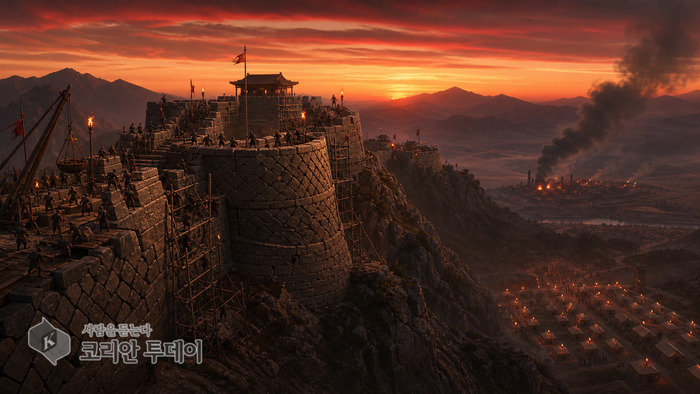
Long before “K-construction” became a global brand, an ancient Korean kingdom was already smelting iron, engineering mountain fortresses, and heating its winters with a technology no other civilization had.
South Korea today builds the world’s tallest towers and exports underfloor heating systems abroad. Trace that lineage back roughly 1,600 years and you arrive at the blast furnaces and mountain ramparts of Goguryeo (37 BCE-668 CE), which across the 3rd to 7th centuries armed the strongest heavy cavalry in East Asia, built one of the most systematic fortress networks of its age, and perfected a heating system that let people survive Manchuria’s brutal winters.
Squeezed between rival Chinese dynasties and nomadic powers on a harsh northern frontier, how did Goguryeo manage to master metallurgy, fortress engineering, and civil construction all at once – and why does it matter to a Western reader today?
🌍 Western Historical Parallel
While Goguryeo’s armorers were forging heavy cavalry plate, Rome’s legions relied on similarly systematized ironworking, and centuries later Byzantine engineers heated bathhouses with hypocausts – underfloor channels of hot air strikingly similar in principle to Korea’s ondol. Both civilizations discovered, independently, that the floor itself could be the furnace.
◆ The Ancient Landscape
The Liaodong region under Goguryeo control was rich in high-quality iron ore, comparable in strategic value to the iron-bearing regions of Roman Noricum or Anatolia. As China fragmented through its Wei-Jin and Southern-Northern Dynasties period, Goguryeo used state-managed iron production to arm itself independently, while its capitals at Gungnaeseong and Hwandoseong along the middle Yalu River (3rd-4th centuries) developed defenses adapted to steep mountain terrain.
In 244 CE, Wei general Guanqiu Jian invaded with a large army and captured Hwandoseong the following year – a crisis roughly contemporary with Rome’s third-century military emergencies. Rather than collapsing, Goguryeo used the lesson to tighten its mountain-fortress network. By the time of King Gwanggaeto (r. 391-413) and King Jangsu (r. 413-491), the kingdom had built over 100 fortresses across Manchuria and the northern Korean peninsula – arguably the most organized defensive grid in East Asia at the time.
“The poor, in winter, dig a long trench and light a fire beneath it to keep warm.”
◆ Same Era, Different Worlds
🏛️ China
Fractured under the Southern and Northern Dynasties, later unified by Sui and Tang, who showcased engineering power through the Grand Canal and vast new capitals.
🗿 Byzantine Empire
Constantinople’s triple land walls and hypocaust-heated baths represented the era’s engineering pinnacle, much as Goguryeo’s fortresses and ondol did in the east.
⚔️ Western Europe
Post-Roman kingdoms retained fragments of Roman ironworking and hillfort traditions, but nothing on the scale of Goguryeo’s fortress network.
🌏 Japan
The Yayoi and Kofun periods absorbed ironworking know-how and craftsmen migrating from the Korean peninsula, accelerating Japan’s own metal age.
[Image: Goguryeo’s three core technologies – ironworking, ondol heating, fortress construction]
⚔️ Scene from That Day
“On the ridge of Hwando Mountain Fortress, masons fit diamond-cut stones into the wall one by one – sharp edge inward, smooth face outward – each wedge locking tighter than the last, like a Roman legion’s dry-stone castra wall built to outlast a siege.”
“Below, in the forge, bellows hiss without pause day and night. Each hammer strike on glowing iron shapes another plate of a gaemamusa’s armor – Goguryeo’s answer to the cataphract.”
◆ Uncovering Historical Truth
The pinnacle of Goguryeo ironworking was the gaemamusa (鎧馬武士), a heavily armored cavalryman comparable to Rome’s clibanarii or the Byzantine cataphract. A rider’s armor weighed roughly 20kg, the horse’s barding another 40kg, and with lance and additional gear the total load reached about 70kg. After the 244-245 CE invasion by Wei general Guanqiu Jian – which briefly captured both Gungnaeseong and Hwandoseong – Goguryeo drew on Liaodong’s abundant iron to expand this heavy cavalry, which later became the spearhead of King Gwanggaeto’s sweeping conquests.
Goguryeo did not invent ondol – its earliest form appeared among the Okjeo people around the 4th-3rd century BCE – but Goguryeo systematized and spread it. Archaeologists have found ondol installed even in frontier garrison barracks next to stables, where a raised floor section was heated for soldiers. This underfloor-heating tradition was later inherited by the ruling elite of Balhae, the kingdom that succeeded Goguryeo.
In construction, Goguryeo’s fortress engineering stands out most. At sites like Hwando Mountain Fortress and Baegam Fortress, masons wedged diamond-shaped fill stones between pentagonal facing stones so each piece interlocked with its neighbors, and on steep or high sections they used a stepped, inward-battered foundation technique to reinforce the base – a method distinct from, though functionally comparable to, the battered walls of Roman fortifications. The curved bastions (chi) applied even on mountain fortresses are considered a signature Goguryeo innovation. After King Jangsu moved the capital to Pyongyang in 427 CE, the newly built Anhak Palace formed a square walled complex roughly 622m per side and 2,488m in circumference, with remains of a timber bridge over 7m wide found nearby – evidence of civil engineering on a scale comparable to a major Roman provincial capital.
Period
3rd-7th century CE
Key Figures
King Dongcheon, King Gwanggaeto, King Jangsu
Fortress Network
Over 100 mountain fortresses
Cavalry Load
~70kg fully-armored rider and horse
🔍 International Academic Perspectives
Korean/Asian Scholars
Most Korean archaeologists view the wedge-stone masonry and curved bastion technique as an indigenous Goguryeo adaptation to steep Manchurian terrain.
Comparative Historians
Some researchers note possible cross-influence with northern nomadic and Chinese Southern-Northern Dynasties fortification traditions, alongside the accepted Okjeo origin of ondol.
📖 Key Terms Explained
- Gaemamusa (鎧馬武士)
- Goguryeo’s heavily armored cavalry, comparable to Roman/Byzantine cataphracts, wearing roughly 70kg of combined rider and horse armor.
- Ondol (溫突)
- A Korean underfloor heating system where smoke and heat from a fire pass through flues beneath the floor, conceptually parallel to the Roman hypocaust.
- Chi (雉)
- A projecting bastion on a fortress wall used to enable flanking fire, applied by Goguryeo even on mountain fortresses.
◆ Lessons for Today’s World
South Korea’s global leadership in steel (POSCO), shipbuilding, and construction, along with the worldwide export of Korean-style radiant floor heating, is not a modern accident – it echoes a kingdom that turned limited resources into a coherent technological system 1,600 years ago.
Just as Goguryeo’s fortress network protected it from stronger neighbors, and its heavy cavalry projected power abroad, modern Korea channels similar resourcefulness into advanced defense industries and infrastructure exports – a reminder that technological resilience is often forged under geopolitical pressure, not despite it.
| Aspect | Goguryeo Era | Modern Parallel |
|---|---|---|
| Defense | 100+ mountain fortress network | Advanced missile/air defense systems |
| Military | 70kg fully-armored gaemamusa cavalry | Exported K2 tanks and K-defense industry |
| Culture | Ondol and practical civil engineering | Globally exported Korean floor-heating systems |
[Image: From Goguryeo’s mountain fortresses to modern Korea’s steel and construction industries]
📚 Diving Deeper
- Hwando Mountain Fortress and Gungnaeseong in Ji’an, China, along with Wunyeosanseong in Liaoning, were jointly inscribed as UNESCO World Heritage sites in 2004.
- Murals in the Tomb of the Dancers depict armored horses and riders, offering visual evidence of gaemamusa cavalry comparable in importance to Sutton Hoo finds for early medieval Europe.
- Excavations at the Anhak Palace site in Pyongyang uncovered timber bridge remains that reveal the scale of Goguryeo’s capital-building projects.
The Voice of Living History
Goguryeo never blamed its harsh environment. Instead, it turned scarce resources into disciplined technology – iron became weaponry, stone and earth became walls, and simple ingenuity became a heating system that warmed an entire civilization.
“In every wedge-stone of a mountain fortress, in every flue beneath a heated floor, the hands of those who built a civilization remain.”
Previous Episode
Episode 29: Goguryeo’s Food Culture – Maekjeok and Handmade Meat Dishes
Next Episode
Episode 31: Balhae – Inheriting Goguryeo’s Legacy
The Korean Today “History Lives On” Series
The Goguryeo Chronicle (40 Episodes)
Bridging Ancient East Asia and the Modern World
© 2025 The Korean Today. All rights reserved.
This content is based on historical facts and presents balanced academic perspectives
for international readers.
THE KOREAN TODAY × WIA CODE
이 기사의 WIA Code

WIA Code 스캐너로 비추면 인터넷 없이 발행 사실과 위·변조 여부를 확인할 수 있습니다.
휴대폰 기본 카메라로 찍으면 스캐너 안내 페이지가 열립니다 — 기사 바로 열기

움직이는 코드는 스트림입니다 — WIA Code 스캐너로 약 22초 비추면 기사 전문(사진 포함)이 폰에 저장되어 인터넷 없이도 읽을 수 있습니다.
WIA Code · 코리안투데이






Leave a Reply