
A kingdom can fall, but the people who carried its identity do not disappear with it.
In 668 CE, allied Tang and Silla forces breached Pyongyang and ended Goguryeo, a kingdom that had stood for roughly seven centuries. To break the conquered population’s cohesion, Tang forcibly relocated much of the former elite to Yingzhou, in what is now western Liaoning. For a defeated people, the future looked like silence and subjugation.
Yet exactly thirty years later, in 698 CE, a new state rose from among those very deportees. It called itself Balhae — and openly claimed descent from Goguryeo. How does a conquered, exiled population found a new kingdom, and why would that kingdom later reclaim the name “Goryeo” for itself?
🌍 Western Historical Parallel
698 CE was also the year Umayyad forces captured Carthage, extinguishing the last Byzantine foothold in North Africa while the Byzantine throne itself was in chaos after Justinian II’s deposition. Just as post-Roman successor kingdoms in Western Europe reused Roman titles and law to claim legitimacy, Balhae’s founders reused Goguryeo’s name and institutions to claim continuity with a fallen empire.
◆ The Ancient Landscape
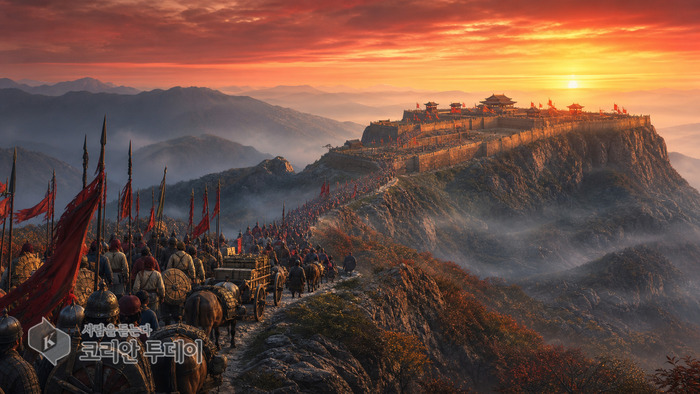
For nearly thirty years, Goguryeo refugees and Mohe tribespeople lived under Tang surveillance at Yingzhou. In 696, a Khitan rebellion under Li Jinzhong threw the region into chaos. A former Goguryeo military commander, Geolgeolzhungsang, and his son Dae Jo-yeong seized the moment, leading their people on a breakout march east.
Tang forces gave chase, but Dae Jo-yeong crushed them at the Battle of Cheonmunryeong and pushed deep into former Goguryeo territory. At Dongmosan — near modern Dunhua, Jilin Province, China — he founded a new state in 698 CE, first called Jin (振國). In 713, when Tang formally invested him as “King of Balhae,” the name Balhae (渤海) became permanent.
“Dae Jo-yeong, a former general of Goguryeo, whose surname was Dae, gathered the surviving soldiers and founded a state south of Taebaeksan, naming it Balhae.”
◆ Same Era, Different Worlds
🏛️ China
Empress Wu Zetian, China’s only female sovereign, ruled Tang (as the Zhou interregnum) around 698. The Khitan revolt on her northeastern frontier is precisely what let Balhae’s founders slip away.
🗿 Byzantine Empire
Justinian II had just been overthrown (695); by 698 Byzantium lost Carthage to the Umayyads for good, ending centuries of Roman rule in Africa.
⚔️ Islamic World
The Umayyad Caliphate was in the middle of its rapid conquest of the Maghreb, taking Carthage in the very year Balhae was founded.
🌏 Silla and Japan
Unified Silla was consolidating the southern peninsula, while Japan, from the 8th century on, exchanged frequent embassies with Balhae and readily called it “Goryeo.”
[Image: Dae Jo-yeong’s breakout march and the founding of Balhae at Dongmosan (696-698 CE)]
⚔️ Scene from That Day
“Dust rises over the Cheonmunryeong pass as Tang banners close the gap. Dae Jo-yeong reins in his horse and looks back — the column of refugees behind him stretches out of sight.”
“‘If we break here, we never get a homeland again.’ He places Mohe fighters and Goguryeo veterans shoulder to shoulder and uses the narrow ravine to blunt the pursuit. After the battle, the column moves east again — no longer fleeing, but marching toward a kingdom of their own.”
◆ Uncovering Historical Truth
Balhae’s self-identification with Goguryeo is not inference — it is documented. Around 759, King Mun (Dae Heum-mu) sent a state letter to Japan styling himself “King of Goryeo,” and Japanese court records refer to the temporary office created to receive Balhae envoys as the “Envoy-Receiving Office for Goryeo Guests.” Reviving that name was a deliberate claim to legitimacy, not nostalgia.
Archaeology reinforces the link. The tomb of Princess Jeonghye, King Mun’s daughter, is a stone-chamber burial with a corbelled ceiling — a construction technique straight out of Goguryeo tomb architecture, comparable in significance to how Sutton Hoo reveals Anglo-Saxon elite culture through burial goods. Ondol underfloor heating, roof-tile patterns, and Buddhist art styles all show clear continuity. Yet Mohe cultural and linguistic elements, carried by the many Mohe people within the ruling structure, were woven in as well — Balhae was less a pure resurrection of Goguryeo than a new multi-ethnic state built on a Goguryeo identity.
Politically, Balhae adapted Tang’s Three Departments and Six Ministries system while renaming and restructuring it to suit its own needs, used its own era names instead of Tang’s, and grew prosperous enough to be called “the Flourishing Country of the East” (Haedong Seongguk). That combination — Goguryeo’s assertive independence plus pragmatic balancing among Tang, Silla, and Japan — defined the kingdom’s character.
Period
698-926 CE
Key Figures
Dae Jo-yeong (King Go), King Mun
Key Event
Founding at Dongmosan; use of the “Goryeo” title
Legacy
The “North-South States” period, Haedong Seongguk
🔍 International Academic Perspectives
Korean/Asian Scholars
Dae Jo-yeong was a Goguryeo general, and Balhae’s ruling core descended from Goguryeo refugees — making it a legitimate successor state within Korean history, and the basis for calling this era the “North-South States period” alongside Silla.
Chinese Scholarship
A competing view identifies Dae Jo-yeong and much of the elite as ethnic Mohe (Sumo Mohe), framing Balhae as a regional Tang tributary polity rather than a Korean successor state — a live flashpoint in the broader Northeast Project historiographical dispute.
📖 Key Terms Explained
- Balhae (渤海)
- A kingdom (698-926 CE) founded by Goguryeo refugees and Mohe peoples in Manchuria, regarded in Korean historiography as Goguryeo’s successor state.
- Haedong Seongguk (海東盛國)
- “The Flourishing Country of the East,” an honorific Tang applied to Balhae at its 9th-century peak.
- North-South States Period
- The historiographical framing, coined by Joseon-era scholar Yu Deuk-gong, that treats Unified Silla (south) and Balhae (north) as coexisting Korean states.
◆ Lessons for Today’s World
That deportees under surveillance rebuilt a kingdom within thirty years shows that recovery is rarely accidental — it is the product of a identity deliberately kept alive. Dae Jo-yeong held onto the one thing that could unite a scattered people: the name and memory of Goguryeo. That memory became his new state’s claim to legitimacy.
The same logic applies to any organization or nation rebuilding after crisis: what determines the shape of recovery is not what was lost, but what was refused to be let go. Balhae’s revival of the “Goryeo” name was strategy, not sentimentality — a reminder to ask what identity we refuse to abandon even in crisis.
| Aspect | Founding of Balhae | Modern Parallel |
|---|---|---|
| Geopolitics | Exiled subjects exploit a great power’s (Tang) internal chaos to win independence | Smaller states navigating survival amid great-power rivalry |
| Military/Diplomacy | Pragmatic balancing among Tang, Silla, Japan, and the Gokturks; independent era names | South Korea’s multilateral diplomacy among the US, China, Japan, and Russia |
| Culture | A Goguryeo-rooted identity that unified a multi-ethnic “Flourishing Country of the East” | K-Culture’s global reach built on preserved tradition and identity |
[Image: The symbolic continuity from Goguryeo to Balhae]
📚 Diving Deeper
- The tombs of Princesses Jeonghye and Jeonghyo, excavated near Longtou Mountain, China, blend Goguryeo-style and Tang-style burial architecture
- “Balhaego” (History of Balhae), an 18th-century work by Joseon scholar Yu Deuk-gong that first proposed the “North-South States” framework
- The Sanggyeong Yongcheonbu capital ruins near modern Ning’an, Heilongjiang, including Balhae ondol heating remains
The Voice of Living History
A kingdom can fall, but a name that people refuse to surrender does not. Balhae was rebuilt on exactly that name.
“Goguryeo fell in 668 CE — but its spirit raised a new banner at Dongmosan in 698 CE.”
Previous Episode
Episode 30: Goguryeo’s Technology – Iron and Architecture
Next Episode
Episode 32: Goryeo – Carrying Forward Goguryeo’s Name
The Korean Today “History Lives On” Series
The Goguryeo Chronicle (40 Episodes)
Bridging Ancient East Asia and the Modern World
© 2025 The Korean Today. All rights reserved.
This content is based on historical facts and presents balanced academic perspectives
for international readers.
THE KOREAN TODAY × WIA CODE
이 기사의 WIA Code

WIA Code 스캐너로 비추면 인터넷 없이 발행 사실과 위·변조 여부를 확인할 수 있습니다.
휴대폰 기본 카메라로 찍으면 스캐너 안내 페이지가 열립니다 — 기사 바로 열기

움직이는 코드는 스트림입니다 — WIA Code 스캐너로 약 24초 비추면 기사 전문(사진 포함)이 폰에 저장되어 인터넷 없이도 읽을 수 있습니다.
WIA Code · 코리안투데이






Leave a Reply