
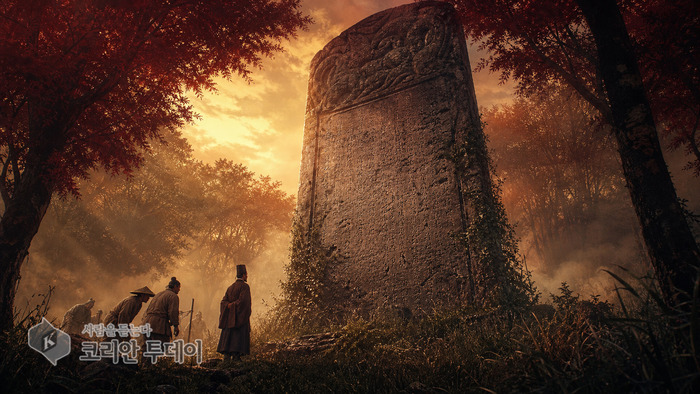
Can a single slab of stone testify for an entire nation’s history? At 6.39 meters tall and roughly 37 tons, this tuff-stone pillar answers yes.
Erected in 414 CE by King Jangsu in honor of his father, King Gwanggaeto the Great, the stele lay buried in the overgrown fields of Ji’an, in today’s Jilin Province, China, for over 1,400 years. The Qing dynasty had sealed off the region as its ancestral homeland, barring settlement. When that ban lifted in 1876, the stone slowly resurfaced — and in 1883, a Japanese army intelligence officer named Sako Kageaki obtained a rubbing and carried it back to Japan, thrusting the stele into the center of East Asian historiography.
But peace did not follow discovery. A handful of characters in the inscription ignited a scholarly battle among Korea, China, and Japan that has raged for over a century — one that even produced allegations that the Japanese military doctored the stone itself. How did 1,775 carved characters become such an explosive diplomatic issue?
🌍 Western Historical Parallel
When King Gwanggaeto died in 412 CE at age 39, the Western Roman Empire was already in freefall — Alaric’s Visigoths had sacked Rome itself just two years earlier, in 410 CE, the first time the city had fallen to a foreign army in nearly 800 years. Two empires on opposite ends of Eurasia crested and cracked within the same decade.
◆ The Ancient Landscape
In 391 CE, an eighteen-year-old prince named Damdeok ascended the throne as Goguryeo’s 19th king — King Gwanggaeto. Within a year he pushed Baekje back beyond the Han River, crushed the Khitan and the Later Yan to seize full control of the Liaodong Peninsula, and — much like a Byzantine emperor dispatching legions to a client state — sent 50,000 infantry and cavalry south to rescue Silla from a combined Gaya-Wa invasion. By the time he died in 412 CE after 22 years on the throne, Goguryeo controlled most of Manchuria and the northern-to-central Korean peninsula, the dominant power in East Asia.
In 414 CE, in his third year as king, his son Jangsu ordered his father’s achievements carved permanently into stone. The result was the Gwanggaeto Stele — 1,775 clerical-script characters across four faces, of which roughly 150 have eroded beyond legibility. The text unfolds in three parts: the Goguryeo foundation myth, a chronicle of Gwanggaeto’s military campaigns, and a register of tomb-keeper households charged with maintaining the royal mausoleum in perpetuity.
“The king’s grace reached to heaven, his martial authority spread across the four seas. He swept away the wicked, so that the people lived their trades in peace, the state grew prosperous and strong, and the five grains ripened abundantly.”
◆ Same Era, Different Worlds
🏛️ China
The early Northern and Southern Dynasties split; Later Yan and Northern Wei contested Liaodong directly against Goguryeo.
🗿 Roman World
The sack of Rome (410 CE) under Emperor Honorius; the Eastern Roman Empire under Theodosius II held on in Constantinople.
⚔️ South Asia
India’s Gupta Empire under Chandragupta II was at its cultural and territorial height — often called India’s “Golden Age.”
🌏 Japanese Archipelago
Still pre-unification, appearing in the stele only as scattered “Wa” forces — centuries before a centralized Japanese state emerged.
[Image: The four inscribed faces of the Gwanggaeto Stele and its rediscovery timeline]
⚔️ Scene from That Day
“Around 1880, on the fields beside the Yalu River near Ji’an: with the Qing ban lifted, settlers clearing brush for farmland strike something hard beneath the sickle. Scraping away soil and moss, they uncover a stone pillar four times a man’s height.”
“In 1883, a Japanese army officer named Sako Kageaki, posing as a mapmaker while scouting the region, hears rumors of the stone. He has local hands press paper against the surface and tap ink across it, then smuggles the rubbing back to Tokyo. Unrolled under lamplight at General Staff headquarters, that single sheet of paper opens a chapter of East Asian source-text warfare that would not close for over a century — not unlike how the Rosetta Stone, seized by Napoleon’s soldiers in 1799, became both a scholarly treasure and an imperial trophy.”
◆ Uncovering Historical Truth
The most contested passage is the so-called “Sinmyo-nyeon” section, which can be read as saying that in the year 391 CE, “Wa crossed the sea and subjugated Baekje and Silla.” Japan used this reading to support the “Imna Nihonbu” theory — a claim that Yamato Japan controlled the southern Korean peninsula in the late 4th century — and that theory was later invoked to help justify Japan’s colonization of Korea in the 20th century, much as European powers once used selective readings of ancient texts to legitimize colonial claims elsewhere.
In 1972, Zainichi Korean historian Yi Jin-hui went further, alleging that the Japanese Army General Staff had applied lime to the stele’s surface to physically alter roughly two dozen characters in Japan’s favor — pointing to discrepancies between Sako’s rubbing and the stone itself. The claim landed like a bombshell in Cold War-era Korea and Japan alike, echoing debates in the West over the authenticity of the Behistun Inscription and other politically charged ancient monuments.
Subsequent comparative research on early rubbings from Korea, China, and Japan, along with Chinese scholars’ field interviews with residents near the stele, found no clear evidence of systematic tampering. What is confirmed is that lime was indeed applied to the surface — but as a rubbing technician’s trick to sharpen the impression for sale, not as deliberate forgery, according to the current scholarly consensus. The Sinmyo-nyeon interpretation debate itself remains separate and ongoing, with several competing readings still in circulation.
Erected
414 CE (Jangsu, year 3)
Rediscovered
1876 ban lifted → 1883 rubbing reaches Japan
Inscription
1,775 characters (~150 illegible)
Today
Ji’an, Jilin, China (UNESCO World Heritage, 2004)
🔍 International Academic Perspectives
Korean/Asian Scholars
The mainstream view now holds that the systematic-forgery theory lacks solid evidence, and reads the Sinmyo-nyeon passage as Goguryeo-centered rhetorical exaggeration glorifying Gwanggaeto’s achievements rather than an accurate record of Wa dominance.
Western Historians
Comparative epigraphers note parallels with other politically fraught inscriptions worldwide, and argue that high-resolution 3D scanning of the eroded 150 characters — much like multispectral imaging used on the Dead Sea Scrolls — could finally settle lingering disputes.
📖 Key Terms Explained
- Goguryeo (고구려)
- Ancient Korean kingdom (37 BCE – 668 CE), one of the Three Kingdoms of Korea, controlling much of Manchuria and the northern Korean peninsula at its peak.
- Sinmyo-nyeon Inscription
- A disputed passage on the stele referencing the year 391 CE, at the heart of the Imna Nihonbu controversy over ancient Wa (Japanese) influence on the Korean peninsula.
- Later Yan
- A short-lived Xianbei-ruled Chinese state (384-407 CE) that fought Goguryeo for control of the Liaodong Peninsula, roughly contemporary with the barbarian kingdoms carving up the Western Roman frontier.
◆ Lessons for Today’s World
The stele’s saga poses a question that outlives any single dispute: if even words carved in stone can be read to serve the reader’s politics, what can we trust as historical fact? This is not a century-old argument about one rubbing — it is the prototype for every modern fight over contested history, from disputed borders to disputed textbooks.
As the next episode will show, China’s “Northeast Project” (Dongbei Gongcheng) has since turned to this very stele and the Ji’an site to argue that Goguryeo history belongs to a regional Chinese dynasty rather than to Korea. Protecting original source material, and openly contesting rival interpretations of it, is why stone monuments like this one remain matters of national concern 1,500 years after they were carved.
| Aspect | Goguryeo Era | Modern Parallel |
|---|---|---|
| Geopolitics | A multi-sided contest among Later Yan, Khitan, Baekje, Silla, Gaya and Wa, settled through conquest | A four-way contest over historical narrative and source-text authority among Korea, China, and Japan |
| Military | Cavalry-led conquest, direct military intervention to save an ally (Silla) | Contests fought with archives, digital scans, and academic publications instead of armies |
| Culture | A martial, record-keeping ethos — carving one’s own achievements into permanent stone | A scholarly sovereignty ethos — preserving and digitizing original heritage against reinterpretation |
[Image: The research journey from Sako’s 1883 rubbing to today’s digital restoration efforts]
📚 Diving Deeper
- The earliest surviving “original stone” rubbings predate Sako’s 1883 copy, taken sometime between 1876 and the early 1880s, and are now scattered across libraries in China and Japan, fueling ongoing cross-comparison research.
- The stele sits within the Ji’an cluster of Goguryeo tombs — including the Taewangneung and General’s Tomb, believed linked to Gwanggaeto or Jangsu — jointly inscribed as a UNESCO World Heritage Site in 2004.
- International teams are now applying high-resolution 3D scanning and multispectral photography, comparable to techniques used on the Dead Sea Scrolls, to re-read characters invisible to the naked eye.
The Voice of Living History
A stele does not speak for itself. It is the reader’s eye — and the power structures of their society — that fill its silences. That is precisely why protecting the original source, and openly contesting rival readings of it, is itself an act of preserving history.
“Even if 150 of 1,775 characters have worn away, the spirit King Gwanggaeto carved into stone has not.”
Previous Episode
Episode 32: Goryeo – Carrying Forward Goguryeo’s Name
Next Episode
Episode 34: China’s Northeast Project – A War Over History
The Korean Today “History Lives On” Series
The Goguryeo Chronicle (40 Episodes)
Bridging Ancient East Asia and the Modern World
© 2025 The Korean Today. All rights reserved.
This content is based on historical facts and presents balanced academic perspectives
for international readers.
THE KOREAN TODAY × WIA CODE
이 기사의 WIA Code

WIA Code 스캐너로 비추면 인터넷 없이 발행 사실과 위·변조 여부를 확인할 수 있습니다.
휴대폰 기본 카메라로 찍으면 스캐너 안내 페이지가 열립니다 — 기사 바로 열기

움직이는 코드는 스트림입니다 — WIA Code 스캐너로 약 26초 비추면 기사 전문(사진 포함)이 폰에 저장되어 인터넷 없이도 읽을 수 있습니다.
WIA Code · 코리안투데이






Leave a Reply