
All four members of the Korean team that competed in the 19th International Earth Science Olympiad (IESO), held in Turin, Italy, came away with medals. In the individual written examination alone they claimed one gold, one silver and two bronze, putting every participating student on the podium.
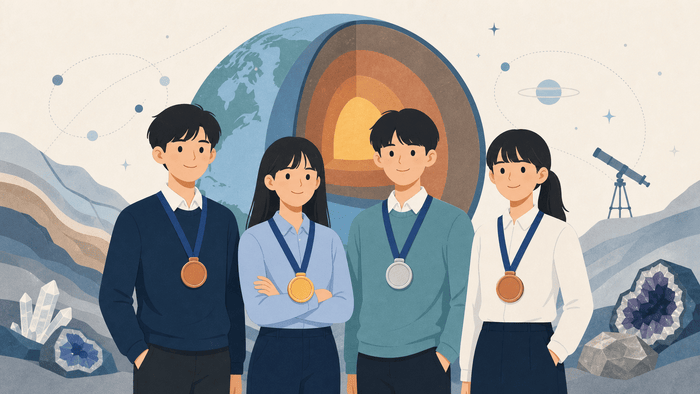 [코리안투데이] Group photo of the Korean team at the 19th International Earth Science Olympiad © 장형임 기자 |
The Ministry of Science and ICT (led by Deputy Prime Minister and Minister of Science and ICT Bae Kyung-hoon) and the Korea Foundation for the Advancement of Science and Creativity (chaired by Chung Woo-sung) announced on the 28th that all four members of the Korean team taking part in the 19th International Earth Science Olympiad, held in Turin, Italy, from August 20 to 27, had won medals.
This year’s competition drew 169 students from 41 countries. The Korean team was made up of four students — Kong Yun-woo (3rd year, Gyeongnam Science High School), Na Hyo-chan (2nd year, Gwangju Science High School), Park Jae-sung (3rd year, Gyeongnam Science High School) and Seo Ha-jin (2nd year, Gyeongsan Science High School) — and competed in all three sections: the individual written examination, the International Team Field Investigation and the Earth System Project.
The individual written examination was divided into a theoretical test and a practical test. The theoretical test, lasting a total of 390 minutes, required students to analyze information on five topics related to the Earth system and provide answers, while the 240-minute practical test asked them to observe and analyze minerals, rocks, rivers and outcrops around the Turin area on site and present their findings. In this section, Na Hyo-chan won a gold medal and Seo Ha-jin a silver medal, while Kong Yun-woo and Park Jae-sung each took bronze, meaning every member of the team earned a medal.
The International Team Field Investigation (ITFI) had teams of six to seven students of differing nationalities work together in the field, observing outcrops in the Turin region, interpreting the geological setting and presenting their conclusions. The four Korean students were each assigned to different teams; the teams that included Park Jae-sung and Seo Ha-jin won silver medals, while those that included Kong Yun-woo and Na Hyo-chan won bronze.
The Earth System Project (ESP) likewise brought together multinational teams to research, discuss and present on climate crisis issues such as glacier melting. The team that included Na Hyo-chan won a gold medal, and the team that included Kong Yun-woo won a silver.
The International Earth Science Olympiad was first held in Korea (Daegu) in 2007 and has since been staged each year in a different country around the world, with the aim of stimulating the learning motivation of talented students in the earth sciences and promoting international friendship and cultural exchange. Each country may enter up to four students under the age of 20 who have not received university education, and the Korean team is selected through the Korean Earth Science Olympiad Committee within the Korean Earth Science Society.
Park Young-shin of Chosun University, who led the Korean team, said, ‘This is a time when nurturing talent in the earth sciences is more important than anything else if we are to tackle the climate crisis,’ adding, ‘I hope the students will use the experience of this competition as a stepping stone to grow into world-class talents who lead the field of earth science.’
The achievement carries significance beyond a simple showing at an international competition: at a moment when responding to climate change has emerged as a challenge of the age, it confirmed the competitiveness of young Koreans in the earth sciences. In particular, leading multinational teams to strong results in the collaboration-based group tasks was seen as a demonstration of the international communication skills expected of future scientific talent.
Meanwhile, following this competition, this year’s Korean teams are set to compete in turn in the International Olympiads in Astronomy and Astrophysics (September 25 to October 5) and Junior Science (December 2 to 9).
지역 홍보대사 신청 기자양성과정 신청 코리안투데이 지부장 신청 코리안투데이 인천강화
THE KOREAN TODAY × WIA CODE
이 기사의 WIA Code

WIA Code 스캐너로 비추면 인터넷 없이 발행 사실과 위·변조 여부를 확인할 수 있습니다.
휴대폰 기본 카메라로 찍으면 스캐너 안내 페이지가 열립니다 — 기사 바로 열기
움직이는 코드(스트림) 한 장에 기사 전문(사진 포함)이 담겨 있습니다 — WIA Code 스캐너로 약 20초 비추면 폰에 저장되어 인터넷 없이도 읽을 수 있습니다. Stream.mp4 도 여기서 받습니다.
WIA Code · 코리안투데이


Leave a Reply