
South Korea has set its minimum wage for 2027 at 10,700 won per hour, an increase of 380 won from this year.
The Ministry of Employment and Labor finalized and announced the 2027 minimum wage on August 5. The new rate represents a 3.7 percent increase from the 2026 minimum wage of 10,320 won per hour and will apply to all workplaces, regardless of industry, from January 1 through December 31, 2027.
For an employee working eight hours a day, the minimum daily wage will be 85,600 won. Based on the standard monthly calculation of 209 hours for a 40-hour workweek, including paid weekly rest hours, the monthly equivalent will be 2,236,300 won before deductions.
Compared with the 2026 monthly equivalent of 2,156,880 won, this represents an increase of 79,420 won per month. On a simple 12-month basis, annual pre-tax earnings would rise by approximately 953,000 won.
A 380-Won Increase Carries Different Implications for Workers and Employers
An increase of 380 won per hour may appear modest when viewed in isolation. Its impact, however, extends directly into both household finances and business operating costs.
For workers earning at or near the minimum wage, the increase translates into additional monthly income at a time when food, transportation, housing and other everyday expenses continue to weigh on household budgets.
For small businesses and employers, meanwhile, a higher minimum wage means recurring labor costs must be recalculated. Businesses employing multiple workers may also need to review their overall payroll structures and related employment costs.
According to estimates released by the Minimum Wage Commission, approximately 660,000 workers could be affected based on the Survey on Labor Conditions by Employment Type. Using the Economically Active Population Survey supplementary data, the estimated number rises to about 2.978 million workers. The difference reflects the different methodologies and populations used in the two surveys.
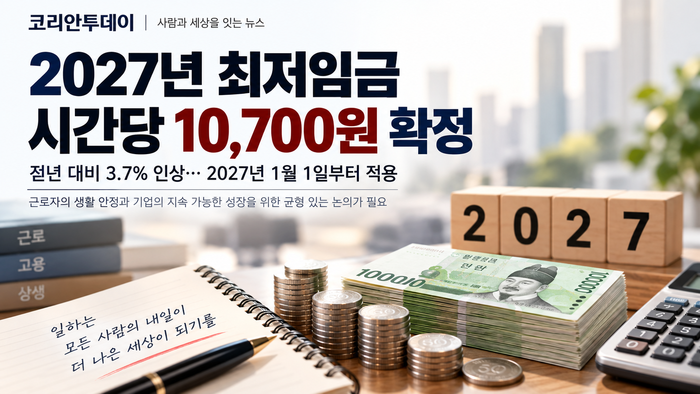 [코리안투데이] 이미지 2027년 최저임금 ©박수진 기자 |
2.236 Million Won Is Not the Same as Take-Home Pay
One distinction is particularly important for workers.
The monthly figure of 2,236,300 won is a pre-tax equivalent, not the amount every employee will actually receive in their bank account.
Actual take-home pay varies depending on factors such as social insurance contributions, income tax, local income tax, dependents and non-taxable components of an employee’s compensation.
For that reason, figures circulating online that present a single amount as the definitive “2027 minimum-wage take-home pay” should be treated with caution. The amount deducted from wages can differ from one employee to another.
Part-Time Workers Should Check Paid Weekly Rest Allowance Rules
Part-time and hourly workers should look beyond the headline figure of 10,700 won per hour.
Actual pay can vary depending on working hours and whether an employee meets the statutory requirements for paid weekly rest.
The monthly equivalent of 2,236,300 won for a standard 40-hour workweek is calculated using 209 hours per month, including paid weekly rest hours.
Part-time employees should therefore review their contracted working hours, work schedules and eligibility for paid weekly rest rather than relying solely on the hourly minimum wage.
Employers Need to Review Payroll and Employment Contracts
Businesses should also prepare before the new minimum wage takes effect.
With the hourly minimum rising to 10,700 won on January 1, 2027, employers need to check whether existing wage arrangements and employment contracts comply with the new statutory rate.
This is particularly relevant to restaurants, convenience stores, service businesses and other workplaces that rely heavily on part-time employees. Employers may need to calculate in advance how the new rate will affect payroll and overall labor costs.
The Ministry of Employment and Labor has said it plans to provide information and guidance and conduct workplace supervision to support compliance with the new minimum wage.
Minimum Wage Remains Above 10,000 Won for Third Consecutive Year
South Korea’s minimum wage first surpassed the 10,000-won mark in 2025, when it reached 10,030 won per hour. It increased to 10,320 won in 2026 and will rise to 10,700 won in 2027.
The corresponding monthly equivalent has also increased from 2,096,270 won in 2025 to 2,156,880 won in 2026 and 2,236,300 won in 2027.
The significance of the new minimum wage, however, goes beyond the figure of 10,700 won itself.
For workers, the central question is how much the increase will contribute to greater financial stability. For small businesses and employers, the challenge is managing higher labor costs while maintaining employment and sustainable operations.
The 380-won increase represents a new baseline for the value of an hour of work. For employers, it is also a cost that must be reflected in their monthly business calculations.
As the January 2027 implementation date approaches, attention will increasingly turn from the announced figure itself to how the new minimum wage is applied across workplaces.

 |
Korean Brand Grand Prize Top CEO Grand Prize Consumer Satisfaction Grand Prize
|
 |
THE KOREAN TODAY × WIA CODE
이 기사의 WIA Code

WIA Code 스캐너로 비추면 인터넷 없이 발행 사실과 위·변조 여부를 확인할 수 있습니다.
휴대폰 기본 카메라로 찍으면 스캐너 안내 페이지가 열립니다 — 기사 바로 열기
움직이는 코드(스트림) 한 장에 기사 전문(사진 포함)이 담겨 있습니다 — WIA Code 스캐너로 약 65초 비추면 폰에 저장되어 인터넷 없이도 읽을 수 있습니다. Stream.mp4 도 여기서 받습니다.
WIA Code · 코리안투데이



Leave a Reply